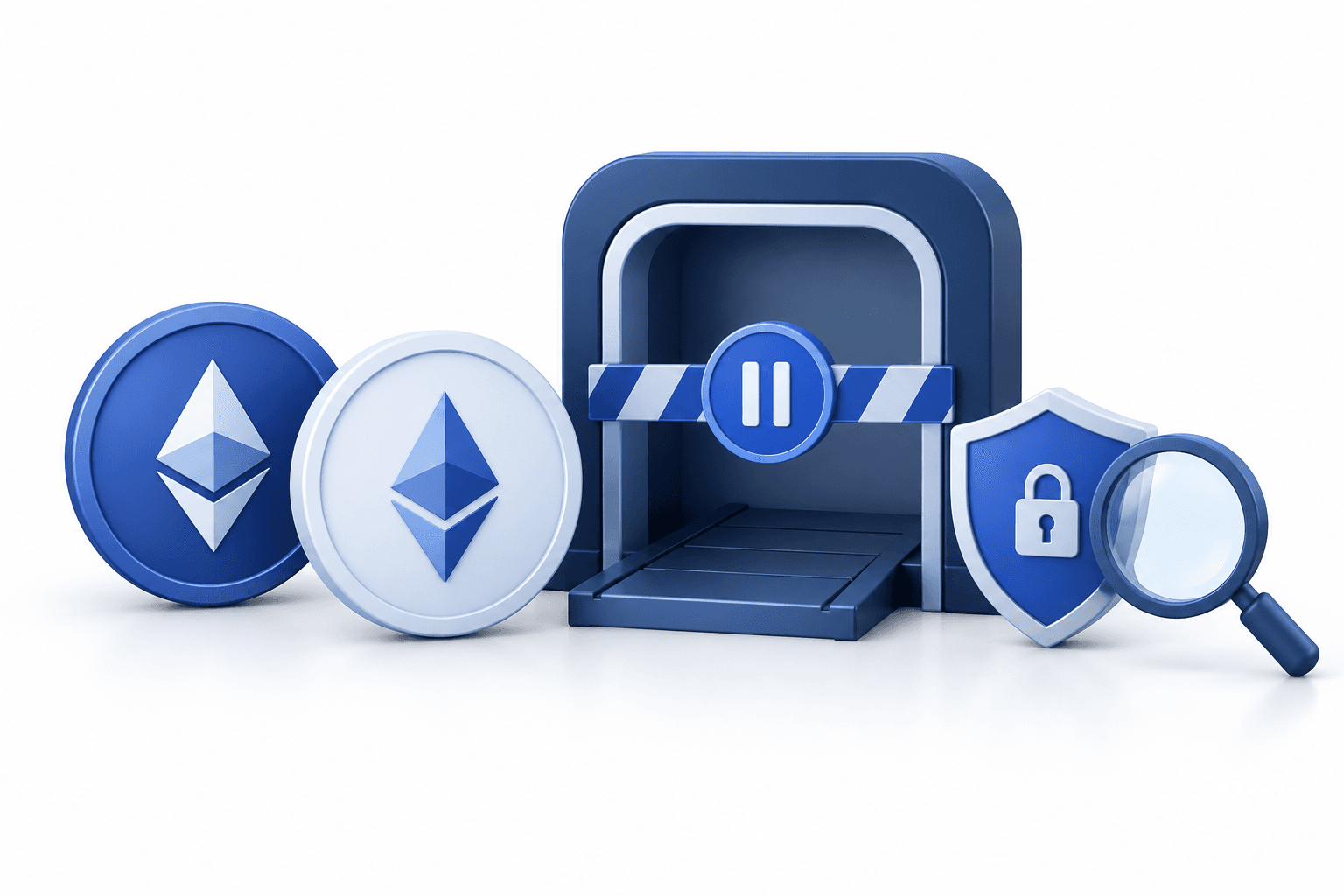
The Swell suspension announced on October 23, 2026, halted deposits and withdrawals for swETH and rswETH after their contracts reported unexpectedly elevated exchange rates. Swell said user funds were safe and no ETH had left the affected deposit or withdrawal contracts, but the cause remained unconfirmed and no reopening timetable had been provided.
Key Takeaways
- The pause blocks deposits, withdrawal requests and ETH claims through the affected contracts.
- Contract exchange rates rose roughly 5%–6% above levels identified as reliable by an on-chain researcher.
- A possible administrative-key compromise remains under investigation; researchers have not established a loss of funds.
Table of Contents
- Swell suspension restricts direct access to ETH
- Contract valuations diverged from trading prices
- Researchers investigate administrative access
- Conclusion
Swell suspension restricts direct access to ETH
The immediate consequence for holders is a loss of direct redemption access through the protocol. Secondary-market trading may remain possible, but selling a token on an exchange is different from redeeming it for underlying ETH.
Swell said it was working with security partners and Seal911, the Security Alliance’s emergency response initiative, to secure its infrastructure and restore accurate valuations. Its statement that funds were safe does not resolve the separate questions of whether the reported exchange rates are accurate and when redemptions can resume.
| Item | Details |
|---|---|
| swETH reference rate | Approximately 1.133 ETH per token, identified by Spreek as the last reliable level. |
| rswETH reference rate | Approximately 1.082 ETH per token, identified by Spreek as the last reliable level. |
| Underlying product value | Approximately $29 million each for swETH and rswETH, based on cited DefiLlama data. |
Contract valuations diverged from trading prices
On October 23, the swETH contract reported approximately 1.203 ETH per token, while rswETH reported about 1.138 ETH. Those readings were roughly 6% and 5% above the respective levels that on-chain investigator Spreek identified as the last reliable rates.
Secondary-market prices were substantially lower: swETH traded near 1.089 wrapped ETH on Uniswap, while rswETH traded around 1.029 wrapped ETH on Curve. The cited Uniswap pool held approximately $143,000, indicating limited liquidity at that particular venue.
Liquid staking tokens represent claims on staked assets and accumulated rewards. Swell’s explanation of reward-bearing versus rebasing tokens describes how rewards can appear in an ETH exchange rate rather than an increasing token balance. That product design is background, not confirmation that the disputed October rates reflected additional backing.
Researchers investigate administrative access
Spreek raised concerns on October 21 that administrative credentials associated with both tokens appeared compromised, alleging that reported net asset values were increasing by as much as 1% per hour without corresponding backing.
The researcher also identified four suspicious upgrade contracts potentially affecting about 2,500 ETH, but said the upgrades had not been queued through Swell’s multisignature authorization process. Odysseus, founder of blockchain security firm Phylax Systems, described possible automated bot-key abuse and emphasized that approximately 2,513 ETH identified in the affected infrastructure was not a confirmed loss.
Swell acknowledged suspicious activity on October 22 before implementing the broader pause the following day. It advised users to follow official communications and watch for phishing attempts during the disruption.
Conclusion
The next milestones to watch are Swell’s confirmation of accurate exchange rates, secured administrative controls and a reopening schedule. Until then, the suspension leaves direct redemptions unavailable, with the cause of the irregularities unresolved.
Read More News
Disclaimer
This FinanceVelix article provides general information, not personalized financial, investment, legal, or tax advice. Market prices, interest rates and economic conditions can change; investments carry a risk of loss. Facts reflect the material available when published and may change. Check important information independently and consult a qualified professional when needed. Mentioning an asset, company, or service is not an endorsement.