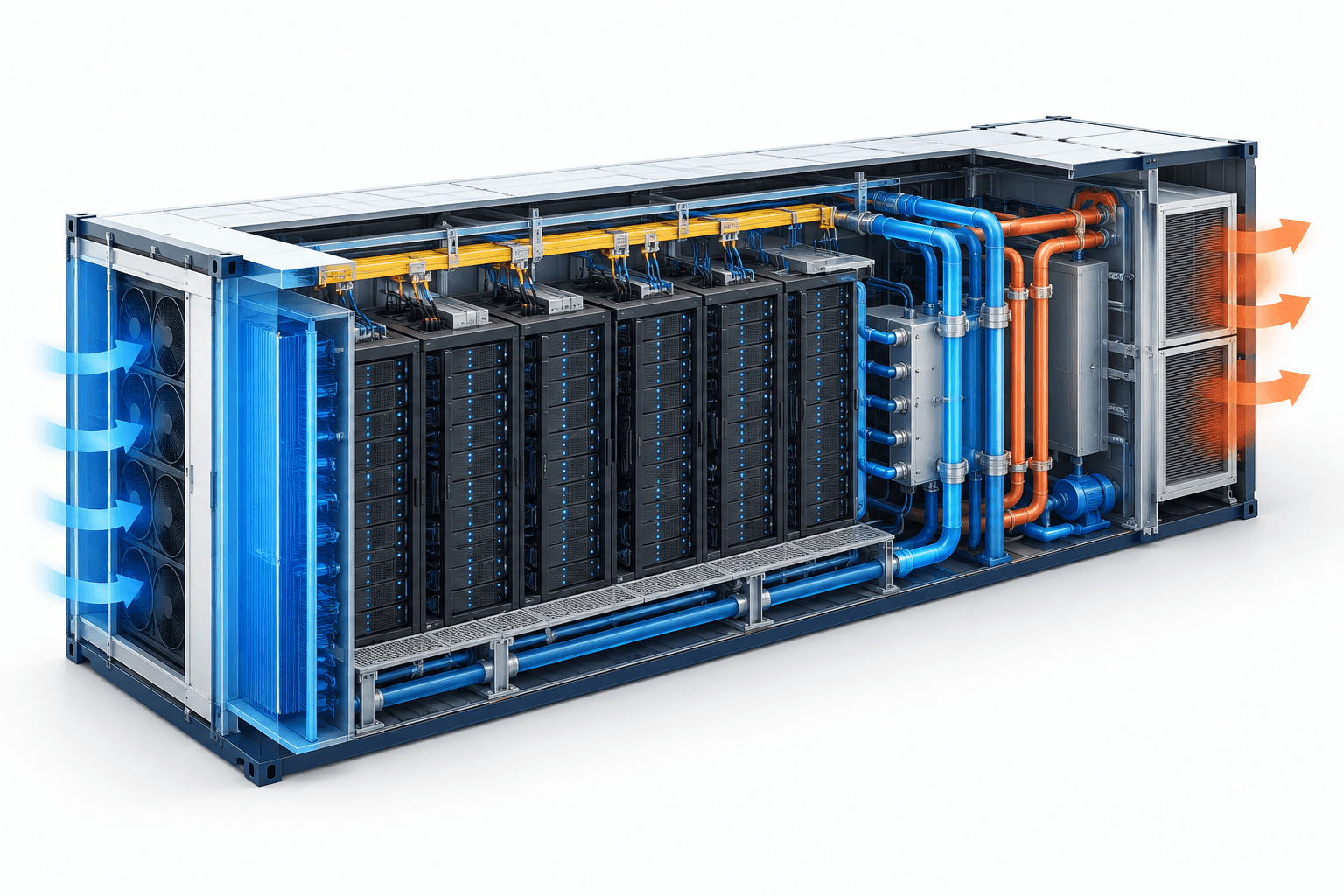
ZTE announced the launch of its ZXEDC M8000 Intelligent Computing Micro-Module at Data Center World Asia in Singapore on October 22, 2026. The integrated data center system combines power distribution, cooling and monitoring to support high-density AI servers, with provisions for customers to shift from air cooling to liquid cooling as their computing needs change.
Key Takeaways
- The M8000 supports rack power of 20–60kW, with a stated peak of 250kW per rack and options for later air-to-liquid cooling retrofits.
- ZTE claims power supply efficiency of up to 98% and PUE as low as 1.15, using shared air-and-liquid cooling infrastructure.
- The company says it has delivered 345 M8000 IT PODs for a Chinese computing center project following a 2025 contract award covering 666 IT modules.
Table of Contents
- ZTE M8000 combines infrastructure for changing workloads
- Cooling flexibility comes with company efficiency claims
- Chinese project provides a deployment reference
- Conclusion
ZTE M8000 combines infrastructure for changing workloads
The launch addresses a challenge ZTE identifies in AI infrastructure: rising rack power requirements alongside uncertainty over future hardware and cooling needs. The company positions the M8000 for mixed deployments of general-purpose and AI computing, rather than requiring separate infrastructure for each.
The system brings together liquid-cooled and network racks, cooling distribution units, secondary-side piping, high-voltage direct current power, intelligent busbars and monitoring. Lighting, cabling and fire linkage are also integrated.
Racks are structurally decoupled from the frame to accommodate full racks and special-form-factor designs. ZTE says standardized components enable faster on-site assembly, while the architecture is designed to support three generations of IT hardware upgrades without large-scale retrofits.
Cooling flexibility comes with company efficiency claims
The M8000 uses a shared-source air-and-liquid cooling architecture that pairs cooling distribution units with thin-sheet air walls. This allows the balance between air and liquid cooling to be adjusted dynamically.
ZTE says the system maximizes free cooling and can deliver power usage effectiveness, or PUE, as low as 1.15 across all regions. Its 800V high-voltage DC system and intelligent busbars provide flexible in-row rack power distribution, with claimed power supply efficiency of up to 98%.
The company also says AI-based optimization reduces cooling CLF energy consumption by more than 10%. Its iDCIM management platform provides visibility across power and cooling systems.
On safety, ZTE describes the M8000 as the industry's first solution with UL system-level leak-proof certification. Protection covers cooling distribution units, liquid-cooled racks, servers and switches, alongside leak detection and automatic liquid replenishment.
Chinese project provides a deployment reference
ZTE cited a computing center project in China's Yangtze River Delta as a reference deployment. It won a bid in 2025 for 666 IT modules for an unnamed leading Chinese internet enterprise and says 345 M8000 IT PODs have been delivered.
That deployment uses single-row racks alongside single-row thin-sheet air walls. Factory prefabrication and skid-mounted transport enabled on-site hoisting, with ZTE reporting one month between purchase-order issuance and arrival at the site.
Conclusion
The M8000 launch centers on accommodating higher-density AI workloads while allowing cooling and hardware upgrades within a single architecture. ZTE's reported deliveries provide a deployment reference, while the efficiency and safety benefits remain claims presented in the company's announcement.
Read More News
Disclaimer
This FinanceVelix article provides general information, not personalized financial, investment, legal, or tax advice. Market prices, interest rates and economic conditions can change; investments carry a risk of loss. Facts reflect the material available when published and may change. Check important information independently and consult a qualified professional when needed. Mentioning an asset, company, or service is not an endorsement.