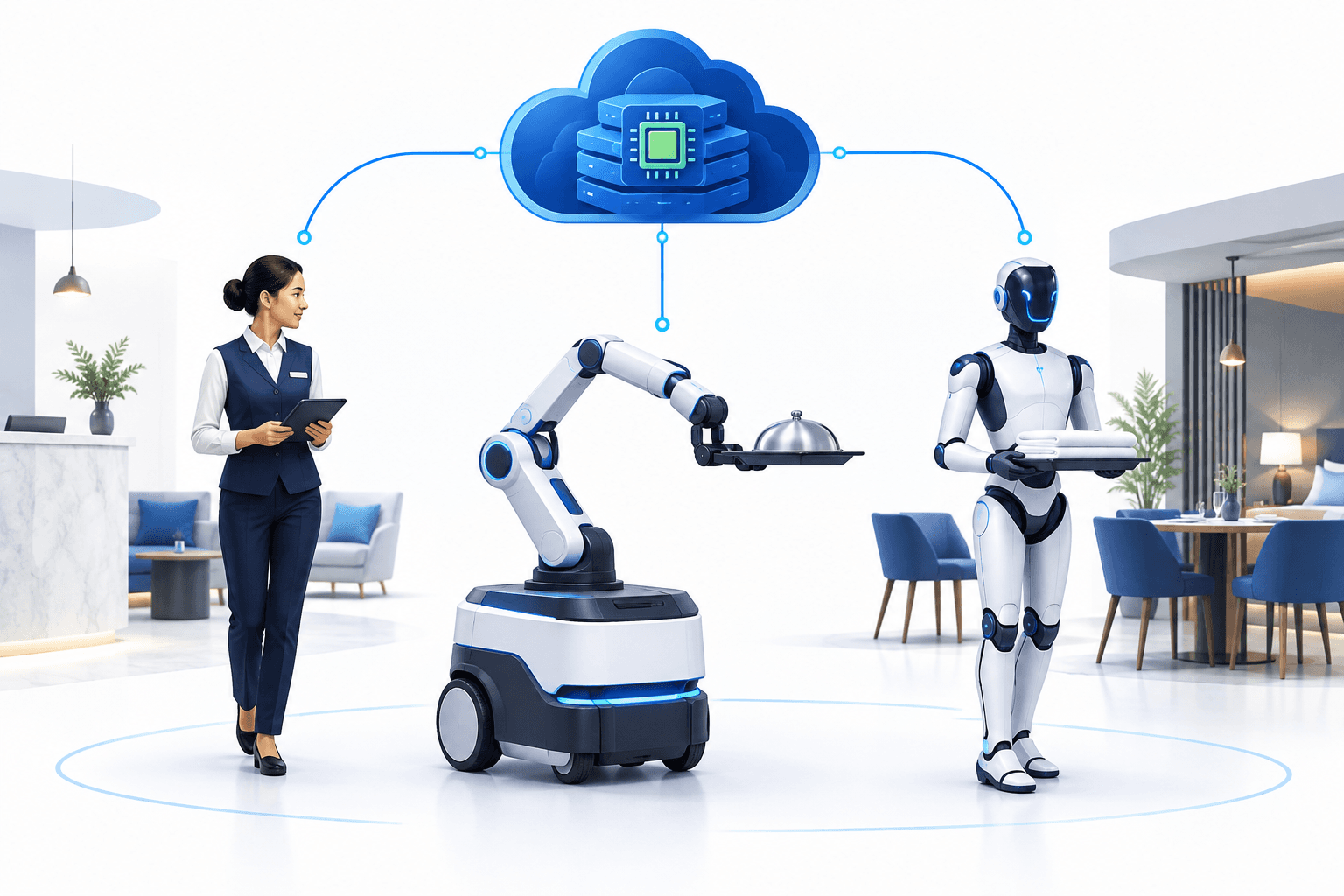
YYForce Inc. said on October 22, 2026, that it plans to develop and scale Workforce OS, a modular robotics software architecture intended to coordinate human workers and autonomous machines. The Singapore-headquartered workforce and facility services provider outlined a phased hospitality rollout using NVIDIA computing and robotics technologies, with Unitree humanoid robots included in later pilot operations.
Key Takeaways
- YYForce intends to build a hardware-agnostic software layer for navigation, manipulation, conversation and multi-robot coordination.
- Its roadmap moves from concierge functions to robotic beverage service and hotel-event pilots over three phases spanning months zero through six.
- The development schedule and commercialization remain forward-looking, with funding, technical execution and deployment risks identified by the company.
Table of Contents
- Workforce OS targets coordinated hospitality operations
- Three phases lead toward hotel-event pilots
- NVIDIA tools underpin the proposed architecture
- Engineering and commercialization remain execution tests
- Conclusion
Workforce OS targets coordinated hospitality operations
The Nasdaq-listed company, which trades under YFOR, is positioning the architecture as a shared software foundation for different types of commercial robots rather than an application tied to a single machine. Its proposed capabilities span computer vision, mapping and navigation, multi-axis manipulation, natural-language interaction and fleet orchestration.
Chief Executive Officer Mike Fu said YYForce's objective is to own the software intelligence layer that makes diverse robots useful in operating businesses. He identified the company's existing hotel and enterprise-facility footprint as a potential testing environment and source of operational data.
The near-term plan concentrates on controlled hospitality settings. YYForce said that approach is intended to avoid the lengthy research cycles associated with less structured tasks, such as autonomous cleaning in wet facilities.
Three phases lead toward hotel-event pilots
For months zero through two, YYForce plans to establish navigation, guest-facing conversational workflows and front-desk integration using NVIDIA Jetson edge modules and Isaac ROS.
The second phase, covering months two through four, calls for stationary and wheeled robotic arms in banquet and food-and-beverage settings. Planned functions include fine-motor grasping, dynamic load balancing and handing items to people.
In months four through six, the company aims to coordinate mobile bases, robotic arms and pilot-stage Unitree humanoids for live hotel banquets and events. These are roadmap targets, not reported completed deployments.
Over the longer term, YYForce intends to extend vision-language-action models, learned humanoid locomotion and orchestration software to facility maintenance, industrial cleaning and other complex physical tasks.
NVIDIA tools underpin the proposed architecture
The planned computing foundation combines Jetson modules on robots with RTX GPUs for accelerated inference and local processing. YYForce said the onboard systems would support perception, sensor fusion and low-latency motor control.
For development and validation, the company is adopting NVIDIA's Project GR00T framework and Isaac Sim, powered by Omniverse. Those tools are intended to support simulation-to-real training, synthetic data generation and digital-twin task testing before physical deployment.
Isaac ROS is designated for hardware-accelerated visual mapping and navigation, while TensorRT is intended to optimize deep-learning inference across stationary manipulators and Unitree bipedal platforms.
Engineering and commercialization remain execution tests
YYForce said it is deploying a specialist engineering task force covering autonomous navigation, perception and multimodal interaction, motion and manipulation control, embodied models, and distributed systems. The company expects the team to prioritize fleet coordination, dynamic labor allocation and integration with its operational network.
The release explicitly classifies the platform's development, features, timelines and commercialization as forward-looking. Identified risks include transferring simulation training into real environments, dependence on NVIDIA and Unitree technologies, recruiting engineers, securing sufficient capital, and addressing safety, liability, privacy and regulatory requirements in customer-facing settings.
Conclusion
YYForce has outlined a staged path from concierge automation to coordinated hotel-event robotics. Whether Workforce OS reaches those targets will depend on development, testing, financing and safe integration into live service operations.
Read More News
Disclaimer
This FinanceVelix article provides general information, not personalized financial, investment, legal, or tax advice. Market prices, interest rates and economic conditions can change; investments carry a risk of loss. Facts reflect the material available when published and may change. Check important information independently and consult a qualified professional when needed. Mentioning an asset, company, or service is not an endorsement.