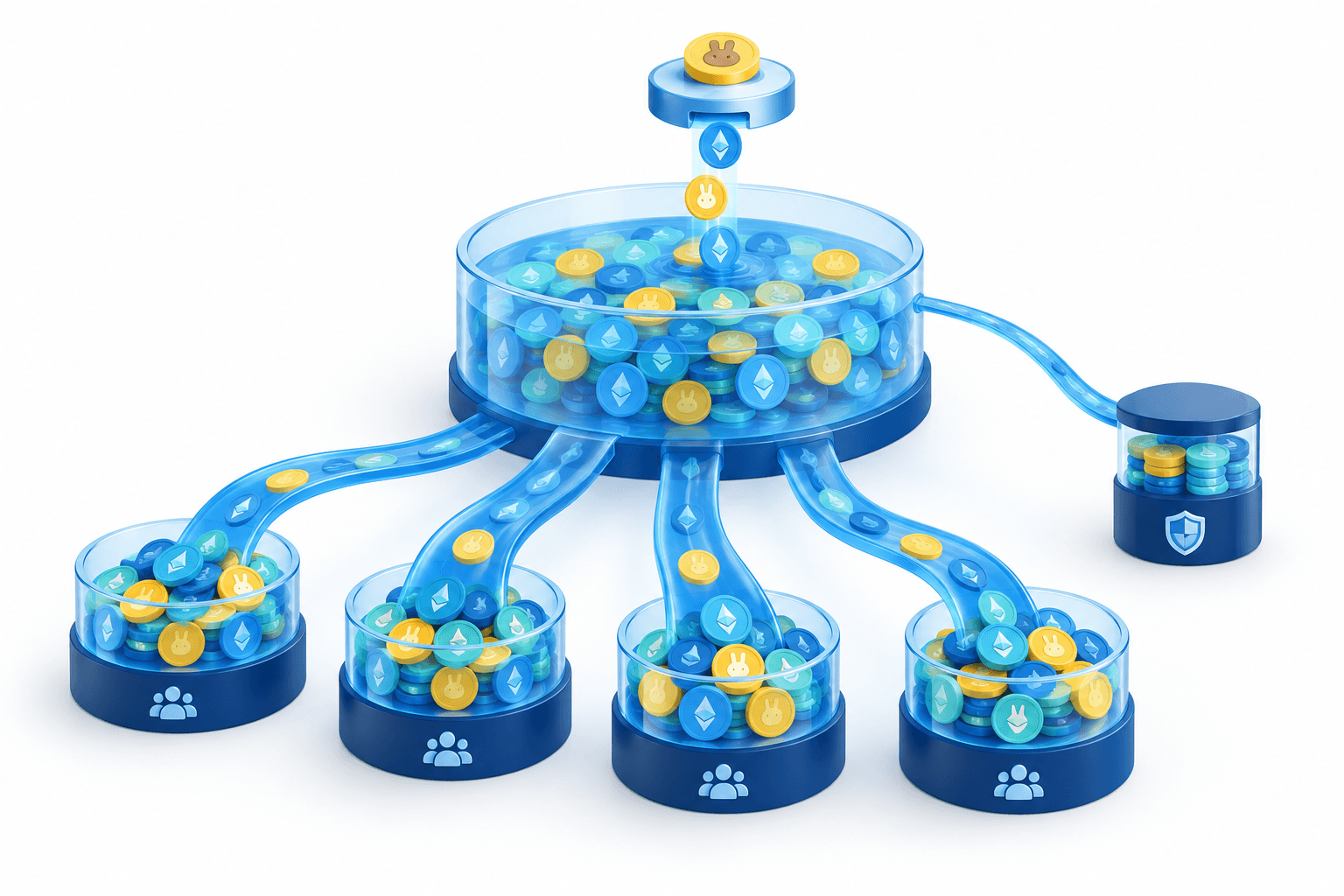
PancakeSwap TVL rose nearly 19% to approximately $2.4 billion in the week ended October 21, 2026, as the decentralized exchange opened voting on a proposed overhaul of trading-fee allocations and CAKE token emissions. The proposal, called The Flip, would give liquidity providers a larger share of fees, but the changes remain subject to a vote closing October 24.
Key Takeaways
- Locked value increased by about $380 million, with growth concentrated in V3 pools.
- The Flip would raise liquidity providers’ fee share to 88% on V3 and Infinity pools, with exceptions for existing Infinity pools.
- Daily CAKE emissions would fall in stages, ultimately reaching 7,000 tokens from the current 22,500.
Table of Contents
- Where PancakeSwap TVL growth concentrated
- What the fee proposal would change
- Lower CAKE issuance comes with a revenue trade-off
- Trading activity will test the new incentives
- Conclusion
Where PancakeSwap TVL growth concentrated
DeFiLlama data showed total value locked rising from approximately $2.02 billion on October 14 to $2.4 billion on October 21. V3 pool liquidity more than doubled, increasing from $336 million to approximately $738 million.
The roughly $402 million increase in V3 exceeded the exchange’s overall $380 million gain, meaning changes elsewhere partly offset that expansion. TVL also reflects changes in the market prices of deposited assets, so its increase should not be treated entirely as fresh deposits.
The liquidity growth coincided with the governance process; it does not establish that the proposed changes caused the increase. The new fee structure had not been implemented.
| Item | Details |
|---|---|
| Governance vote | October 21–24, 2026; approval remained pending when voting opened. |
| Implementation start | Scheduled to begin in November 2026 if approved. |
| Initial emissions phase | 11,000 CAKE daily as chains adopt the changes over approximately three months. |
| Final emissions trigger | 7,000 CAKE daily after the targeted 20% supply reduction from April 2025 levels is reached. |
What the fee proposal would change
PancakeSwap’s official discussion of The Flip sets out an 88% liquidity-provider share and a 12% protocol share for V3 and Infinity pools across 11 supported blockchains. Most existing pools currently allocate about 66%–68% of trading fees to providers. V2 pools would remain unchanged.
Under the proposed split, providers would retain $880 of every $1,000 in applicable swap fees, compared with roughly $660–$680 currently. PancakeSwap estimates that applying the structure to 2025 trading volumes would have generated approximately $62 million in additional provider fees. That is a retrospective estimate, not a revenue forecast.
Existing Infinity pools have a separate implementation constraint: their provider fees are fixed when pools are created. For those pools, reducing the protocol fee would lower the total swap fee instead of increasing the provider payment.
A larger fee share could make supplying liquidity more attractive, but it does not guarantee higher individual returns. Additional capital spreads fee income across a larger liquidity base, while concentrated positions remain exposed to price-range and impermanent-loss risks.
Lower CAKE issuance comes with a revenue trade-off
The voting proposal outlines a staged reduction in effective CAKE emissions. The initial phase would lower issuance to 11,000 tokens daily as chains adopt the new structure over approximately three months. The final reduction to 7,000 would follow achievement of the targeted 20% supply reduction from April 2025 levels.
At the eventual rate, issuance would be approximately 69% below the current schedule, equivalent to about 5.66 million fewer CAKE tokens annually. The remaining daily emissions would support Pantry, a new ecosystem development fund.
Allocating more fees to providers would leave less revenue with the protocol, potentially reducing funds available for CAKE buybacks and burns. PancakeSwap says the non-stablecoin portion of remaining protocol fees would continue supporting buybacks, while V2’s existing fee-burning mechanism would remain unchanged.
The reduction in issuance therefore should not be confused with an equivalent improvement in net deflation. The supply outcome would depend on actual emissions, fee-funded burns and trading activity after implementation.
Trading activity will test the new incentives
PancakeSwap processed approximately $4.67 billion in BNB Chain trading volume over seven days, about 71% of the network’s $6.54 billion total. It accounted for approximately $2.33 billion of BNB Chain’s $5.84 billion in locked value.
That activity provides a substantial base for the proposed fee changes. Whether higher provider allocations improve returns will depend on trading fees relative to deposited capital, rather than TVL growth alone.
Conclusion
The next confirmed milestone is the October 24 vote close. If approved, implementation is scheduled to begin in November; subsequent trading fees, liquidity levels and CAKE burns will show how the revised incentives affect providers and token supply.
Read More News
Disclaimer
This FinanceVelix article provides general information, not personalized financial, investment, legal, or tax advice. Market prices, interest rates and economic conditions can change; investments carry a risk of loss. Facts reflect the material available when published and may change. Check important information independently and consult a qualified professional when needed. Mentioning an asset, company, or service is not an endorsement.