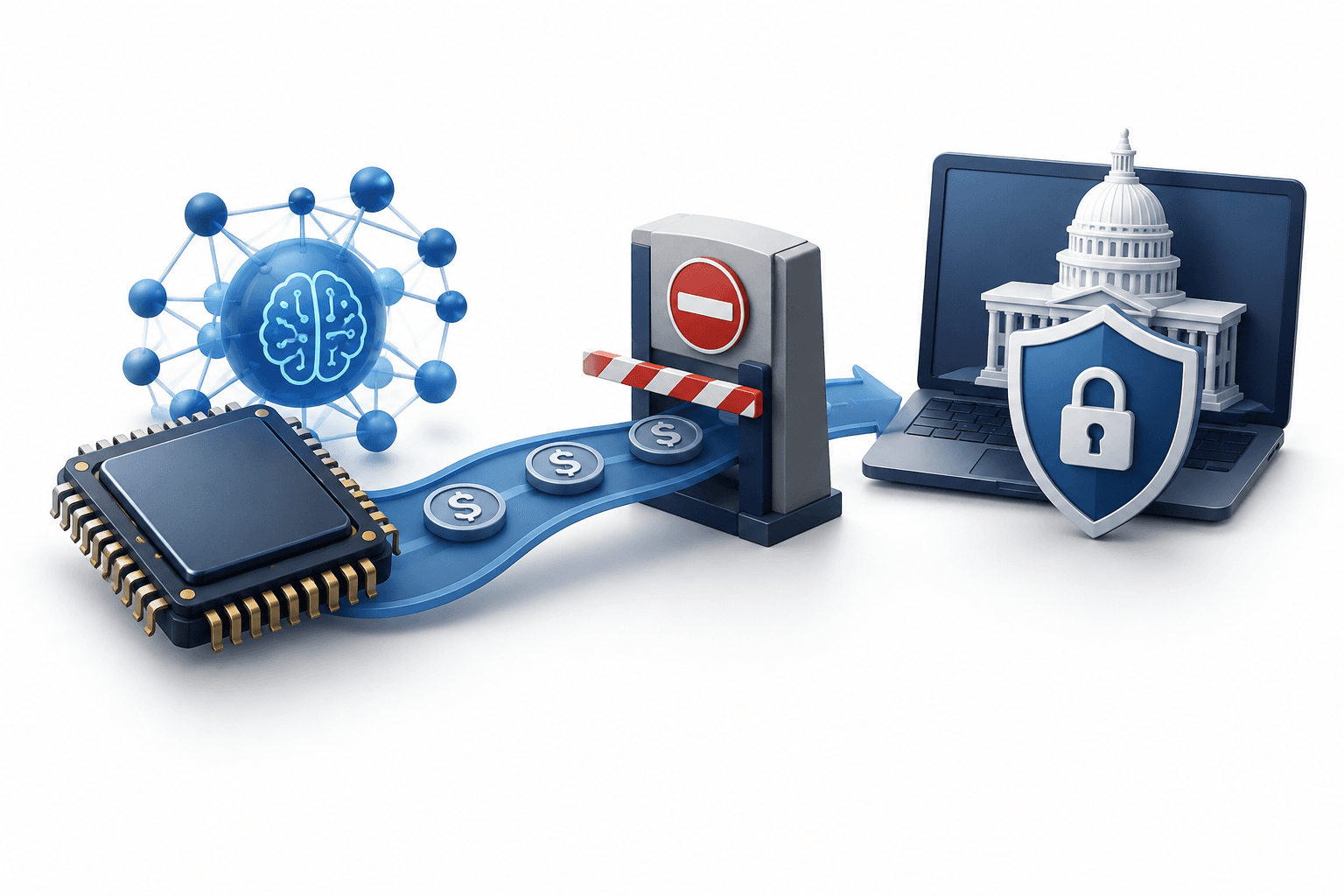
US AI restrictions moved along two tracks in October 2026: Treasury proposed broader limits on outbound technology investment, while the Department of Homeland Security ordered DeepSeek products removed from federal civilian agency IT systems. The proposed investment rules are separate from requirements already in force, under which Treasury has announced its first civil penalty.
Key Takeaways
- Treasury’s proposal would expand restrictions on investments in certain AI and semiconductor projects.
- A $200,000 penalty against Amidi was imposed in July 2026 and announced on October 7.
- The DeepSeek order covers removal from affected federal systems and prohibits new purchases.
Table of Contents
- US AI restrictions target investment and government systems
- First penalty shows existing notification duties
- DeepSeek order addresses federal procurement and data
- Conclusion
US AI restrictions target investment and government systems
Treasury’s proposed rules would broaden the Outbound Investment Security Program to cover additional countries and technology activities. The proposal targets certain artificial intelligence projects and high-risk semiconductors, extending restrictions beyond China to Russia, Iran, North Korea and Cuba.
The changes would implement the Comprehensive Outbound Investment National Security Act of 2025, passed by Congress on December 18, 2025. The proposed expansion should not be confused with a completed change to the program’s rules.
For investors, the distinction matters: existing notification and prohibition requirements remain enforceable while the broader framework is being developed.
| Item | Details |
|---|---|
| Existing program start | January 2, 2025. |
| Existing geographic coverage | Entities in or connected to China, Hong Kong and Macau. |
| Existing technology sectors | Certain quantum computing, artificial intelligence and semiconductor activities. |
| Amidi corporate connection | Parent entity of the organization doing business as Plug and Play Tech Center. |
First penalty shows existing notification duties
Treasury’s first outbound investment penalty announcement, published on October 7, 2026, said it had imposed a $200,000 civil penalty on Amidi, LLC in July. The violation was a failure to submit a required notification, rather than an announced finding that the investment itself was prohibited.
On April 19, 2025, Amidi’s Chinese fund subsidiary invested approximately $92,478 in Shanghai Qiongche Intelligent Technology Company Limited, also known as Noematrix. The private Chinese company develops artificial intelligence, robotics and embodied intelligence.
The program requires US persons to notify Treasury of qualifying transactions by controlled foreign entities and to take all reasonable steps to prevent transactions that would be prohibited. Treasury said it identified the Amidi transaction through its ongoing compliance and market monitoring.
DeepSeek order addresses federal procurement and data
Separately, DHS ordered federal civilian agencies to remove DeepSeek products from their IT systems and barred new purchases. The order also covers DeepSeek affiliates and third-party products and services developed using DeepSeek implementations.
DHS warned that use by government employees and contractors could expose sensitive information to China, including information about US citizens and federal programs. This is a government-system restriction, not a general prohibition on private investment or consumer use.
Conclusion
The next policy step is finalization of Treasury’s proposed expansion. In the meantime, the Amidi penalty demonstrates that existing outbound-investment notification duties are already being enforced, while affected federal agencies face a separate DeepSeek removal order.
Read More News
Disclaimer
This FinanceVelix article provides general information, not personalized financial, investment, legal, or tax advice. Market prices, interest rates and economic conditions can change; investments carry a risk of loss. Facts reflect the material available when published and may change. Check important information independently and consult a qualified professional when needed. Mentioning an asset, company, or service is not an endorsement.