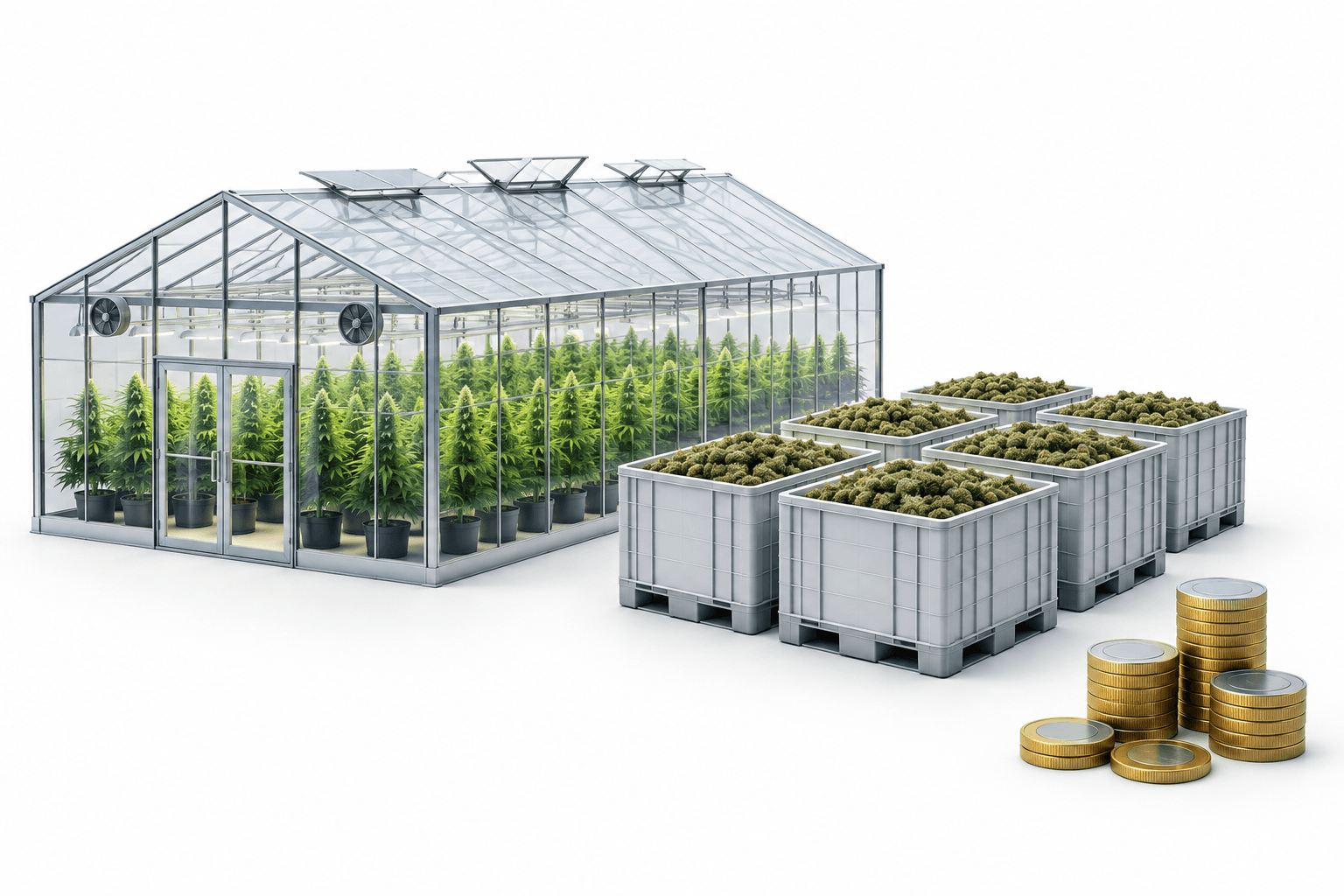
Glass House production reached a record approximately 317,000 pounds in the third quarter of 2026, but lower selling prices outweighed production-cost savings and narrowed gross margins. In preliminary, unaudited results announced October 19 for the quarter ended September 30, Glass House Brands projected revenue of $56.8 million, up from $47.0 million in the preceding quarter.
Key Takeaways
- Biomass output rose about 29% from the second quarter, while production cost fell to approximately $110 per pound.
- Average selling prices declined to $150 per pound, and gross margin narrowed to 26% from 34%.
- Management switched off its at-the-market equity program and retained its approximately 1 million-pound annual production forecast.
Table of Contents
- Glass House production grows faster than revenue
- Lower prices limit the benefit of higher volumes
- Equity funding supports farm upgrades as cash flow remains negative
- Conclusion
Glass House production grows faster than revenue
The company’s preliminary third-quarter results put biomass production at approximately 317,000 pounds, compared with 246,000 pounds in the second quarter. Revenue increased about 21% sequentially and was more than double the $26.2 million recorded a year earlier.
The larger harvest came with lower unit costs. Production cost declined to approximately $110 per pound from $122 in the second quarter, a reduction of about 10%. President and Chief Cannabis Officer Graham Farrar said costs had fallen from $175 per pound in the first quarter.
The financial results generally reflect continuing operations. Prior-period operating results were recast to exclude Glass House Retail, which was deconsolidated on June 12, 2026.
| Item | Details |
|---|---|
| Quarter-end cash, restricted cash and cash equivalents | $39.7 million, compared with $22.1 million at the end of Q2. |
| Q3 at-the-market offering proceeds | $18 million at an average price of $8.11 per share. |
| Q3 warrant proceeds | $10 million. |
Lower prices limit the benefit of higher volumes
Average selling price fell to $150 per pound from $211 in the second quarter and $155 a year earlier. That sequential decline of about 29% was substantially larger than the reduction in production cost.
Chief Executive Kyle Kazan attributed the margin pressure to seasonally lower California cannabis prices and a sales mix weighted toward trim from second-quarter production. Higher volumes kept gross profit relatively close to the previous quarter, but did not prevent a decline: preliminary gross profit was $14.9 million, versus $15.8 million.
The year-over-year comparison was stronger. Gross profit increased from $5.6 million, while gross margin improved from 21% to 26%, despite the sequential contraction.
Equity funding supports farm upgrades as cash flow remains negative
Glass House reported preliminary operating cash outflow of $0.4 million for the quarter. Its second-quarter and year-earlier cash-flow comparisons include Glass House Retail, limiting direct comparability with the current period.
Kazan said the company had switched off its at-the-market equity facility after raising $46 million in gross proceeds through the program during 2026. Management believes available capital is sufficient to complete farm optimization and reach positive cash flow; that remains an expectation rather than an achieved result.
Funding is supporting the Greenhouse 2 expansion and improvements across the Camarillo farm, including automation and climate controls. Glass House reaffirmed its approximately 1 million-pound production forecast for 2026 and its long-term production-cost target of $95 per pound. It expects fourth-quarter production cost to remain in line with the third quarter.
Conclusion
The fourth-quarter benchmark is management’s expectation that production cost will hold near the third-quarter level while annual output reaches approximately 1 million pounds. Positive cash flow remains a goal, not a result established by this preliminary update.
Read More News
Disclaimer
This FinanceVelix article provides general information, not personalized financial, investment, legal, or tax advice. Market prices, interest rates and economic conditions can change; investments carry a risk of loss. Facts reflect the material available when published and may change. Check important information independently and consult a qualified professional when needed. Mentioning an asset, company, or service is not an endorsement.