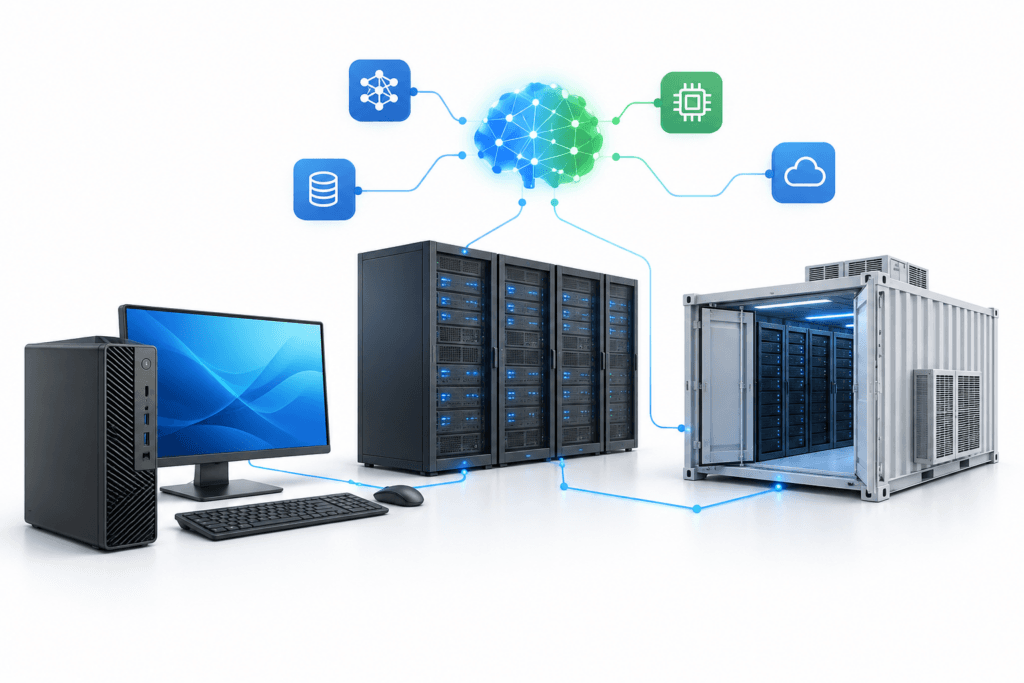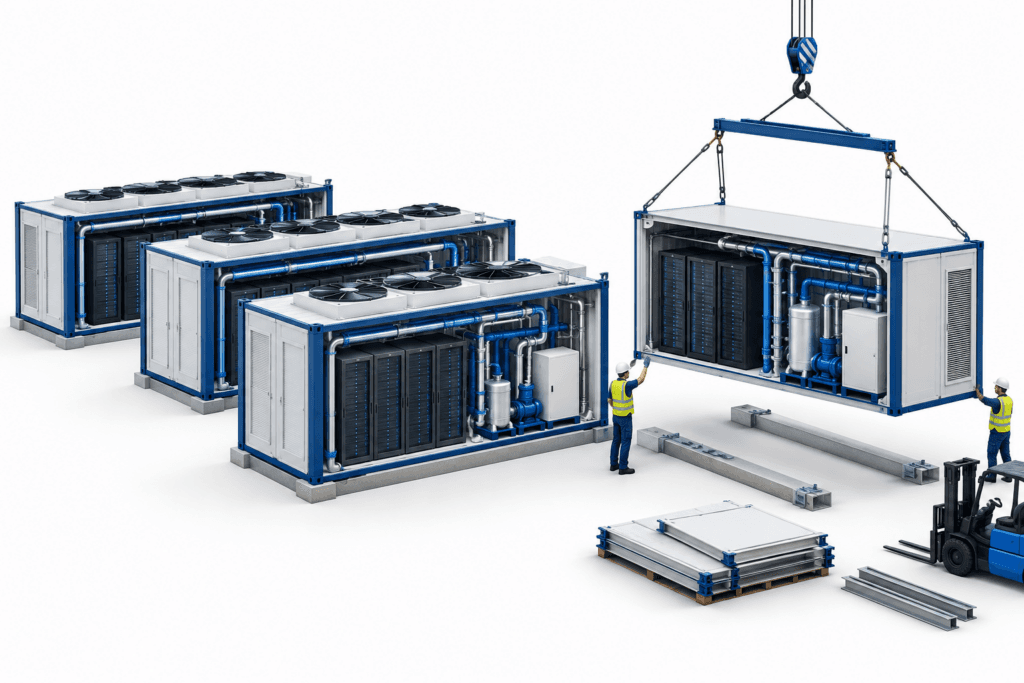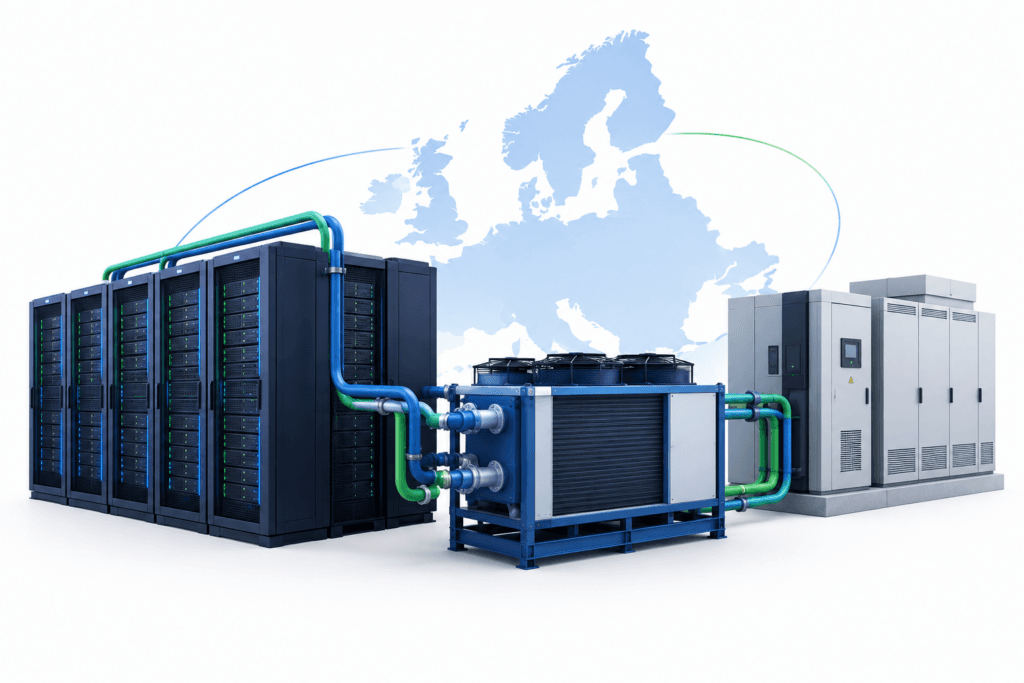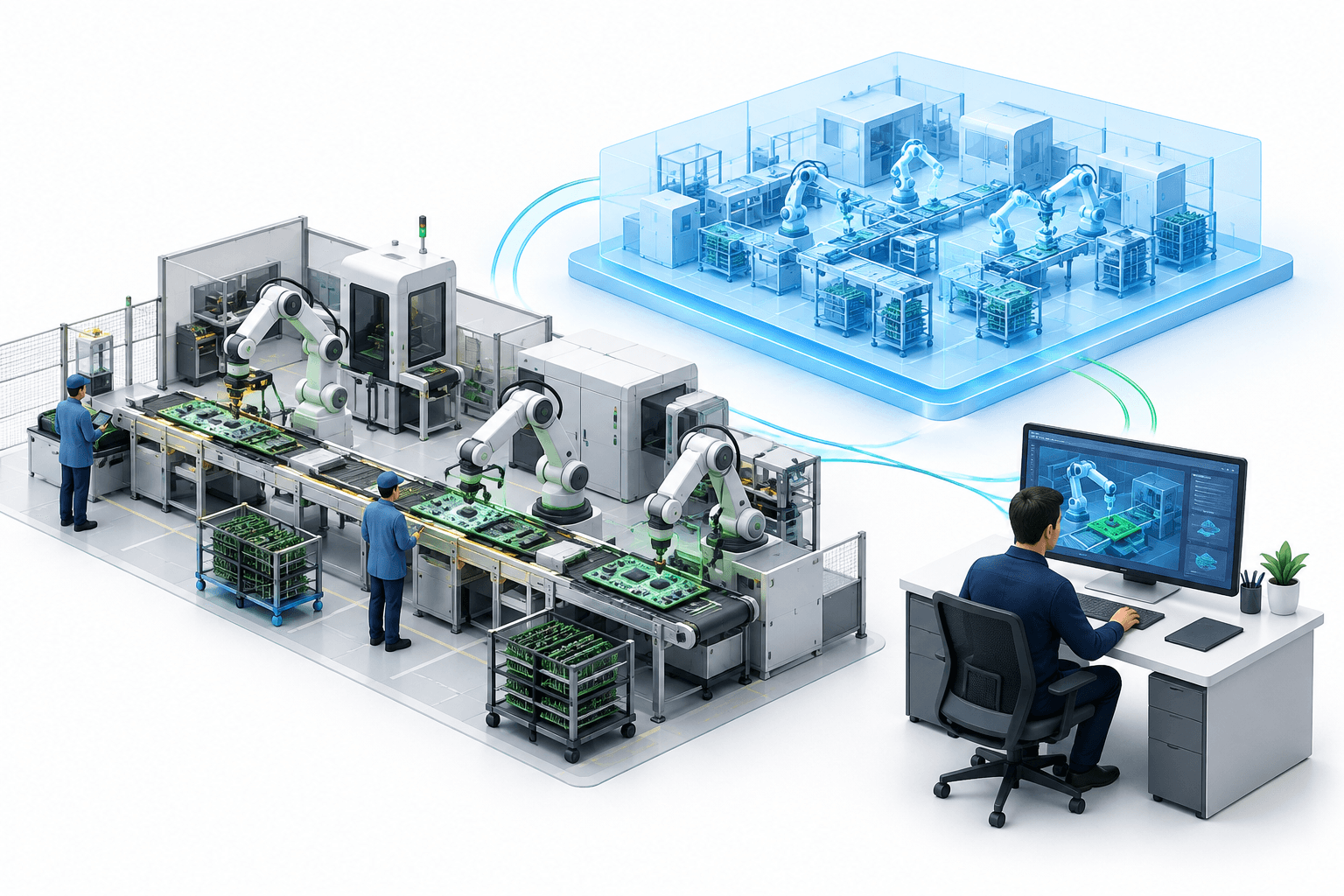
NVIDIA industrial AI is moving further into European manufacturing with an early-access blueprint for factory-management agents and newly available simulation software. In its October twenty-first, twenty twenty-six report, NVIDIA described how manufacturers are using its technology to investigate production problems, inspect products and test designs virtually. The announcements span tools available to developers now, reported factory results and projects still under development.
Key Takeaways
- The Factory Operations Blueprint is available in early access, while the cuDSS simulation library is reaching general availability.
- Siemens reports a shorter inspection-calibration process, separately from estimated savings associated with its factory-agent integration.
- European manufacturers are using virtual testing for products, production systems and robots, although individual projects are at different stages.
Table of Contents
- What NVIDIA industrial AI makes available now
- Where Siemens reports a measured factory result
- How engineering adoption differs from benchmarking
- Why manufacturers are testing equipment virtually
- Conclusion
What NVIDIA industrial AI makes available now
The Factory Operations Blueprint, known as FOX, gives developers a starting point for building agents that oversee factory activity and handle specialist tasks. Available through GitHub in early access, it supports work such as visual inspection, fault investigation, reporting and fleet management.
Its practical role is to connect information that would otherwise sit across separate systems. Agents can draw on design files, product-lifecycle software, simulations and operational systems, then compare camera findings with machine logs to investigate a problem and coordinate a response. NVIDIA says Cosmos in-context learning lets agents adapt from examples and documentation without fine-tuning.
For engineering teams, NVIDIA is also releasing cuDSS for general availability at GTC Berlin. The library accelerates calculations used in simulations involving structural stress, fluid flow, electromagnetic fields and semiconductor behavior. Unlike FOX’s early-access status, this is a general-availability software release.
| Item | Details |
|---|---|
| imec semiconductor simulation | S-Litho benchmarks on imec’s model showed up to 40x speedup with NVIDIA accelerated computing. |
| Infineon power-device simulation | Sentaurus Device with NVIDIA CUDA libraries achieved a 12x speedup in three-dimensional breakdown simulation. |
| Cadence automotive simulation | GPU fluid-dynamics workloads are being benchmarked to assess opportunities for faster design iteration. |
Where Siemens reports a measured factory result
Siemens provides a distinction between an achieved operational improvement and an anticipated financial benefit. At its Erlangen electronics factory, the company used generated circuit-board defect images to reduce inspection-process calibration time by 40%. Its Process Preparation X agents use NVIDIA Cosmos Data Factory tools and skills to create those images.
Separately, Siemens is integrating FOX-based agents into Intelligence Center X to investigate root causes and coordinate operations. NVIDIA’s report puts the estimated cost savings at 20%; it does not present that estimate as a realized result.
Mercedes-Benz is applying Cosmos and the Metropolis VSS blueprint to inspection agents, including checks on windshield assembly. This extends the technology beyond engineering calculations into checking whether physical production matches expectations.
How engineering adoption differs from benchmarking
The engineering examples cover both software already in use and evaluations of potential gains. Mercedes-Benz uses Siemens’ Simcenter STAR-CCM+ on NVIDIA GPUs to compare vehicle designs through faster aerodynamic simulation. Autodesk, meanwhile, is incorporating PhysicsNeMo and Warp into NavPack, integrated with Alias, to support performance prediction using simulation-trained AI.
Semiconductor examples include specific benchmark results, while Cadence’s automotive work remains an assessment of opportunities for faster iteration. Those differences matter: a result from a defined simulation workload is not a claim that every engineering task will accelerate by the same amount.
Why manufacturers are testing equipment virtually
For Audi, virtual testing addresses a practical timing problem: production planning can begin before the relevant machinery is physically available. Its battery-production digital twin supports that work. A separate collaboration with Dassault Systèmes and Agile Robots uses virtual environments to assess mobile humanoid robots and logistics processes.
Schaeffler’s work focuses on the components inside robots. By integrating digital representations of humanoid actuators with NVIDIA Isaac simulation frameworks, it aims to help robotics partners evaluate joint-moving components with less physical testing.
The approach also reaches data-center engineering. Schneider Electric and AVEVA are developing a digital twin for Nscale that would let engineers evaluate alternative power, cooling and equipment arrangements before altering physical infrastructure. That project remains in development, rather than a completed deployment.
Conclusion
The clearest immediate changes are developer access to FOX and general availability for cuDSS. Across the European projects, the evidence ranges from measured task-level improvements to benchmarks and ongoing development—not a single, uniform rollout of autonomous factories.
Read More News
Disclaimer
This FinanceVelix article provides general information, not personalized financial, investment, legal, or tax advice. Market prices, interest rates and economic conditions can change; investments carry a risk of loss. Facts reflect the material available when published and may change. Check important information independently and consult a qualified professional when needed. Mentioning an asset, company, or service is not an endorsement.