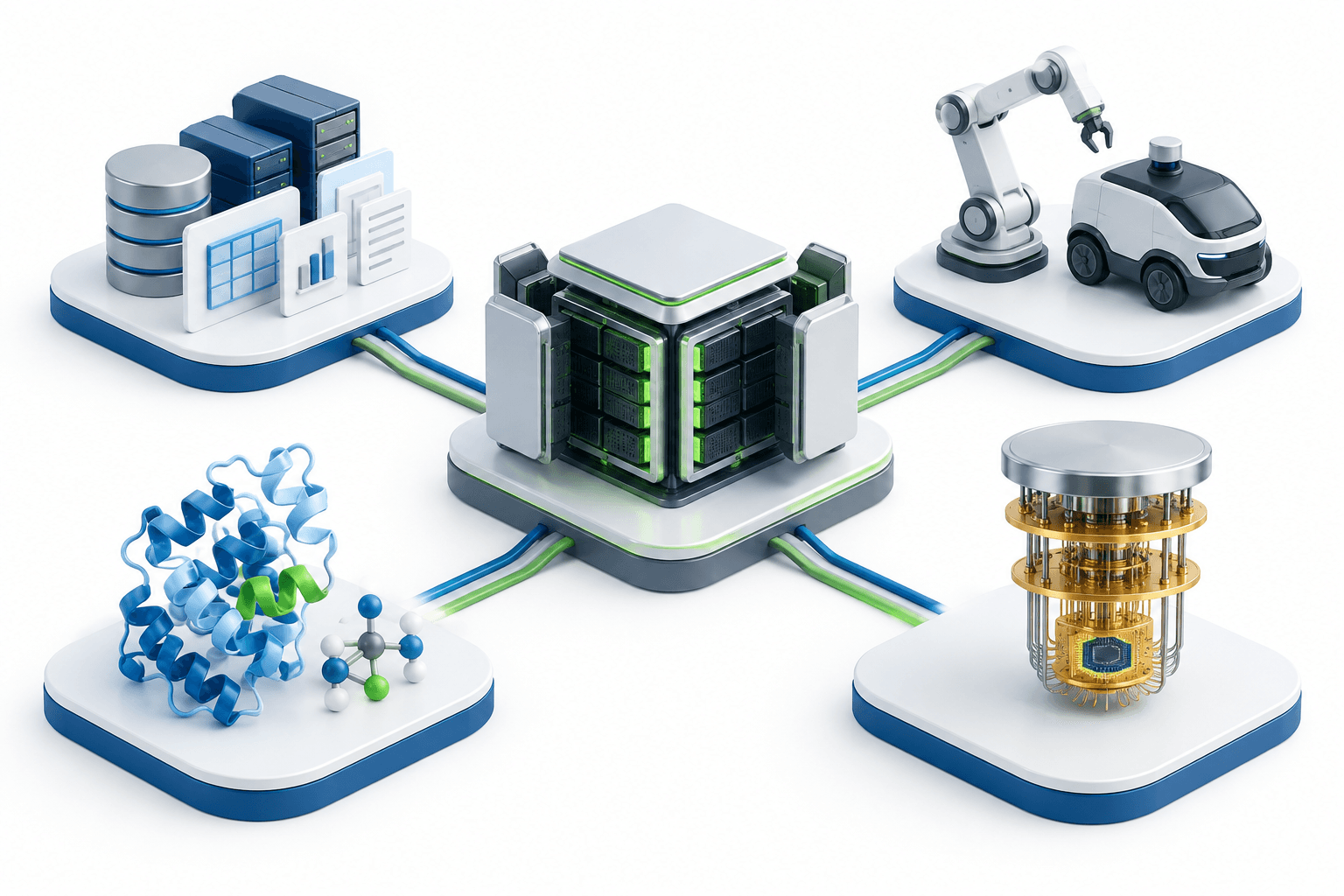
NVIDIA is expanding its open-model portfolio with Kumo models for structured business data, new Nemotron models and tools spanning robotics, protein design and quantum computing. The NVIDIA open models expansion, detailed on October 21, 2026, gives organizations foundations they can customize with local data and deploy on infrastructure they control. Most of the announced offerings are available, while Nemotron 3.5 Bolt is expected on October 23 and Alpamayo 2 Edge is scheduled for later this month.
Key Takeaways
- Kumo adds prediction, forecasting and fraud-risk capabilities for structured enterprise data, with Coinbase, Revolut and Databricks among the first organizations working with it.
- The expansion reaches beyond language models into robotics training, onboard vehicle reasoning, protein design and quantum hardware calibration.
- Availability differs across the portfolio: several model families are accessible now, but Nemotron 3.5 Bolt and Alpamayo 2 Edge remain forthcoming.
Table of Contents
- What NVIDIA open models let organizations customize
- Kumo targets predictions from business data
- Robotics tools focus on training before deployment
- Science models address protein design and quantum systems
- What is available now and what is still planned
- Conclusion
What NVIDIA open models let organizations customize
The expansion centers on giving developers models they can adapt to their own languages, knowledge and industry requirements rather than using only a general-purpose system. NVIDIA describes the portfolio as a foundation for applications that organizations can run on infrastructure under their control.
Nemotron supplies language models, datasets and training recipes for agents that work with text and images. The announced additions include Nemotron 3.5 Super VL and Nemotron 3.5 Bolt, alongside Retriever models for embedding, reranking and document parsing. Together, these address both agent capabilities and the work of making enterprise documents usable by those systems.
The company identifies Dassault Systèmes, SAP, Salesforce, Shopify, Synopsys and WPP among organizations working with Nemotron models and datasets to develop custom models and domain-specific agents. Accenture and EY are also involved. These are described as development efforts, not evidence that every participant has completed a production deployment.
European contributors to the NVIDIA Nemotron Coalition include Black Forest Labs, H-Company and Mistral. Their data, research and expertise feed into the Nemotron foundation, according to NVIDIA.
| Item | Details |
|---|---|
| Nemotron 3.5 Super VL | Available through Hugging Face, ModelScope, OpenRouter, NVIDIA NIM and partners. |
| Nemotron 3.5 Bolt | Expected to become available on October 23. |
| Nemotron Retriever | Available through Hugging Face, partner platforms and NVIDIA NIM for embedding, reranking and document parsing. |
| Kumo | Available on Hugging Face and packaged as an NVIDIA NIM microservice for production inference. |
| Cosmos | Openly available on Hugging Face and GitHub, and through selected inference partners. |
| Alpamayo 2 Edge | Planned for download on GitHub and Hugging Face later in October. |
| BioNeMo RFD4-Proteina | Available through NVIDIA’s developer platform, NVIDIA NIM, GitHub, Hugging Face and selected inference partners. |
| Ising | Available on GitHub, Hugging Face and NVIDIA’s developer platform. |
Kumo targets predictions from business data
Kumo is the most directly business-data-focused addition. Its open-weight foundation models, libraries and tools are designed to help applications forecast outcomes, score fraud risk and recommend actions from structured information.
The practical change NVIDIA describes is reducing the need to build a separate machine-learning pipeline for each prediction task. Developers can begin with pretrained models and fine-tune them on proprietary data when a workload requires higher performance.
Kumo Structured covers relational and tabular prediction, forecasting and anomaly detection. Kumo Engine provides the open library stack for developing and deploying structured-data foundation models. The family is part of NVIDIA Agent Knowledge Foundation.
Cognite, Coinbase, Databricks, DoorDash, Revolut and Tubi are among the first organizations working with Kumo. NVIDIA also says Snowflake customers are already using the models to accelerate AI development in advertising, energy, financial services and retail. The report does not quantify customer savings or prediction improvements.
Robotics tools focus on training before deployment
For physical AI, NVIDIA is adding Cosmos post-training and optimization tools intended to improve world models with less compute. Simulation checkpoints allow developers to evaluate behavior in interactive driving and robotic manipulation scenarios before real-world testing.
The new Cosmos Data Factory combines blueprints and core agent skills for curating, labeling, generating and evaluating training data. Its uses include driving scenarios, product defects and image augmentation. Developers can use complete workflows or individual capabilities, with agents coordinating the process.
NVIDIA says Porsche with Voxel51, ANYbotics with Encord, Zalando and CEVA Logistics with Sereact, as well as Siemens, are using Cosmos Data Factory to create diverse training datasets and improve model precision.
Alpamayo 2 Edge addresses a different stage: reasoning inside autonomous vehicles. The compact model combines real-time scene understanding and motion planning, is built on the Nemotron-based foundation of Cosmos 3 Edge, and is optimized for NVIDIA DRIVE AGX Thor. NVIDIA says it is designed to bring advanced driving capabilities to vehicles with lower computing requirements; its download remains scheduled for later this month.
Science models address protein design and quantum systems
The scientific additions serve distinct workflows rather than a single general-purpose research assistant. BioNeMo RFD4-Proteina generates protein sequences and three-dimensional structures, while Ising targets calibration and error correction for quantum hardware.
Protein candidates still move through laboratory testing
Developed by NVIDIA and the Baker Lab at the University of Washington’s Institute for Protein Design, RFD4-Proteina is intended to help design proteins that bind difficult targets or small molecules, or assemble into complex structures.
NVIDIA reports leading performance across more than 10 protein-design tasks and generation about 13x faster than RFdiffusion3 in a benchmark using proteins of 200 amino acids. Those figures describe model performance in the reported benchmark, not completed laboratory validation. Researchers can use agents to generate and evaluate candidates before selecting designs to test in the lab.
Quantum partners target calibration and error correction
IQM Quantum Computers is using Ising to calibrate its quantum processors. SEEQC is combining Ising, NVIDIA NVQLink and its Digital Link to address the low-latency requirements of real-time quantum error correction.
AWS is integrating Ising into AWS Parallel Computing Service so researchers can work with the models before deployment. NVIDIA notes that decoding is typically performed on classical hardware colocated with the quantum processor because of latency requirements; the AWS integration supports research ahead of that deployment stage.
What is available now and what is still planned
NVIDIA’s report distinguishes currently accessible models from upcoming releases. Super VL is available through model platforms, NVIDIA NIM and partners. Kumo, Cosmos, Retriever, BioNeMo RFD4-Proteina and Ising also have listed distribution channels, although those channels differ by offering.
The remaining near-term releases are Nemotron 3.5 Bolt, expected on October 23, and Alpamayo 2 Edge, due later in October. Those dates are stated availability plans, rather than completed releases.
Conclusion
The expansion broadens NVIDIA’s customizable model offerings from enterprise agents to business predictions, physical AI and scientific research. For developers, the immediate distinction is between tools already available for evaluation and the Bolt and Alpamayo releases still scheduled for later in October.
Read More News
Disclaimer
This FinanceVelix article provides general information, not personalized financial, investment, legal, or tax advice. Market prices, interest rates and economic conditions can change; investments carry a risk of loss. Facts reflect the material available when published and may change. Check important information independently and consult a qualified professional when needed. Mentioning an asset, company, or service is not an endorsement.