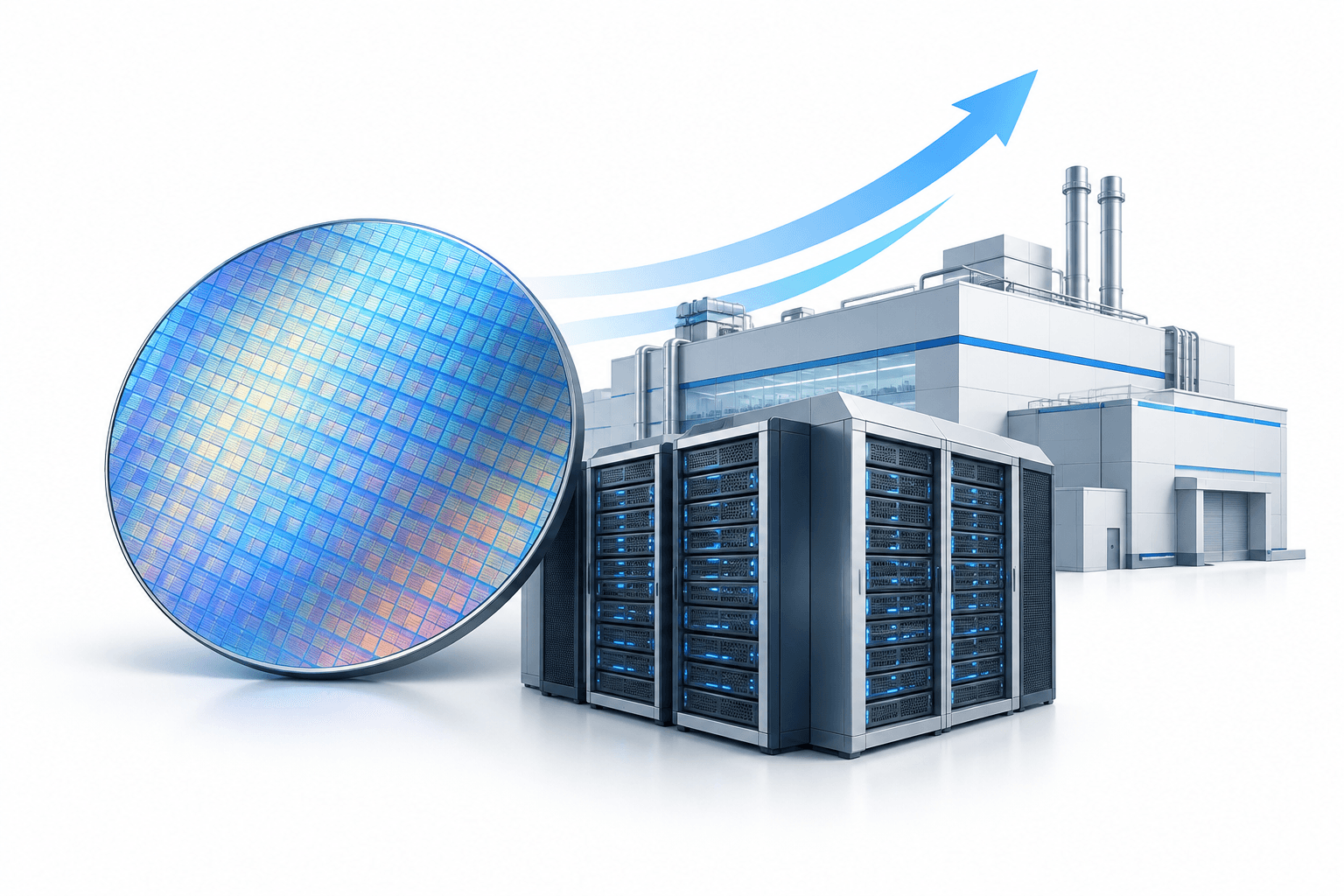
TSMC earnings for the third quarter of 2026 showed revenue rising above company guidance as demand for advanced chips strengthened. Results announced on October 15 put revenue at $46.72 billion, up 16.2% from the previous quarter and 41.2% from a year earlier. Management expects roughly 44% full-year revenue growth in U.S. dollars, even as the ramp-up of 2-nanometer production weighs on margins.
Key Takeaways
- Third-quarter revenue exceeded the $45.8 billion upper end of guidance.
- High-performance computing accounted for 68% of revenue, supported by strong AI demand.
- Fourth-quarter sales are forecast to grow further, while new capacity continues to pressure margins.
Table of Contents
- TSMC earnings exceed sales guidance as profit rises
- AI demand increases the weight of advanced chips
- Fourth-quarter outlook pairs higher sales with margin pressure
- Cash generation supports a large capacity budget
- Conclusion
TSMC earnings exceed sales guidance as profit rises
TSMC’s third-quarter earnings presentation showed net income attributable to shareholders of NT$763.06 billion, up 68.7% from a year earlier. Earnings per share reached NT$29.43, compared with NT$17.44 in the third quarter of 2025.
Revenue exceeded the top of management’s $44.6 billion–$45.8 billion forecast range by $920 million. In New Taiwan dollars, sales increased 17.6% sequentially to NT$1.494 trillion; the different growth rate from the U.S.-dollar measure reflects the reporting currency.
Gross margin fell 1.3 percentage points from the second quarter to 66.4%, mainly because of dilution from the initial 2-nanometer production ramp. Operating margin declined to 58.7% from 60.3%, although it remained above the previous guidance range of 56%–58%. Both margins were higher than a year earlier.
| Item | Details |
|---|---|
| Smartphone platform | Q3 2026 revenue rose 10% sequentially; 21% of total revenue. |
| Internet of Things platform | Q3 2026 revenue rose 5% sequentially; 4% of total revenue. |
| Automotive platform | Q3 2026 revenue rose 23% sequentially; 4% of total revenue. |
| Digital consumer electronics platform | Q3 2026 revenue fell 12% sequentially; 1% of total revenue. |
AI demand increases the weight of advanced chips
High-performance computing revenue increased 22% quarter over quarter and represented 68% of total sales. Chairman and Chief Executive C.C. Wei said demand remained above TSMC’s ability to supply it, with the company working to narrow that gap.
Advanced technologies, defined as 7 nanometers and below, generated 79% of wafer revenue. The 3-nanometer process contributed 33%, followed by 5-nanometer at 28%, 7-nanometer at 10% and 2-nanometer at 8%. These percentages describe wafer revenue, rather than the platform sales mix.
Chief Financial Officer Wendell Huang said AI demand showed no sign of slowing. Management also noted pressure on consumer and price-sensitive markets from rising component costs and economic uncertainty, making the strength of AI-related demand distinct from conditions across all end markets.
Fourth-quarter outlook pairs higher sales with margin pressure
Management forecast fourth-quarter revenue of $52.3 billion–$54.3 billion. The $53.3 billion midpoint implies about 14% sequential growth. Gross margin is expected to be 65%–67%, with operating margin of 56.5%–58.5%, based on an exchange-rate assumption of NT$31.8 per U.S. dollar.
The gross-margin midpoint of 66% is slightly below the third-quarter result. Management attributed the expected pressure to the steep 2-nanometer ramp and overseas factories, illustrating how expanding advanced capacity can weigh on profitability even while sales grow.
TSMC expects overseas factories to dilute full-year 2026 margins by closer to 2 percentage points, with dilution widening to 3–4 percentage points in the coming years. These are management expectations, not realized future results.
Cash generation supports a large capacity budget
Third-quarter operating cash flow reached NT$919.77 billion. After capital expenditures of NT$443.21 billion, free cash flow was NT$476.56 billion. Cash and marketable securities totaled NT$4.017 trillion at quarter-end.
TSMC reiterated its 2026 capital budget of $60 billion–$64 billion. Huang said spending across 2026–2028 was expected to be significantly higher than in the preceding three years, but did not provide annual budgets beyond 2026.
The company expects annual 2-nanometer capacity to more than double in 2027. Its A14 technology remains scheduled for risk production in 2027 and volume production in 2028, keeping those milestones separate from the capacity already producing revenue.
Conclusion
The next reporting checkpoint is the fourth quarter, when results can be measured against the $52.3 billion–$54.3 billion revenue forecast and 65%–67% gross-margin range. Those figures will show how rising sales and the cost of expanding advanced production balance out.
Read More News
Disclaimer
This FinanceVelix article provides general information, not personalized financial, investment, legal, or tax advice. Market prices, interest rates and economic conditions can change; investments carry a risk of loss. Facts reflect the material available when published and may change. Check important information independently and consult a qualified professional when needed. Mentioning an asset, company, or service is not an endorsement.