Germany’s federal government and NVIDIA have signed a declaration of intent to advance industrial AI, linking the country’s engineering and manufacturing expertise with research into models for physical AI. On October 19, 2026, NVIDIA also detailed planned investments in German startups as Chancellor Friedrich Merz urged smaller manufacturers to put their existing company data to work.
Key Takeaways
- The signed declaration establishes an intent to pursue a joint physical AI initiative, rather than documenting a completed deployment.
- NVIDIA plans investments in Agile Robots, Avelios Medical, Mirelo and Reflex Aerospace within a nearly $10 billion commitment across Europe.
- The adoption push targets Germany’s Mittelstand, while Siemens showcased factory applications with reported engineering and cost benefits.
Table of Contents
- What Germany’s industrial AI agreement establishes
- Where NVIDIA plans to invest
- Why smaller manufacturers are central to the push
- Factory applications provide a more concrete reference point
What Germany’s industrial AI agreement establishes
The declaration was signed during the Invest in Germany Summit by Merz, the Federal Ministry for Economic Affairs and Energy, the Federal Ministry for Research, Technology and Space, and NVIDIA. It sets out an agreement to work on a joint initiative advancing AI models for physical AI.
The initiative formalizes and expands cooperation with Germany’s federal government and its Industry 4.0 Platform, which brings together representatives from politics, industry, research and trade associations. The government’s stated objective is widespread industrial AI adoption and a state-of-the-art European industrial AI ecosystem.
| Item | Details |
|---|---|
| Federal cooperation | Declaration of intent signed; a joint physical AI initiative is to be pursued. |
| Startup investments | Investments in Agile Robots, Avelios Medical, Mirelo and Reflex Aerospace are planned. |
| European commitment | Nearly $10 billion covers support across Europe, not Germany alone. |
| Siemens manufacturing work | AI solutions showcased at Erlangen; reported benefits include up to 85% less engineering effort and up to 20% cost savings. |
Where NVIDIA plans to invest
Huang announced planned investments in Agile Robots, Avelios Medical, Mirelo and Reflex Aerospace. These sit within NVIDIA’s nearly $10 billion commitment to support companies, universities, research institutions and other organizations across Europe; that figure is not a Germany-only allocation.
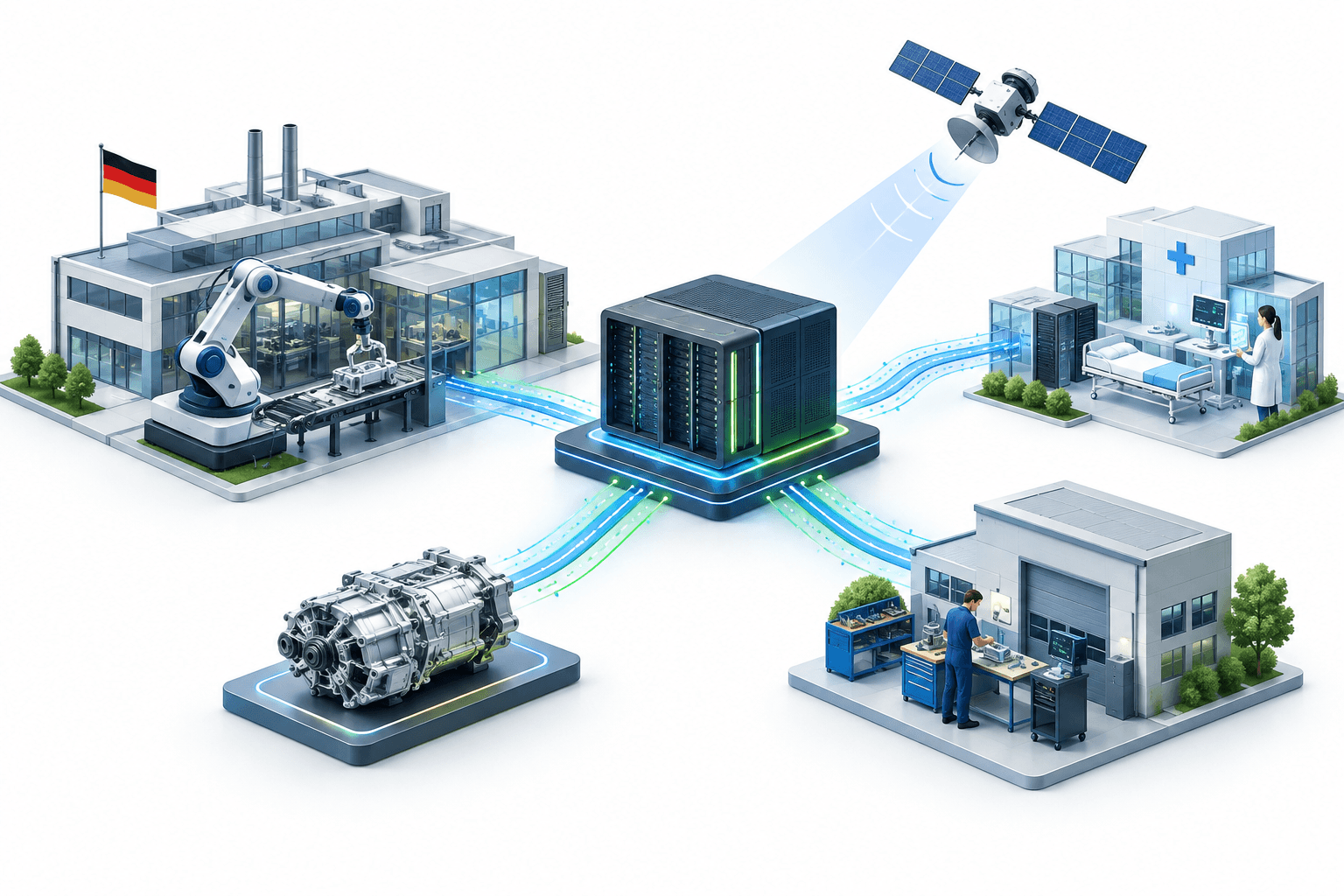
The proposed investments span factory robotics, hospital software, generated audio and satellites. They extend a German investment presence that already includes n8n, Neura Robotics and Black Forest Labs, according to NVIDIA.
Agile Robots develops AI-powered robotic systems for manufacturing, logistics and healthcare. Avelios Medical builds an AI-native hospital information system covering clinical and administrative workflows. Mirelo develops models that generate audio for video, while Reflex Aerospace designs and builds satellites that NVIDIA says can be ready for launch in about 12 months.
Why smaller manufacturers are central to the push
At Berlin’s Kraftwerk venue, Merz and Huang framed Germany’s manufacturing and automotive knowledge as the foundation for AI adoption. Their discussion emphasized the Mittelstand—the small and medium-sized businesses that Merz identified as a particular national advantage.
Merz urged those businesses to open their doors to AI and use the data already held within their companies. The practical emphasis was on applying technology to existing industrial expertise, rather than treating AI as a substitute for that knowledge.
Huang similarly argued that AI could augment German companies’ capabilities. That was an argument for adoption, not evidence that the wider economic benefits have already been achieved.
Factory applications provide a more concrete reference point
Alongside the government cooperation, Siemens announced a partnership with NVIDIA to advance AI-driven autonomous factories and showcased new AI solutions at its Erlangen factory.
NVIDIA reported reductions in engineering effort of up to 85% from fully virtual production ramp-up, and cost savings of up to 20% from agent-based production planning. These figures concern the showcased manufacturing applications, not expected savings for every German business adopting AI.
NVIDIA researchers used the JUPITER supercomputer at the Jülich Supercomputing Centre for a 104-qubit simulation of a fault-tolerant quantum computer. This research result is separate from the newly agreed industrial initiative.
Read More News
Disclaimer
This FinanceVelix article provides general information, not personalized financial, investment, legal, or tax advice. Market prices, interest rates and economic conditions can change; investments carry a risk of loss. Facts reflect the material available when published and may change. Check important information independently and consult a qualified professional when needed. Mentioning an asset, company, or service is not an endorsement.