NVIDIA has expanded the tools surrounding Cosmos world models, adding data-generation blueprints, broader model-training support and simulation variants for testing autonomous systems. The October 22, 2026, announcement connects dataset preparation, model adaptation and deployment, with reported customer applications spanning vehicle development, industrial inspection and safety monitoring.
Key Takeaways
- Cosmos Data Factory now offers five blueprints for preparing and generating physical AI training data.
- Cosmos Framework extends training and optimization tools to more open models, while new simulation variants support policy testing.
- NVIDIA reports faster inference in validated configurations; Porsche’s projected development savings remain expectations, not completed results.
Table of Contents
- Cosmos world models get a broader development toolkit
- Five blueprints address gaps in training data
- Simulation variants support testing before deployment
- Video applications extend the deployment update
- Conclusion
Cosmos world models get a broader development toolkit
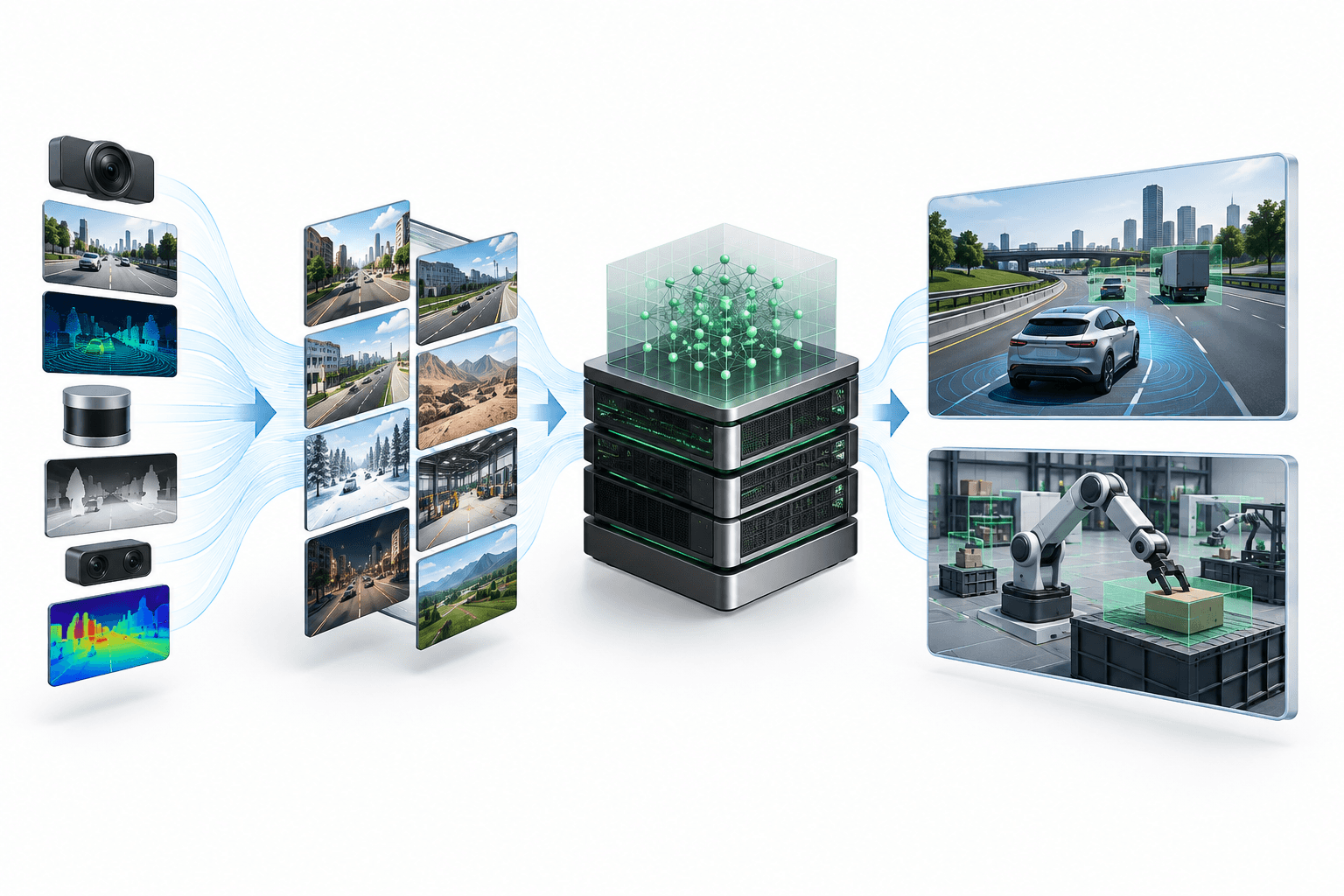
The expansion targets developers building physical AI systems that need to understand and simulate real-world environments. Rather than introducing only another model, NVIDIA is extending the surrounding tools used to assemble training data, adapt models, evaluate behavior and run supported models.
At GTC Berlin, the company extended Cosmos Framework training, optimization and deployment tools and recipes as agent skills to more open models, alongside Cosmos 3. Supported options include GR00T, Alpamayo, QWEN, Pi0.5 and other compatible Hugging Face models.
Developers and agents can use fine-tuning and reinforcement learning to adapt models, then apply distillation and quantization before deployment. NVIDIA described one application at robotics research lab MicroAGI, which post-trained Cosmos 3 on videos of people manipulating objects and distilled its 32-billion-parameter reasoner into an 8-billion-parameter Nano model, reportedly without losing accuracy.
Five blueprints address gaps in training data
Cosmos Data Factory now provides five cloud-native blueprints through GitHub, Microsoft Azure, Nebius and CoreWeave. They cover autonomous-vehicle datasets, image attribute augmentation, synthetic videos of rare or unsafe events, defect images for inspection, and changes to weather and lighting in existing footage while preserving scene structure.
Cosmos Curator, the platform’s GPU-accelerated video-dataset curation tool, has also added support for multimodal, multisensory inputs and processing blocks.
Porsche is using Cosmos Data Factory through Voxel51 on Microsoft Azure to lead development of a shared autonomous-vehicle data flywheel across Volkswagen Group brands. NVIDIA said the work is expected to reduce repeated physical test drives by up to 90% and shorten development cycles by up to 85%; those figures are projected benefits.
Other examples concern work already performed. ANYbotics generated more than 1,500 synthetic video clips, using Encord’s platform to curate real-world data and validate outputs, for training inspection robots to recognize spills and other facility changes. Ultralytics retrained its YOLO model with real images and targeted synthetic defects, improving defect localization and recall, according to NVIDIA.
Simulation variants support testing before deployment
New Cosmos 3 Nano simulation variants let developers test autonomous policies in repeatable scenarios that are difficult to capture, using multiple views and sensors. Accompanying code supports adapting the models to train and evaluate policies for autonomous vehicles and bimanual robots in interactive simulations before real-world testing.
For deployment, updated Cosmos 3 NIM microservices deliver up to twice the inference speed without quality loss in validated configurations, NVIDIA said. The company also reported that continuous video analysis enables sub-second alerts.
Video applications extend the deployment update
The new NVIDIA Metropolis Blueprint for video search and summarization, version 3.3, is built on Cosmos NIM microservices. NVIDIA said it turns a prompt into a video AI application and allows teams to monitor 40% more video streams with the same GPU.
ADNOC uses Fogsphere’s MistIQ agentic platform, built with Cosmos and the Metropolis blueprint, to detect safety hazards in real time across 65 sites. Fogsphere also uses Cosmos Data Factory to generate training examples of rare events, improving detection without physically staging dangerous situations.
Conclusion
The Cosmos update broadens NVIDIA’s tools for developing and testing physical AI before deployment. Its customer examples combine completed data-generation work and active safety applications with projected vehicle-development savings, while performance claims retain configuration-specific limits.
Read More News
Disclaimer
This FinanceVelix article provides general information, not personalized financial, investment, legal, or tax advice. Market prices, interest rates and economic conditions can change; investments carry a risk of loss. Facts reflect the material available when published and may change. Check important information independently and consult a qualified professional when needed. Mentioning an asset, company, or service is not an endorsement.