SKF earnings for the third quarter of 2026 showed stronger industrial sales and profitability despite higher input costs. Results released on October 21 put organic growth in continuing operations at 4.3% and the adjusted operating margin at 16.3%, up 0.9 percentage points from a year earlier. Management also brought forward its target date for annual cost savings.
Key Takeaways
- Continuing operations grew sales by 5.5%, with specialized industrial solutions helping lift profitability.
- SKF now targets SEK2 billion in annual run-rate savings by mid-2027, six months earlier than planned.
- Inventory absorbed more cash, while management cut its 2026 capital expenditure forecast.
Table of Contents
- SKF earnings improve despite persistent cost inflation
- Specialized industrial solutions leads margin expansion
- Inventory absorbs cash as savings timetable advances
- Fourth-quarter outlook points to modest sales improvement
- Conclusion
SKF earnings improve despite persistent cost inflation
Net profit from continuing operations rose by SEK490 million to SEK1.8 billion. Sales growth combined a 4.3% organic increase with a 1.7% currency benefit, partly offset by a 0.5% negative contribution from changes in the business structure.
Higher material, utilities, logistics and wage costs reduced the operating margin by 2.7 percentage points. Commercial measures, growth and efficiency savings nevertheless supported an increase in adjusted operating profitability. The rightsizing program contributed SEK350 million in savings during the quarter.
The distinction between continuing operations and the full group matters: group net profit, including automotive, was SEK1.4 billion. Discontinued automotive operations reduced that result by SEK349 million.
| Item | Details |
|---|---|
| Adjusted gross margin, continuing operations | 34.9% in Q3 2026, largely unchanged year over year |
| EPS, continuing operations | SEK3.9 versus SEK3.5 a year earlier |
| EBITDA, continuing operations | SEK3.6 billion versus SEK3.2 billion a year earlier |
| Automotive, discontinued operations | Organic sales declined 4%; adjusted operating margin improved to 4.6% |
| Q4 currency guidance | Expected positive EBIT impact of SEK150 million |
| 2026 tax-rate guidance, continuing operations | 27%, excluding divestments and automotive separation |
Specialized industrial solutions leads margin expansion
Specialized Industrial Solutions, representing 26% of net sales, recorded strong organic growth across all four business units. Aerospace and magnetics grew fastest, and the segment's adjusted operating margin increased by 2.4 percentage points to 14%.
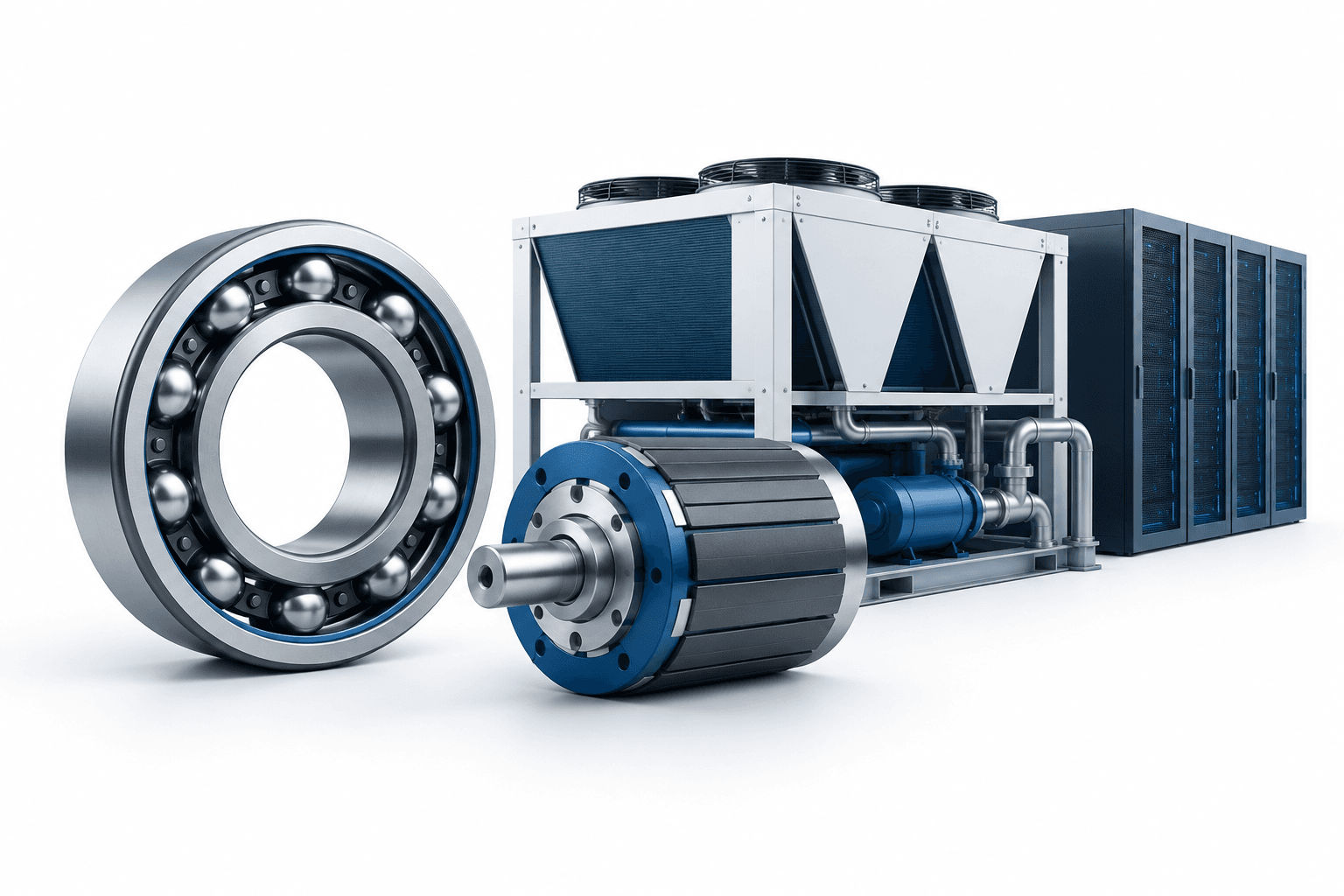
SKF described magnetics as a roughly SEK1.5 billion business supported by demand from data centers, semiconductors and energy. Its data-center magnetic bearing applications include high-speed motors engineered for centrifugal compressors in cooling systems, illustrating one use of the technology rather than providing a measure of quarterly demand.
Bearing Solutions, the larger segment with 74% of sales, delivered organic growth of almost 3% and a slightly higher adjusted operating margin of 18.8%.
Demand remained uneven geographically. Organic growth was about 10% in the Americas and 12% in India and Southeast Asia, while EMEA and China and Northeast Asia were broadly flat. Chief Executive Rickard Gustafson said European distributors remained hesitant to rebuild inventories.
Inventory absorbs cash as savings timetable advances
Operating cash flow increased to SEK2.1 billion from SEK1.8 billion a year earlier. However, working capital absorbed SEK587 million, SEK266 million more than in the comparable quarter, as Specialized Industrial Solutions built component and material inventories to support growth.
Net working capital in the industrial business reached 38% of sales, compared with 32%. Management said the specialized business's inventory was not expected to decline in the short term, limiting the immediate cash benefit from stronger earnings.
SKF now expects its rightsizing program to reach SEK2 billion in annual run-rate savings by mid-2027, about six months ahead of the original schedule. That is a target for the ongoing annual savings rate, not the amount already realized.
Estimated one-off automotive separation costs increased by approximately SEK0.5 billion to about SEK3 billion. An equal reduction in industrial footprint optimization costs offsets that increase within the broader cost plan.
Fourth-quarter outlook points to modest sales improvement
Management expects continuing-operations sales to strengthen somewhat year over year in the fourth quarter. Gustafson described broadly stable activity levels amid uncertainty, rather than a sharp change in demand. SKF does not expect cost inflation to differ materially from the third quarter.
The company reduced its full-year forecast for additions to property, plant and equipment to SEK2.5 billion, down SEK0.5 billion. Chief Financial Officer Susanne Larsson said the reduction reflected a reassessment of the project pipeline around separation activities, not a new sustainable spending rate.
SKF retained its expectation of higher capital expenditure for the next two years until its medium-term planning horizon, followed by a gradual decline.
Conclusion
SKF's fourth-quarter results will show whether modestly stronger sales and further savings can sustain margin improvement while inventory remains elevated. The next stated restructuring milestone is the SEK2 billion annual savings run rate targeted for mid-2027.
Read More News
Disclaimer
This FinanceVelix article provides general information, not personalized financial, investment, legal, or tax advice. Market prices, interest rates and economic conditions can change; investments carry a risk of loss. Facts reflect the material available when published and may change. Check important information independently and consult a qualified professional when needed. Mentioning an asset, company, or service is not an endorsement.