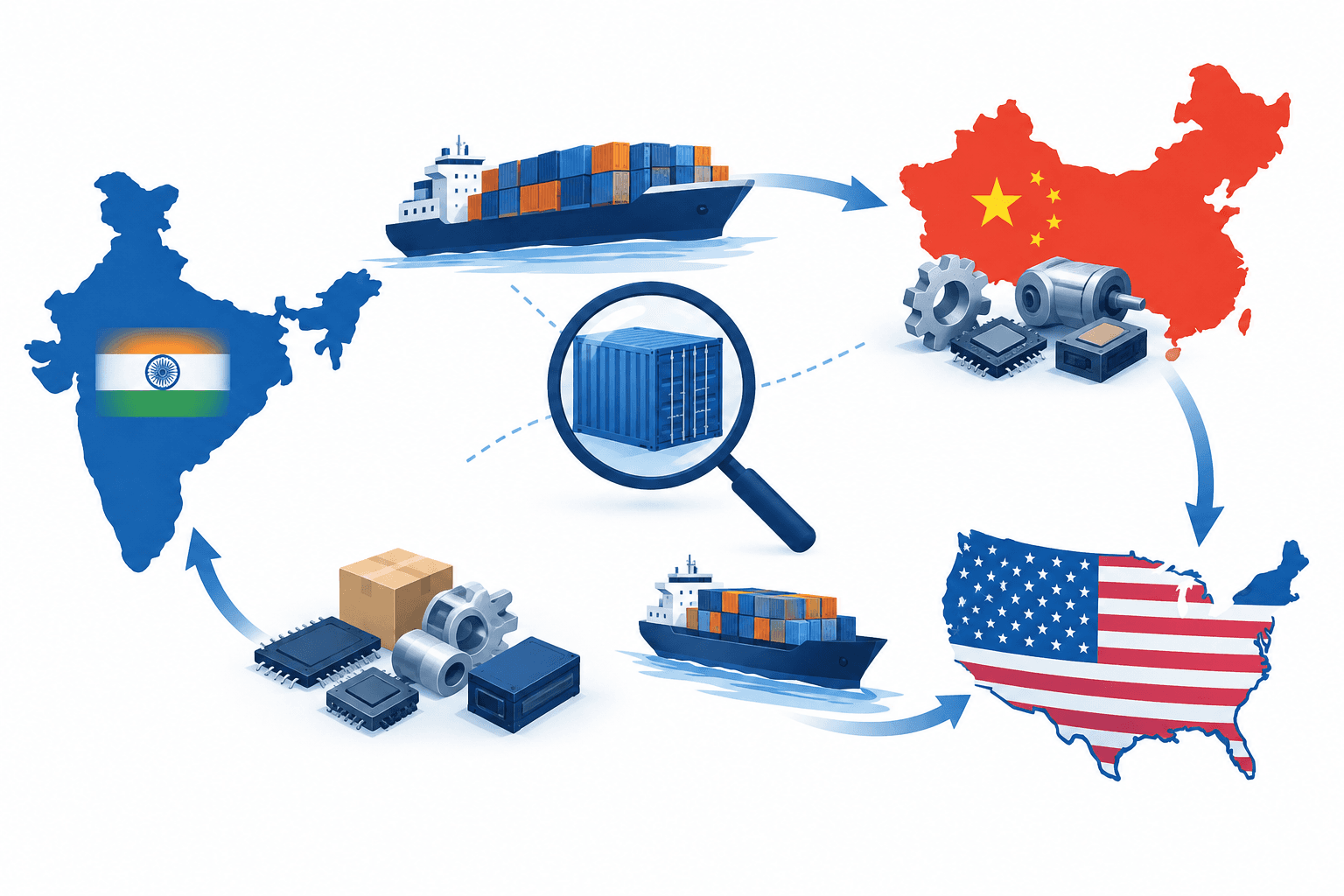
An August 2026 White House report identified India as part of a network allegedly helping China evade US tariffs. Two researchers contest the India transshipment claim, arguing that changes in the country’s exports and domestic value added also point to manufacturing growth.
Key Takeaways
- The White House report grouped India among 40 countries it linked to alleged tariff evasion.
- India’s goods exports to the US rose from $42.5 billion in 2014 to $79.4 billion in 2024.
- The researchers say trade patterns alone cannot distinguish lawful manufacturing from origin fraud.
What the India transshipment claim says
The White House Office of Trade and Manufacturing Policy’s report, The Great Transshipment Scam, placed India among the “Diversified Scale Leaders” in a 40-country network. It highlighted a pattern in which China’s share of US imports fell after the 2018 Section 301 tariffs while the combined share of the other countries rose.
The report described that pattern as “unlikely to be explained by chance alone.” Its approach examines products for which China’s US import share falls while a third country’s imports from China and exports to the US rise.
Researchers point to changing exports
C. Veeramani of the Centre for Development Studies and Himanshu Jaiswal of the Centre for Social and Economic Progress argue that the pattern cannot on its own distinguish industrial upgrading from origin laundering. They say imported Chinese components can be used in goods that undergo genuine manufacturing before export.
The researchers cite growth in India’s two-way trade with the US between 2014 and 2024: India’s goods exports to the US rose 1.86 times, while US exports to India grew 1.94 times. They also point to a shift in India’s export mix toward machinery, electrical goods, pharmaceuticals and chemicals.
Using OECD Trade in Value Added data, they note that from 2012 to 2022, the domestic value added embedded in India’s exports to the US rose 1.89 times, while gross exports to the US rose 1.87 times. They argue that this is inconsistent with a characterization of India as a mere pass-through hub.
Lawful trade versus origin fraud
The distinction matters for enforcement. The researchers describe falsely claiming a country as a product’s origin to avoid duties as fraud, while distinguishing it from legitimate trade in goods genuinely transformed in a third country.
They also argue that differing tariff rates can encourage both unlawful evasion and legitimate shifts in factories, suppliers and investment. The aggregate trade figures they cite do not establish whether individual shipments complied with origin rules.
Read More News
Disclaimer
This FinanceVelix article provides general information, not personalized financial, investment, legal, or tax advice. Market prices, interest rates and economic conditions can change; investments carry a risk of loss. Facts reflect the material available when published and may change. Check important information independently and consult a qualified professional when needed. Mentioning an asset, company, or service is not an endorsement.



Comments
Be respectful. No spam, impersonation or private credentials. Ordinary posts and comments appear immediately; suspicious links are held for review.
Please wait…