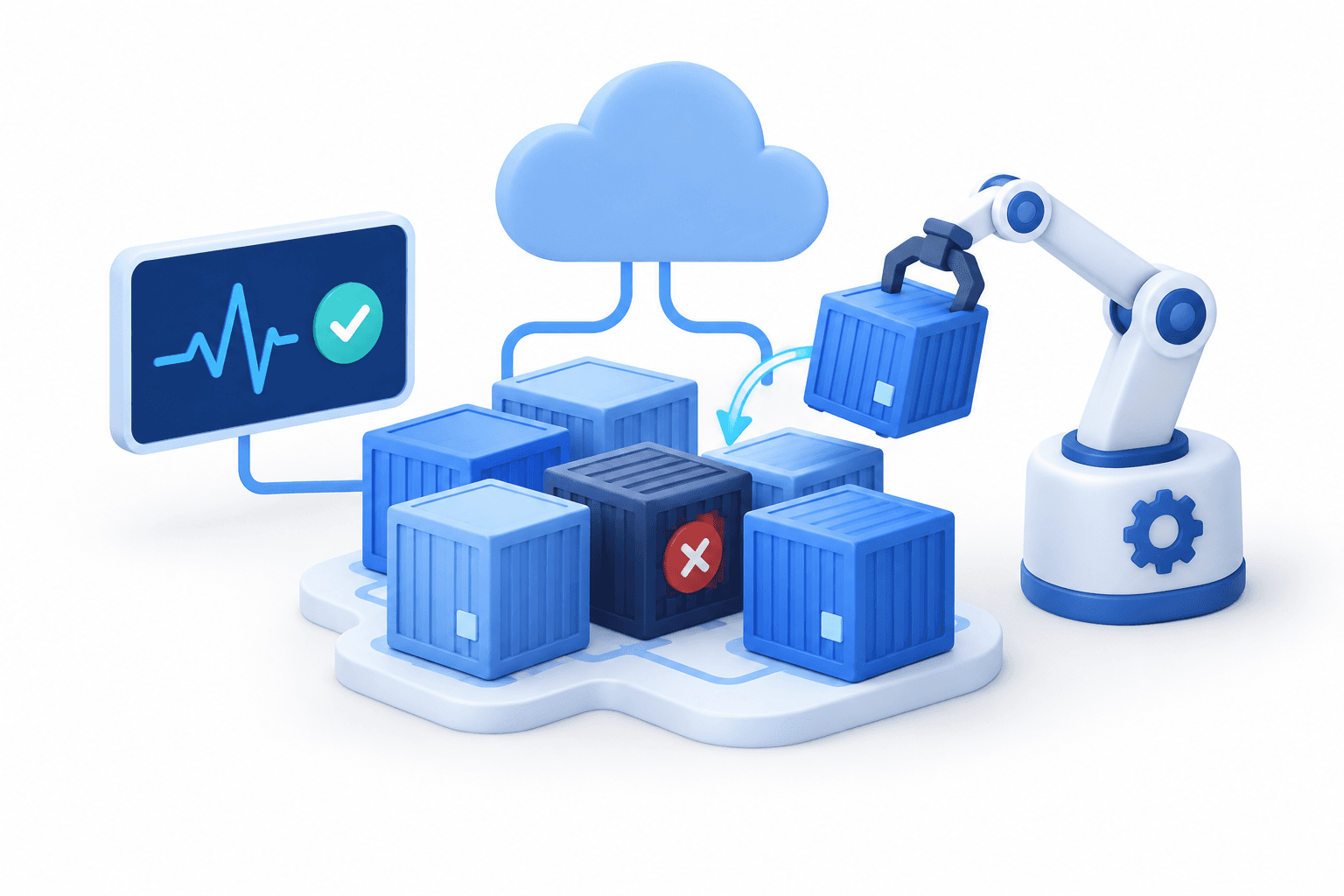
A study highlighted by Barmeter Technologies on October 26, 2026, found that a multi-signal Kubernetes recovery policy resolved 96.7% of injected faults across controlled trials. The results came from a limited test environment and do not establish performance in large-scale production systems.
Key Takeaways
- Researchers compared three operating approaches across 186 independently timed trials.
- The multi-signal policy combined runtime state, application health probes and failure history.
- The implementation covered a single node and a single service.
How the Kubernetes recovery test worked
The research, published in August 2026 and featuring infrastructure specialist Dinesh Kumar Movva, used a Kubernetes control plane and a purpose-built node agent connecting Kubernetes objects to Docker containers.
Researchers tested six fault categories: container crashes, out-of-memory failures, defective application rollouts, silent application hangs, network partitions and severe CPU starvation. They compared no automation, a basic restart-on-crash rule and a deterministic policy using multiple operational signals.
The multi-signal policy had the highest recovery rate. The study also found limits to restart-only remediation, particularly for hangs, network partitions and bad deployments, where another restart may not address the underlying problem.
| Item | Details |
|---|---|
| Multi-signal policy | Recovered from 96.7% of injected faults |
| Basic restart-on-crash rule | Recovered from 47.9% of injected faults |
| No automation | Recovered from 14.6% of injected faults |
What the results do and do not show
Despite the study title’s reference to AI, the proposed approach is an inspectable rule-and-score system, not a trained machine-learning model or an autonomous language-model agent.
The evaluation used a single-node, single-service reference implementation in a constrained environment. Its results should not be treated as validated performance across large-scale production environments.
Read More News
Disclaimer
This FinanceVelix article provides general information, not personalized financial, investment, legal, or tax advice. Market prices, interest rates and economic conditions can change; investments carry a risk of loss. Facts reflect the material available when published and may change. Check important information independently and consult a qualified professional when needed. Mentioning an asset, company, or service is not an endorsement.




Comments
Be respectful. No spam, impersonation or private credentials. Ordinary posts and comments appear immediately; suspicious links are held for review.
Please wait…