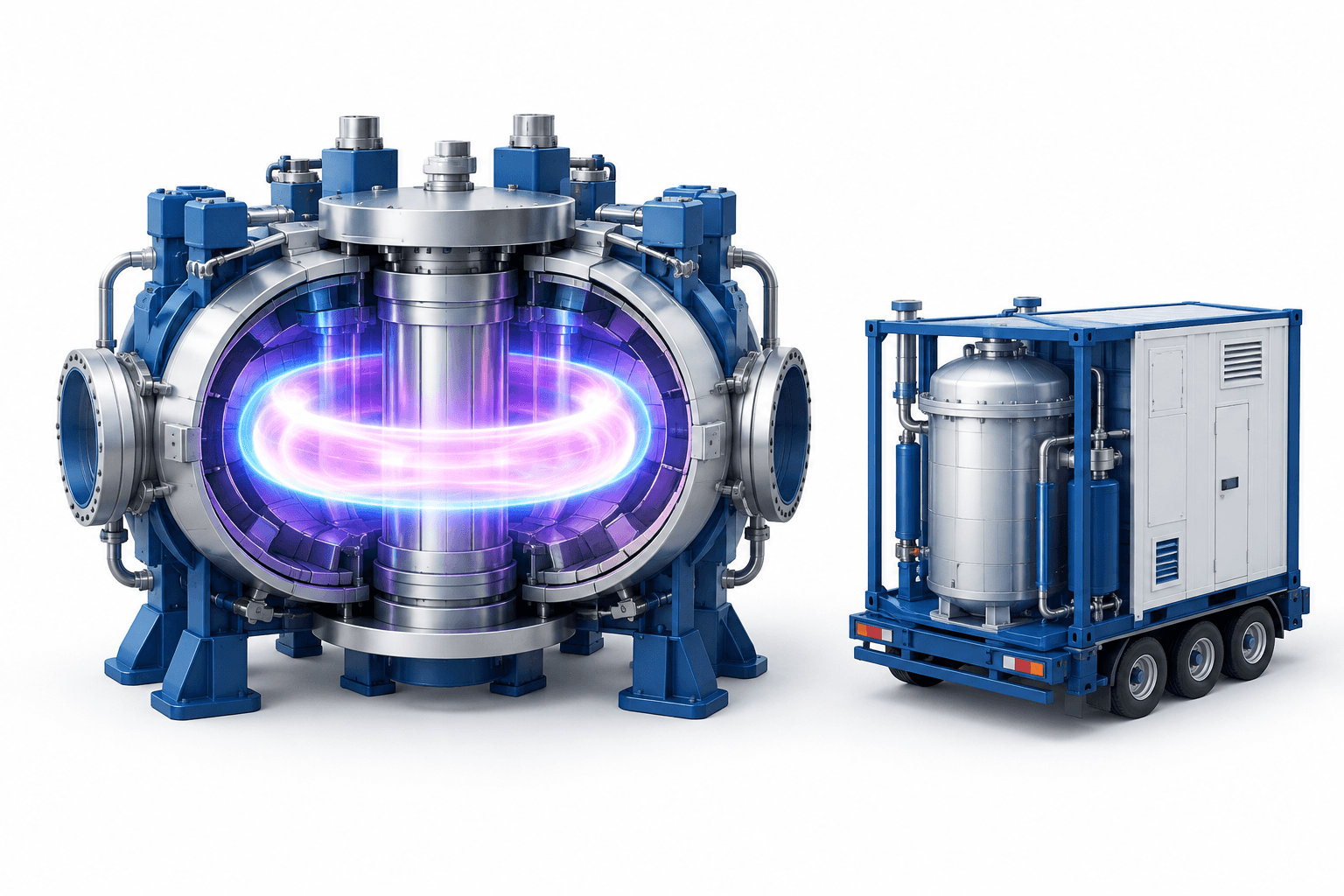
Indian nuclear startups are pursuing fusion technologies and portable fission reactors as regulatory changes open more of the country’s nuclear sector to private participation. The projects remain at an early stage, with commercial fusion power still years away.
Key Takeaways
- Pranos Fusion targets its first plasma in a compact tokamak in January 2027.
- Big Bang Boom aims to build a working portable fission reactor within five years.
- Nuclear ventures face long development cycles, substantial capital needs and regulatory oversight.
Indian nuclear startups take different approaches
Bengaluru-based Pranos Fusion unveiled Pragya in September 2026, describing it as India’s first privately developed compact tokamak. The doughnut-shaped machine uses magnetic fields to confine plasma, an extremely hot, electrically charged gas.
Pranos aims to generate and magnetically confine its first plasma in Pragya in January 2027. Its approach seeks to harness fusion, the process of combining atomic nuclei that powers the Sun.
Hyderabad-based Anubal is developing a different fusion approach, using powerful laser pulses to compress and heat a small fuel capsule. It is also working on plasma optics intended to reduce the size of components used in high-intensity lasers and is exploring commercial opportunities in laser technology while fusion power remains years from commercialization.
Neither fusion startup has demonstrated a commercially viable power plant that reliably produces more usable energy than it consumes.
Portable reactor would use fission
Defence technology company Big Bang Boom is developing a truck-transportable micro-modular reactor in the 1–10 megawatt range. Unlike the fusion projects, it would use fission, the splitting of atomic nuclei.
Potential customers include industrial facilities, mines, commercial complexes, AI data centres and remote defence installations. Co-founder and chief technology officer R Shivaraman says the company targets a working reactor within five years.
Big Bang Boom estimates development will require ₹1,000 crore or more. It expects to draw on internal accruals, strategic partners and government research and development programmes for funding.
Policy changes and funding hurdles
The SHANTI Act, which received presidential assent in December 2025, opened the way for private participation in licensed nuclear facilities and activities, subject to regulatory oversight. The February 2025 Union Budget also announced a ₹20,000-crore Nuclear Energy Mission focused on small modular reactor research and development.
The government targets at least five indigenously designed small modular reactors by 2033 and 100 gigawatts of nuclear power capacity by 2047.
Funding remains limited. Market intelligence platform Tracxn says five of the 33 companies in the sector had raised a cumulative $6.8 million year-to-date as of October 2026. Its co-founder Neha Singh cites long development cycles, high capital requirements, complex liability provisions and stringent oversight among the challenges.
Next milestone
The next stated project milestone is Pranos Fusion’s target of generating and confining first plasma in January 2027.
Read More News
Disclaimer
This FinanceVelix article provides general information, not personalized financial, investment, legal, or tax advice. Market prices, interest rates and economic conditions can change; investments carry a risk of loss. Facts reflect the material available when published and may change. Check important information independently and consult a qualified professional when needed. Mentioning an asset, company, or service is not an endorsement.



Comments
Be respectful. No spam, impersonation or private credentials. Ordinary posts and comments appear immediately; suspicious links are held for review.
Please wait…