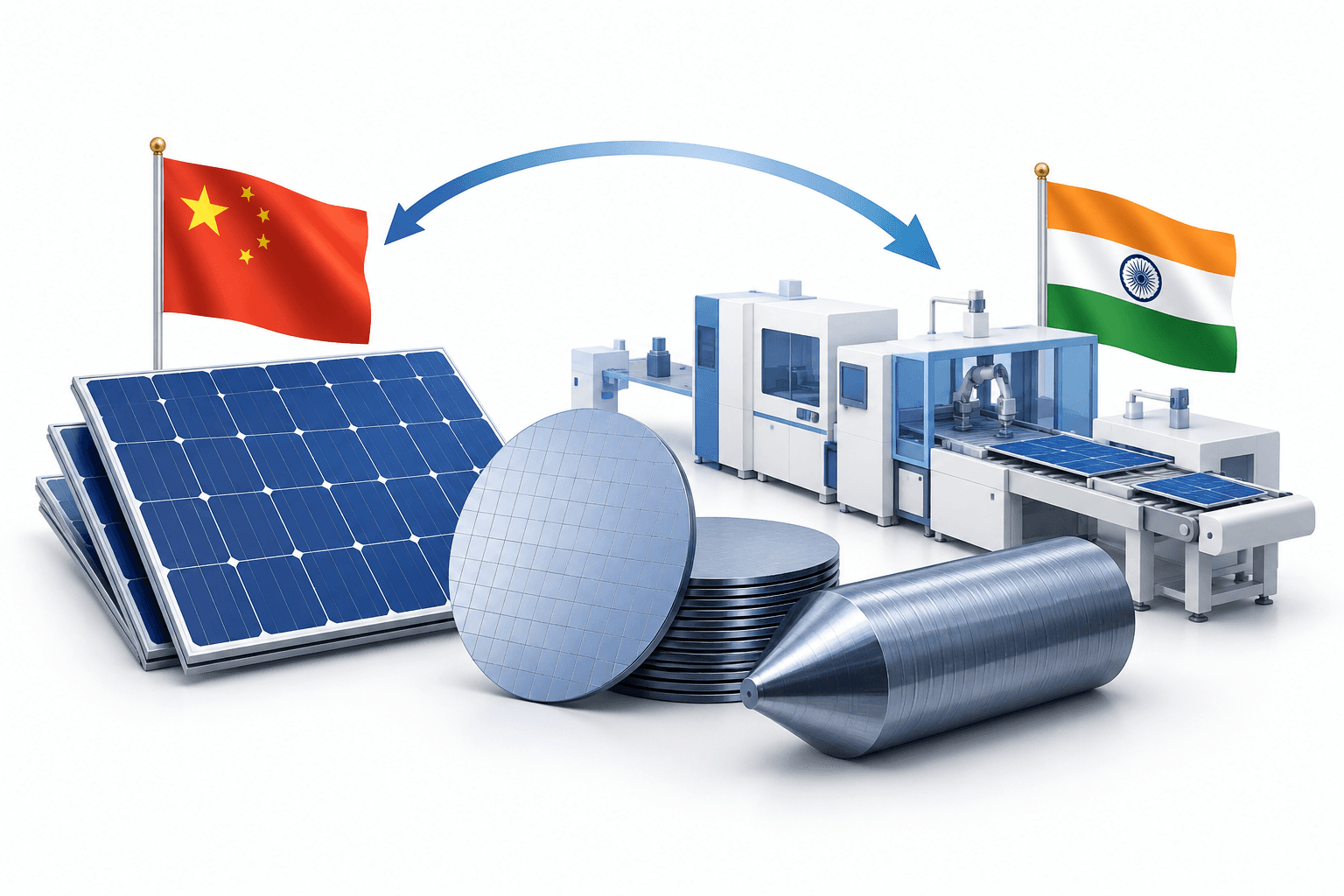
China solar export controls proposed in October 2026 could complicate India’s plans to build a more complete domestic solar manufacturing supply chain, although industry executives do not expect an immediate disruption to module production.
Key Takeaways
- China’s proposal covers 12 solar manufacturing technologies and remains open for industry consultation.
- Indian manufacturers are particularly concerned about equipment for making ingots, where China has a near monopoly.
- India has a February 2028 deadline for domestic manufacturing standards covering solar ingots and wafers.
What the China solar export controls propose
China’s Ministry of Commerce has proposed partial restrictions on some widely used solar cell technologies and outright bans on advanced equipment for upstream components, including wafers and polysilicon.
The measures are a proposal, not an enacted rule, and no effective date has been confirmed. The available information does not specify the previous export-control requirements.
Vinay Rustagi, chief business officer at Premier Energies, expects the severity of the restrictions to vary with the technology’s level of advancement, with newer, higher-efficiency technology facing tighter curbs.
India’s upstream expansion faces uncertainty
Indian module makers planning to enter cell, ingot, wafer and polysilicon production could face difficulties sourcing machinery. SWELECT Energy Systems CEO and Managing Director Arulkumar Shanmugasundram said non-Chinese suppliers exist for cells, wafers and polysilicon, but ingot technology is particularly sensitive.
Rustagi said existing businesses can continue operating cell and production lines using imported wafers and that he does not expect a short-term sector impact over the next two to three years. He expects the impact to emerge as newer technologies become commercially viable and more widely accepted.
Anujesh Dwivedi, a partner at Deloitte India, said a blanket ban is not anticipated and that some imports may remain possible with licences. He cautioned that equipment lead times could lengthen and that the effect on India’s domestic expansion would depend partly on whether manufacturers have already secured supplies.
February 2028 deadline adds pressure
India’s Ministry of New and Renewable Energy earlier in 2026 extended mandatory sourcing requirements under the Approved List of Models and Manufacturers to include ingots and wafers. The requirements apply to solar projects from February 2028.
Rustagi said it is not yet clear how a Chinese export ban would affect that deadline. Industry representatives also pointed to potential collaboration with equipment and technology suppliers outside China, although some global suppliers manufacture equipment there.
Next milestone
The proposal remains open for industry consultation; no effective date for the China solar export controls has been confirmed.
Read More News
Disclaimer
This FinanceVelix article provides general information, not personalized financial, investment, legal, or tax advice. Market prices, interest rates and economic conditions can change; investments carry a risk of loss. Facts reflect the material available when published and may change. Check important information independently and consult a qualified professional when needed. Mentioning an asset, company, or service is not an endorsement.




Comments
Be respectful. No spam, impersonation or private credentials. Ordinary posts and comments appear immediately; suspicious links are held for review.
Please wait…