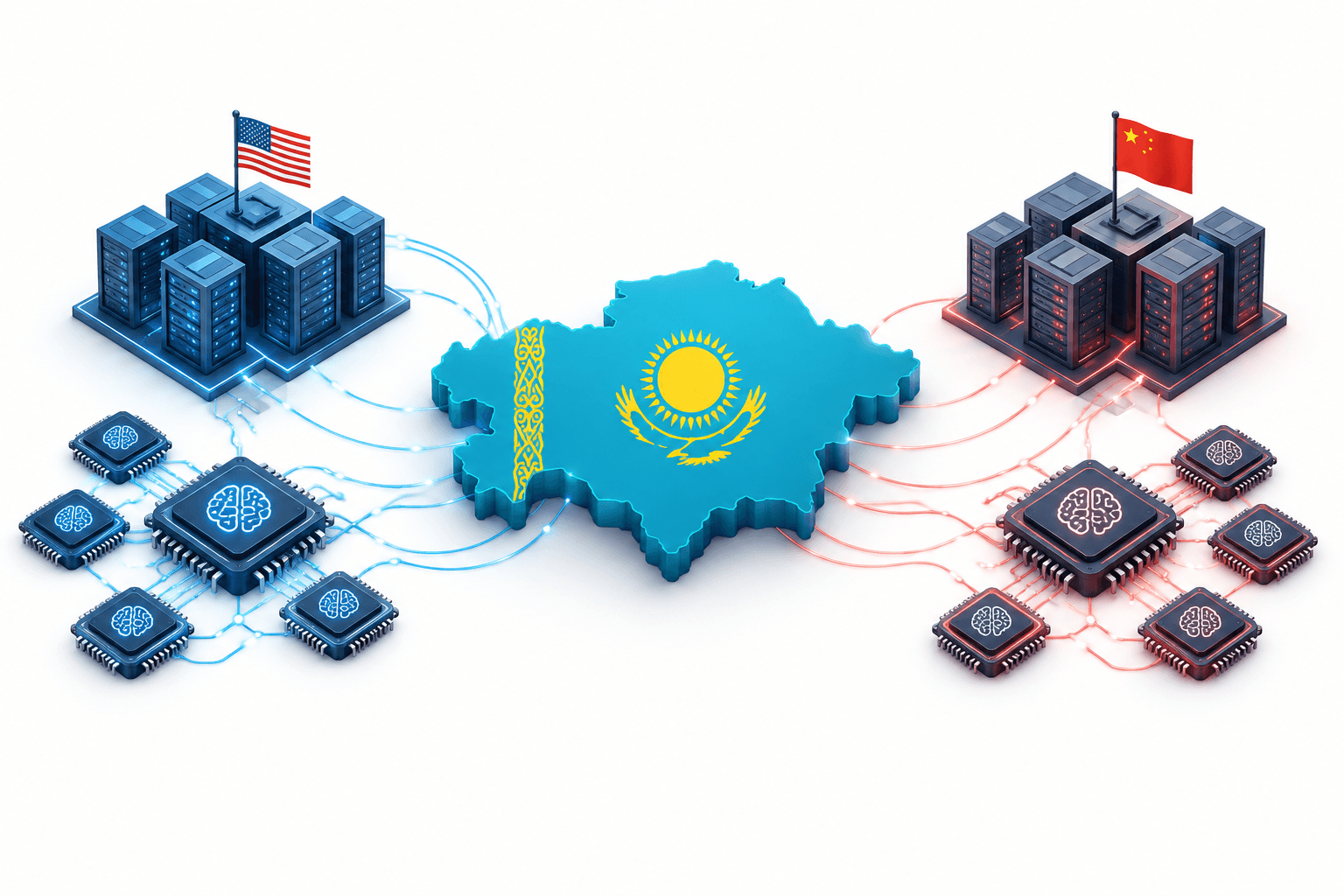
AI blocs led by the United States and China are drawing countries into a contest over technology access and global standards. Kazakhstan has joined initiatives associated with both powers, even as Washington signals that substantive engagement with a competing vision could be incompatible with its own partnership.
Key Takeaways
- Kazakhstan joined the US-led Pax Silica supply-chain initiative and became a founding member of China’s World AI Cooperation Organisation.
- The US State Department has questioned whether countries can be trusted Pax Silica partners while substantially engaging in competing initiatives.
- Kazakhstan has an investment agreement worth up to $10 billion involving Nvidia for a planned data centre valley.
Kazakhstan straddles the AI blocs
Kazakhstan’s AI minister, Zhaslan Madiyev, visited Washington in June 2026 to join the US group working to strengthen AI supply chains. Three weeks later, he attended a Shanghai signing ceremony that made Kazakhstan a founding member of China’s World AI Cooperation Organisation.
The US initiative offers the prospect of technology partnerships and a place in AI supply chains. Through the Chinese organisation, Kazakhstan also hopes to have a voice in regional and global AI standards. The organisation had 28 other initial founding countries, including Pakistan and Russia.
Dana Masalimova, a former Kazakh diplomat and independent scholar, said countries were hedging because they did not want a binary choice. She described Kazakhstan’s position as precarious despite its access to investment from both sides.
Investment and technology access
Kazakhstan has critical mineral resources and relatively cheap electricity that can support data centres. Earlier in 2026, its government signed an investment agreement worth up to $10 billion involving Nvidia to build a data centre valley. The agreement is an investment plan, not a completed project.
Chinese investment is also growing. Local officials said Chinese foreign direct investment in Kazakhstan reached a record $2.8 billion in 2025. In July 2026, Chinese leader Xi Jinping met Kazakh President Kassym-Jomart Tokayev to expand cooperation under the Belt and Road initiative.
The US offers access to advanced chips and AI technologies, while China promotes more affordable, open-source systems. Washington has restricted China’s access to some advanced AI chips and chipmaking machinery.
Washington signals limits to cooperation
The US State Department said countries cannot be trusted partners in Pax Silica while substantively engaging in initiatives that advance a competing vision for superintelligence. Its statement raises a question for countries seeking to participate in both groups, although it did not specify how that standard would be applied.
China has promoted its organisation as open and inclusive. Its embassy in Washington said the two countries should draw on their respective AI strengths rather than guard against each other.
Other countries seek options
Indonesia, which has joined China’s organisation, also wants to benefit from both powers. Mari Pangestu, vice chair of Indonesia’s National Economic Council, said the country should be able to participate in both and choose the best system.
Singapore says it is considering joining the Chinese organisation, while US AI company Anthropic is establishing an Asia office in the city-state. In Saudi Arabia, AI startup Humain unveiled a platform in September 2026 built on an open model from a Chinese company; the kingdom also has a deal with Nvidia to expand AI computing using advanced chips.
China has provided official-sector grants and loans for projects and activities that use or enable AI in at least 77 low- and middle-income countries, research lab AidData said. Recipients include Nigeria, Zambia, Ghana and Bangladesh.
Read More News
Disclaimer
This FinanceVelix article provides general information, not personalized financial, investment, legal, or tax advice. Market prices, interest rates and economic conditions can change; investments carry a risk of loss. Facts reflect the material available when published and may change. Check important information independently and consult a qualified professional when needed. Mentioning an asset, company, or service is not an endorsement.



Comments
Be respectful. No spam, impersonation or private credentials. Ordinary posts and comments appear immediately; suspicious links are held for review.
Please wait…