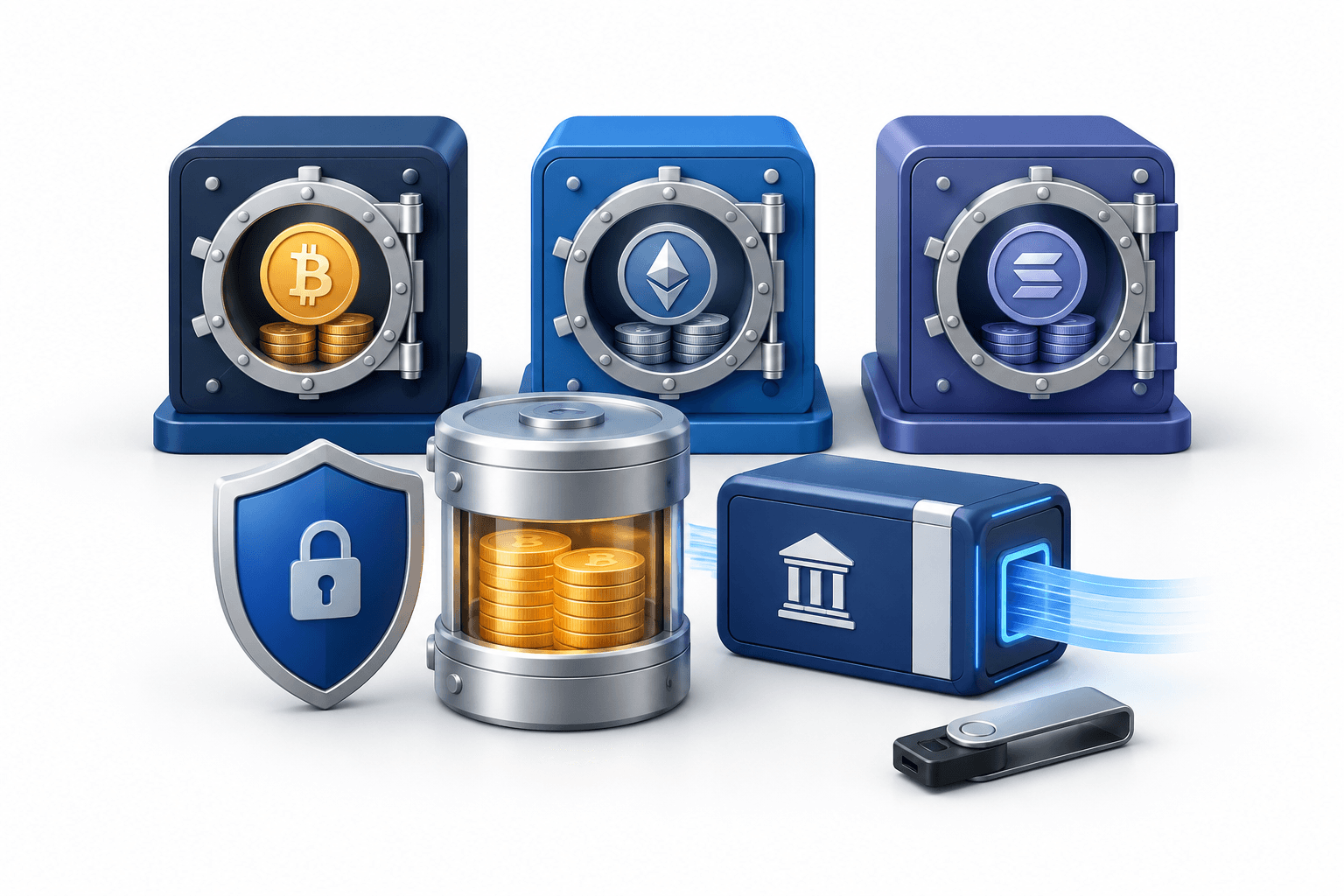
Crypto exchange insurance does not provide a government-backed guarantee for cryptocurrency held at Binance, Coinbase or Kraken. As of October 21, 2026, the platforms offer different combinations of emergency reserves, crime insurance, custody controls and banking oversight—but those protections address different risks, rather than guaranteeing repayment after any loss.
Key Takeaways
- Binance’s SAFU is an exchange-managed reserve, not a third-party insurance policy guaranteeing customer reimbursement.
- Coinbase distinguishes eligible US dollar deposit protection from cryptocurrency holdings, which have no FDIC or SIPC coverage.
- Kraken Financial’s limited-purpose Federal Reserve account provides payments access, not federal insurance for exchange-held cryptocurrency.
Table of Contents
- Binance’s reserve fund carries Bitcoin price exposure
- Coinbase separates dollar protection from crypto coverage
- Kraken’s banking access is not deposit insurance
- What crypto exchange insurance leaves uncovered
- Conclusion
Binance’s reserve fund carries Bitcoin price exposure
Binance established its Secure Asset Fund for Users, or SAFU, in July 2018, initially allocating 10% of trading fees to the fund. It used SAFU to cover customer losses following its May 2019 security breach.
In February 2026, Binance converted $1 billion in SAFU stablecoin holdings into Bitcoin. The supplied October snapshot puts the reserve at approximately 15,000 BTC, worth about $1.27 billion. That dollar value is a point-in-time estimate, not a fixed amount of coverage.
Binance says it will replenish SAFU to $1 billion if its value falls below $800 million. Publishing the wallet address allows users to inspect its holdings, but a visible balance does not establish an enforceable entitlement to reimbursement. Unlike third-party insurance, the arrangement depends on Binance’s ability to maintain and deploy its own reserve.
| Item | Details |
|---|---|
| Binance SAFU | Exchange-funded reserve; Binance says it will restore the fund to $1 billion if its value falls below $800 million. |
| Coinbase dollar balances | Eligible custodial USD deposits may receive FDIC pass-through protection, subject to conditions and limits. |
| Coinbase crime insurance | Covers certain security losses; the cited $255 million limit dates to 2019, not 2026. |
| Kraken Financial account | Limited-purpose Federal Reserve account approved March 4, 2026, for an initial one-year term. |
| Kraken reserve verification | Allows balance-inclusion checks for specified reviews; does not provide insurance. |
Coinbase separates dollar protection from crypto coverage
Coinbase’s FDIC pass-through protection concerns eligible US dollar balances held through custodial bank arrangements, with coverage subject to applicable conditions and limits of up to $250,000 per depositor. It does not turn Coinbase into an FDIC-insured bank or insure cryptocurrency holdings.
Coinbase also carries crime insurance intended to address certain security-related losses. The last publicly reported policy limit cited in the supplied material was $255 million in 2019; that historical figure should not be treated as its current coverage limit.
The distinction matters because protection against a covered security incident is not protection against every reason a customer might lose money. Individual phishing incidents and exchange insolvency fall outside the coverage described. Cold storage reduces online exposure, while public-company disclosures provide information about risks; neither is a reimbursement guarantee.
Kraken’s banking access is not deposit insurance
On March 4, 2026, the Federal Reserve Bank of Kansas City announced its limited-purpose account approval for Kraken Financial, formally Payward Financial. The Wyoming-chartered Special Purpose Depository Institution received an initial one-year term, with restrictions tailored to its business model and risk profile.
That approval concerns access to Federal Reserve payment services. It does not establish federal insurance for cryptocurrency in standard Kraken exchange accounts. Kraken states that standard accounts and digital assets are not insured against losses.
Kraken’s proof-of-reserves reviews serve another purpose: Merkle-tree verification lets customers check whether their balances were included in a review of specified assets and liabilities. This is evidence about a defined snapshot, not an insurance policy or a guarantee against future losses. The banking entity’s charter and the exchange’s custody arrangements should therefore be assessed separately.
What crypto exchange insurance leaves uncovered
The practical question is not simply whether an exchange says it has insurance, but which event triggers payment, whose assets are covered and what limits or exclusions apply. A policy covering some platform security breaches may not cover stolen customer credentials, insolvency or losses beyond its limit.
Reserve funds, insurance policies and proof-of-reserves reviews answer different questions. A reserve shows resources set aside; a policy defines covered losses; a reserve review provides evidence about specified balances. None should be treated as interchangeable with government-backed deposit insurance.
Self-custody removes reliance on an exchange to safeguard the assets transferred out, but shifts responsibility for keys, backups and transaction security to the holder. It changes the risk rather than eliminating the possibility of loss.
Conclusion
The central distinction is between protection against a specified incident and a guarantee that customers will recover their assets. None of these arrangements supplies the latter for cryptocurrency. Kraken Financial’s March 2026 approval establishes an initial one-year account term; any continuation beyond that term would need separate confirmation.
Read More News
Disclaimer
This FinanceVelix article provides general information, not personalized financial, investment, legal, or tax advice. Market prices, interest rates and economic conditions can change; investments carry a risk of loss. Facts reflect the material available when published and may change. Check important information independently and consult a qualified professional when needed. Mentioning an asset, company, or service is not an endorsement.