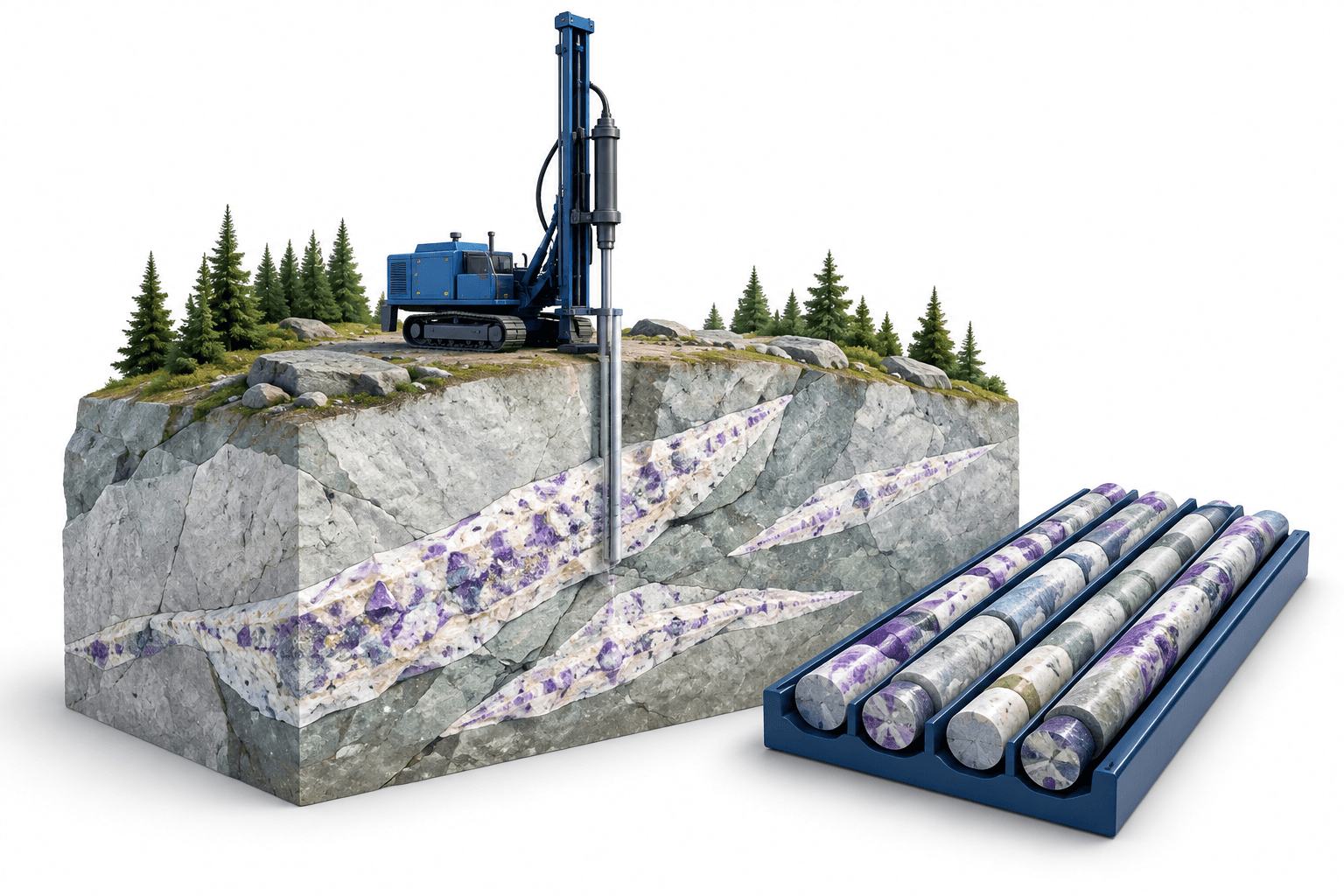
PMET drilling at the Shaakichiuwaanaan critical-minerals project in Quebec has exceeded 30,000 metres across more than 250 holes since June 2026. In its October 2026 update, PMET Resources said seven rigs were active, with work supporting mine engineering and geological models while updated resource estimates and development studies remained scheduled for the fourth quarter.
Key Takeaways
- The drilling program is supporting engineering and permitting work at the CV5 and CV13 deposits.
- Updated development studies remain planned for late 2026; drilling assays are expected through the first quarter of 2027.
- PMET is targeting a first CV5 caesium resource estimate in late 2027, not announcing one now.
Table of Contents
- PMET drilling targets engineering and geological confidence
- The 2026 studies and 2027 resource update are separate milestones
- Caesium work extends beyond lithium development
- Conclusion
PMET drilling targets engineering and geological confidence
PMET’s October 2026 drilling update describes work at the wholly owned Shaakichiuwaanaan project in Quebec’s Eeyou Istchee James Bay region. Much of the program is designed to assess ground conditions around the CV5 and CV13 pegmatites and proposed infrastructure, rather than solely to identify additional mineralization.
The company is collecting information on soil stability, depth to bedrock, water quality and bedrock strength. Those findings are intended to inform detailed engineering, permitting submissions, buildings and waste-rock facilities. PMET said drilling to date supported the suitability of ground conditions for its mine-development plans.
Targeted infill holes are also testing geological interpretations. Further drilling at CV13 before the program ends is intended to support the potential upgrade of some resources from Inferred to Indicated. That remains an objective, not a completed reclassification.
| Item | Details |
|---|---|
| BerryPick sample collection | At least 7 tons of material estimated to have been collected. |
| Ore-sorting testwork | X-ray transmission testing scheduled for early 2027. |
| CV4-CV5 gap coverage | Only part of the gap is expected to be tested, using step-out holes from both ends. |
The 2026 studies and 2027 resource update are separate milestones
PMET expects to complete drilling in mid-November 2026, with assay results expected through the first quarter of 2027. The company plans to incorporate results into ongoing and future development studies and a sixth mineral resource estimate, known as MRE-6, anticipated in the second half of 2027.
A nearer-term fifth resource estimate, MRE-5, is expected shortly. It will underpin an updated CV5 lithium-tantalum feasibility study and a broader CV5-CV13 preliminary economic assessment covering lithium, caesium and tantalum. Those studies remain scheduled for release before the end of 2026.
The distinction matters: the forthcoming studies and the later resource update are separate deliverables. The October announcement does not present assay results from the 2026 drilling program or establish that new resources have been defined.
Caesium work extends beyond lithium development
At CV5, tightly spaced drilling is targeting a caesium-enriched zone within the open-pit design from the 2025 feasibility study. Prior mineralogical work has confirmed pollucite, a caesium-bearing mineral, and PMET aims to define a first CV5 caesium mineral resource estimate in late 2027.
The BerryPick sampling program has also used two dedicated shallow coring rigs to collect pollucite-bearing pegmatite. Separately, a barge-mounted rig is testing part of the gap between CV4 and CV5, which the company considers prospective for lithium-caesium-tantalum pegmatite.
These activities broaden the technical work beyond the lithium-only CV5 feasibility study announced in 2025. They do not guarantee additional resources or economic viability; drilling results, testwork and subsequent studies still need to support those conclusions.
Conclusion
The next planned disclosures are MRE-5 and the updated development studies before year-end 2026. Assay results through early 2027 will provide a later test of the geological objectives behind the current drilling program.
Read More News
Disclaimer
This FinanceVelix article provides general information, not personalized financial, investment, legal, or tax advice. Market prices, interest rates and economic conditions can change; investments carry a risk of loss. Facts reflect the material available when published and may change. Check important information independently and consult a qualified professional when needed. Mentioning an asset, company, or service is not an endorsement.