Synaptics made Coralboard SL generally available through DigiKey on October 20, 2026, moving the edge AI development board beyond its limited-edition release. The company also introduced Coralboard SR and expanded access to its open-source Torq compiler, broadening the hardware and software platform developed with Google Research.
Key Takeaways
- Coralboard SL is now available through DigiKey’s global distribution network.
- The new Coralboard SR targets microcontroller-based edge AI applications.
- Synaptics aims to give developers a shared software workflow across both boards.
Table of Contents
- Coralboard SL moves beyond its limited release
- The SR board adds a different hardware option
- Shared software targets repeated integration work
- Conclusion
Coralboard SL moves beyond its limited release
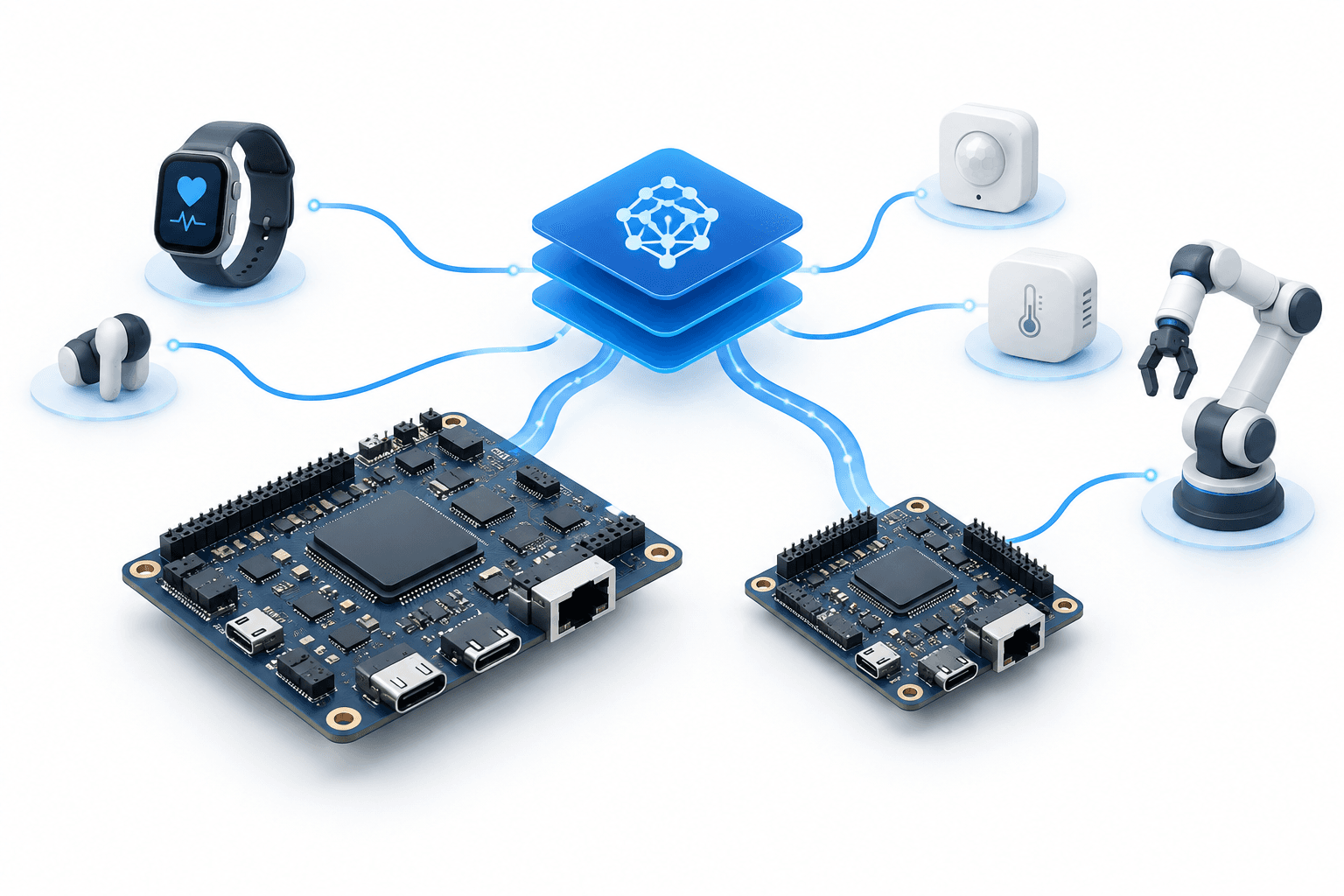
The launch gives developers broader access to a board built around Synaptics’ Astra SL2619 processor and a Torq/Coral neural processing unit rated at 1 trillion operations per second. DigiKey is the exclusive distribution partner for the Coralboard.
The platform is designed for low-power, always-on applications that process sensor information on the device. Synaptics identified wearables, smart-home appliances, industrial controls and robotics among its intended uses.
Google’s Coral NPU ecosystem announcement confirms the SL board’s worldwide general availability and the unveiling of the SR developer kit. Google describes SL as a Linux-based platform for connected devices and robotics, while SR addresses microcontroller-class applications.
| Item | Details |
|---|---|
| SL availability | General availability through DigiKey began October 20, 2026. |
| SL host processors | Two 2GHz Arm Cortex-A55 cores and a Cortex-M52. |
| SL expansion | M.2 expansion slot for Wi-Fi and Bluetooth connectivity. |
| SR imaging | Multi-camera support, dual image signal processors and digital microphones. |
| Shared interfaces | MicroSD, NOR flash, CSI/DSI, USB, QWICC and mikroBUS. |
The SR board adds a different hardware option
Coralboard SR expands the lineup around the newly launched Astra SR200 processor family. Its listed configuration uses an Astra SR250-series processor with an 800MHz Arm Cortex-M85, a Cortex-M52 and a Torq/Coral accelerator rated at 400 billion operations per second.
The two boards offer different compute and memory configurations rather than a single performance tier. SL includes 2GB of DDR4 memory, while SR offers integrated SRAM of up to 8MB and high-bandwidth custom DRAM of up to 256MB.
Google Research engineering director Billy Rutledge said the SR200 series brings second-generation Coral NPU technology with RISC-V vector support into silicon. The announcement introduced SR but did not separately specify an order date for that board.
Shared software targets repeated integration work
Synaptics said its MLIR-based Torq compiler and runtime provide a consistent development experience across the SL and SR boards. The open-source toolchain supports model optimization and deployment, mapping neural-network layers to the available accelerator engines.
The practical aim is to reduce the work required when developers move between hardware configurations. Open-source access also lets teams inspect the compiler, customize performance and debug their implementations rather than rely entirely on a closed toolchain.
Synaptics listed Google Gemma3 270M, Liquid AI LFM2.5 and Ultralytics YOLO26 among the model families Torq is designed to support. These are company-stated capabilities, not evidence of commercial adoption. The announcement did not disclose board pricing, sales volumes or an expected revenue contribution.
Conclusion
The confirmed commercial step is Coralboard SL’s move into global distribution. The SR introduction broadens the platform, but its separate ordering timetable and the lineup’s financial contribution remain undisclosed.
Read More News
Disclaimer
This FinanceVelix article provides general information, not personalized financial, investment, legal, or tax advice. Market prices, interest rates and economic conditions can change; investments carry a risk of loss. Facts reflect the material available when published and may change. Check important information independently and consult a qualified professional when needed. Mentioning an asset, company, or service is not an endorsement.