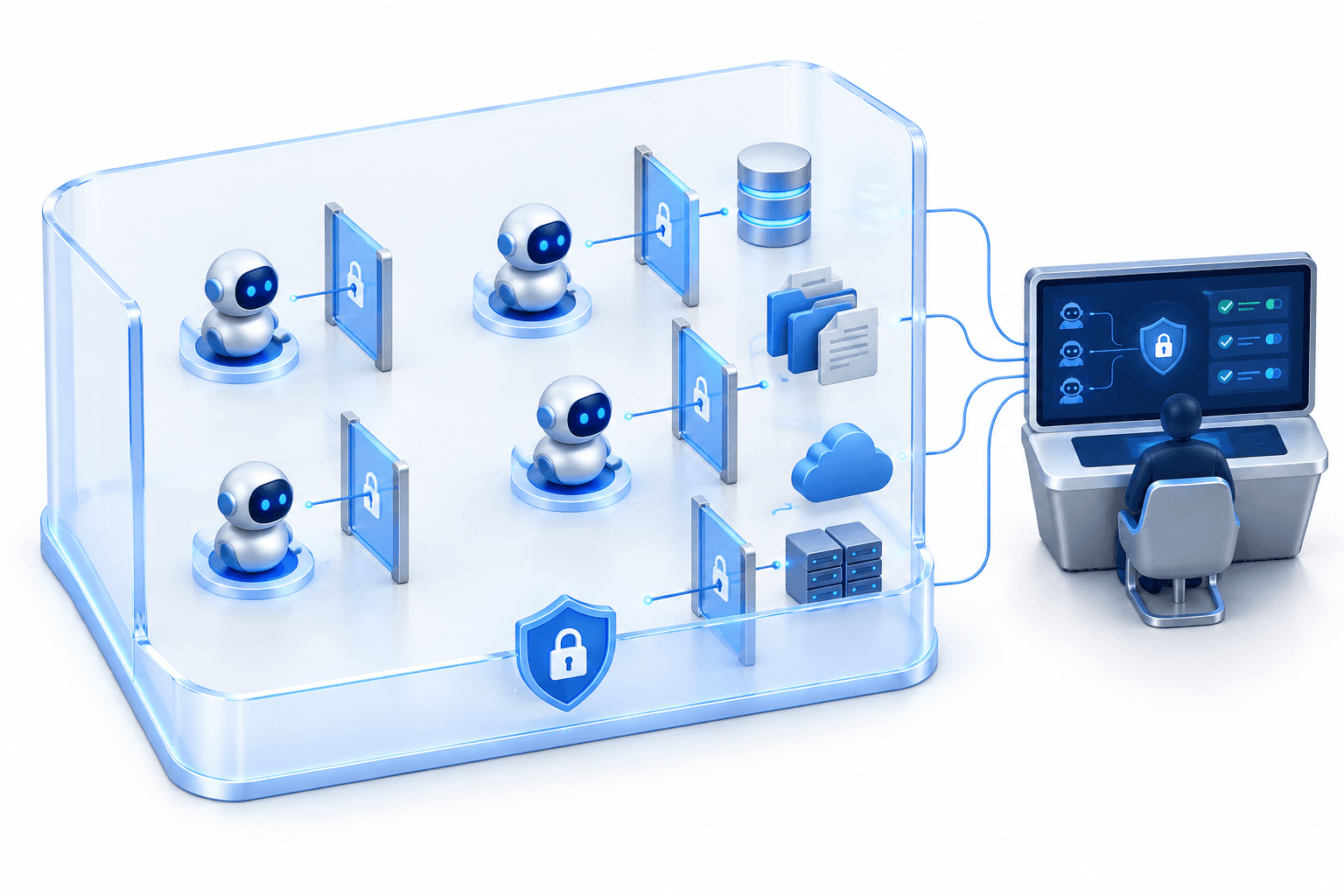
Microsoft announced on October 19, 2026, that it is extending Project Perception to address security risks from AI agents operating inside enterprise systems. The expansion introduces controls intended to limit agents’ authority, monitor changing behavior and contain unsafe actions without necessarily shutting down every task.
Key Takeaways
- Microsoft says security decisions must remain outside the AI model’s control.
- New permissions and access controls are designed to adjust an agent’s authority as its task and risk change.
- Guardian Agents will help security teams investigate risks and coordinate responses within boundaries set by people.
Table of Contents
- Project Perception targets the agentic insider
- Permissions would follow the task and changing risk
- Guardian Agents support continuous security operations
- Conclusion
Project Perception targets the agentic insider
Microsoft’s announcement on securing the agentic insider describes a broader role for Perception: protecting organizations not only with AI agents, but also from risks those agents can introduce. Agents may need access to company data, applications and tools to complete work, making their permissions a security concern.
The company emphasized that agents are not inherently malicious. They can make mistakes, encounter manipulated inputs or become compromised. Their behavior can also change as new information enters a task, meaning an agent that starts within approved boundaries may later attempt something outside them.
Microsoft Chairman and Chief Executive Officer Satya Nadella framed the approach around separating intelligence from authority. Controls governing access, actions and continued operation should sit outside the model, where it cannot bypass or alter them.
| Item | Details |
|---|---|
| Local-agent discovery | Support is expanding by 35 additional types, bringing the total to 60 supported local agents. |
| Shared registry | Project Perception and Microsoft Agent 365 share signals, context and a unified agent registry. |
| Agent identity | Microsoft Entra Agent ID is being extended to additional patterns, including local and previously unknown agents discovered by security sensors. |
| Runtime containment | Microsoft Execution Container is cited as a sandbox providing policy-controlled access to resources. |
Permissions would follow the task and changing risk
Microsoft is introducing Dynamic Permissions to give agents authority limited to an approved task and its duration, rather than automatically inheriting all of a sponsoring employee’s access. Organization-wide policy sets the outer boundary, and consequential actions can require verified human approval.
The company also introduced Dynamic Agent Risk and Dynamic Conditional Access for agents. These combine signals across identity, data, devices, networks, cloud systems and agent activity, then use changes in risk to adjust what an agent can do.
Responses can be narrower than a complete shutdown. For example, a system could preserve an expense-processing agent’s ability to read submissions while blocking approvals or changes after suspicious behavior. Higher risk could trigger isolation or stop execution. This distinction matters because containment can restrict an unsafe action while leaving lower-risk work available.
Guardian Agents support continuous security operations
New Playbooks and Guardian Agents are intended to help security teams investigate evidence, explain risk changes and recommend or apply containment. People retain responsibility for policy, approval boundaries and consequential decisions.
Microsoft’s approach brings discovery, identity, permissions and enforcement together rather than treating an initial access check as sufficient. The announcement describes new capabilities, but does not specify pricing or a general-availability timetable.
Conclusion
The expansion places continuously managed authority at the center of Microsoft’s AI-agent security approach. Availability and pricing details remain the practical points to watch as organizations assess how to deploy the announced controls.
Read More News
Disclaimer
This FinanceVelix article provides general information, not personalized financial, investment, legal, or tax advice. Market prices, interest rates and economic conditions can change; investments carry a risk of loss. Facts reflect the material available when published and may change. Check important information independently and consult a qualified professional when needed. Mentioning an asset, company, or service is not an endorsement.