The JPMorgan initiative aimed at strengthening strategic industries financed and facilitated more than $230 billion in transactions during its first year, the bank announced on October 19, 2026. Its Security and Resiliency Initiative also committed $5 billion of an initial $10 billion equity allocation, as the broader $1.5 trillion program entered its second year.
Key Takeaways
- The $230 billion total covers financing and facilitated transactions, not solely JPMorgan’s own investments.
- Equity commitments reached $5 billion, half the initiative’s initial equity allocation.
- Nearly one-third of first-year activity occurred outside the United States.
Table of Contents
- JPMorgan initiative separates financing from direct investment
- Industrial capacity is the common thread
- Expansion adds a cross-border dimension
- Conclusion
JPMorgan initiative separates financing from direct investment
The announcement was a progress update on a program launched a year earlier, rather than a new $1.5 trillion commitment. The initiative combines financing, direct investment, research and policy engagement to support industries the bank considers important to economic resilience and national security.
JPMorgan’s first-year Security and Resiliency Initiative update distinguishes the more than $230 billion in financed and facilitated transactions from direct equity activity. The headline transaction total should therefore not be interpreted as an equivalent amount of spending from the bank’s own capital.
Direct investments are led by the Strategic Investment Group, headed by Todd Combs. The group committed $5 billion of the initial $10 billion equity allocation in its first year, backing businesses in areas including next-generation defense technology, distributed battery storage and automated manufacturing.
| Item | Details |
|---|---|
| Supply chain and advanced manufacturing | One of the initiative’s five financing focus areas. |
| Defense and aerospace | Includes support for manufacturers and defense suppliers. |
| Energy independence and resilience | Activity includes next-generation nuclear and geothermal energy. |
| Frontier and strategic technologies | Activity includes artificial intelligence, cybersecurity and quantum computing. |
| Pharma and healthtech | Includes critical medicine production and supply chains. |
Industrial capacity is the common thread
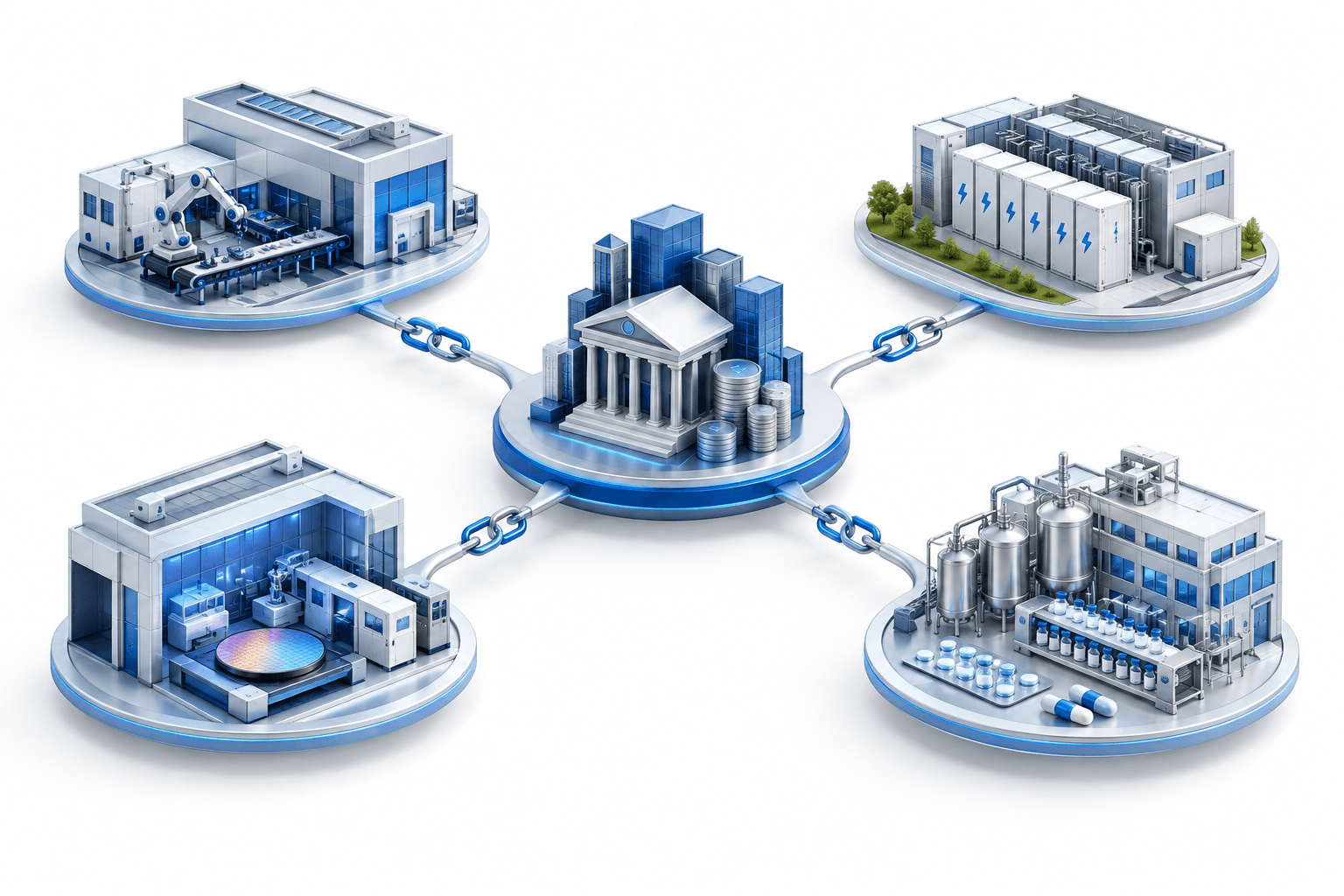
The program spans five priority areas, connecting defense and manufacturing needs with energy, technology and medicine supply chains. Its financing has supported smaller suppliers in the defense industrial base as well as companies developing nuclear and geothermal energy and expanding domestic critical-minerals capacity.
The practical aim extends beyond making capital available. JPMorgan said its analysis had identified workforce shortages, permitting obstacles and procurement challenges that continue to constrain industrial investment and production.
Since October 2025, the bank has mapped seven critical value chains to identify supply-chain dependencies and financing gaps. It has also built a dedicated initiative team of more than 35 professionals, including 13 managing directors.
Expansion adds a cross-border dimension
Although strengthening U.S. industrial capacity remains central to the program, JPMorgan expanded the initiative into Europe and Canada during 2026. Nearly one-third of related activity over the first year occurred outside the United States.
The bank said that expansion reflects the international nature of critical technologies, supply chains and industrial capabilities. For its second year, it plans to focus on helping companies expand capacity, structuring financing for strategic projects, strengthening supplier and workforce networks, and coordinating policy across borders.
Conclusion
The first-year figures show the scale of JPMorgan’s financing activity, but do not by themselves establish how much industrial capacity has been added. The next phase is the bank’s stated second-year effort to turn that financing and supply-chain analysis into expanded production, stronger suppliers and more financeable strategic projects.
Read More News
Disclaimer
This FinanceVelix article provides general information, not personalized financial, investment, legal, or tax advice. Market prices, interest rates and economic conditions can change; investments carry a risk of loss. Facts reflect the material available when published and may change. Check important information independently and consult a qualified professional when needed. Mentioning an asset, company, or service is not an endorsement.