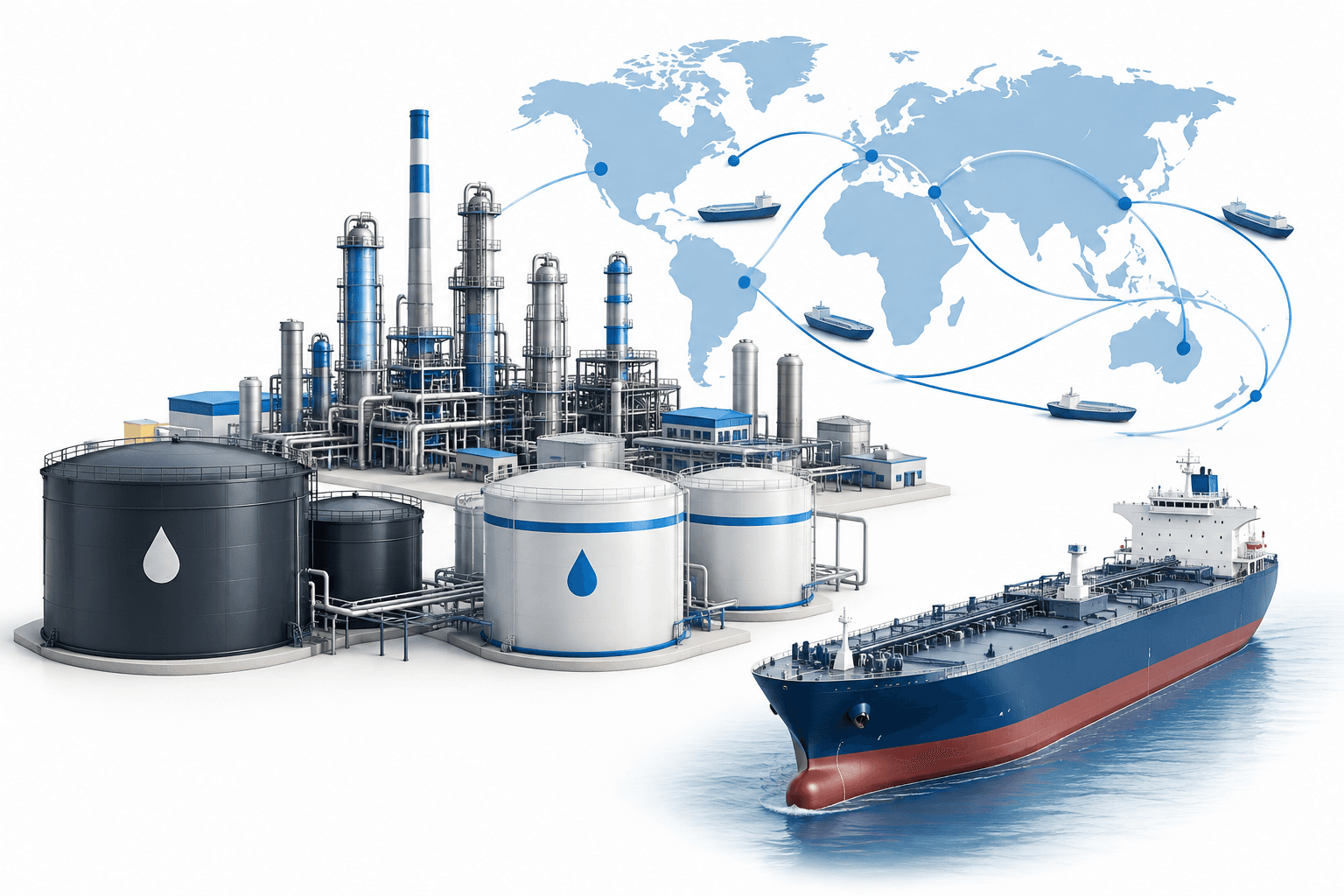
Refinery fuel exports from plants processing Russian crude in India, Turkiye and Brunei reached about €1 billion in September 2026, up 43% from August, the Centre for Research on Energy and Clean Air (CREA) estimated. The increase covers all three countries, not India alone, with the European Union taking the largest share.
Key Takeaways
- The 43% increase covered exports from refineries in India, Turkiye and Brunei to countries sanctioning Russia.
- CREA estimated that €295 million of the exported products were refined from Russian crude.
- India’s Russian crude imports fell 13% in September, their second consecutive monthly decline.
Table of Contents
- Refinery fuel exports rise across three countries
- EU arrivals raise questions about feedstock origin
- India buys less Russian crude despite export increase
- Conclusion
Refinery fuel exports rise across three countries
CREA’s September 2026 fossil fuel analysis put shipments to sanctioning countries at approximately €1 billion. That figure covers all oil products exported by the tracked refineries to those destinations; it is not an estimate that every shipment was made from Russian feedstock.
The EU was the largest destination, followed by Australia, the United States and New Zealand. CREA estimated the Russian-crude-derived portion at €295 million.
Reliance Industries’ Jamnagar refinery in Gujarat supplied six of the seven shipments unloaded at EU ports during September. The remaining shipment came from Turkiye’s Tupras Izmit refinery. Italy received three cargoes, Romania two, and Spain and Cyprus one each.
| Item | Details |
|---|---|
| EU | €667 million of September 2026 oil product imports from the tracked refineries |
| Australia | €168 million |
| United States | €154 million |
| New Zealand | €19 million |
EU arrivals raise questions about feedstock origin
The EU’s ban on imports of oil products made from Russian crude took effect on January 21, 2026. Shipments from refineries that use Russian crude warrant scrutiny, but a refinery’s use of Russian feedstock does not by itself establish the origin of every exported product or prove that each shipment breached the ban.
The value of exports reported as destined for EU ports from the tracked refineries rose 80% month on month. That measure included a 104,000-tonne gasoil cargo from Jamnagar still en route to Rotterdam, distinguishing it from cargoes already unloaded.
CREA called for a refinery-level restriction covering products from any plant that had processed Russian crude in the preceding six months, regardless of the products’ declared origin. This is the research group’s recommendation, not an adopted policy.
India buys less Russian crude despite export increase
India’s Russian crude imports fell 13% in September to their lowest level since April 2026. Intake declined 27% at Jamnagar, 21% at Indian Oil Corporation’s Paradip refinery and 8% at Nayara Energy’s Vadinar refinery. Despite its decline, Vadinar overtook Jamnagar as India’s largest Russian crude importer.
India nevertheless remained Russia’s second-largest fossil fuel customer after China, purchasing €4.1 billion of Russian hydrocarbons during the month. Crude accounted for 88%, or €3.6 billion.
Kpler analysts attributed part of the volume decline to tighter supply and stronger Chinese competition, rather than US pressure alone. They expected India’s October imports to hold at 1.8 million–1.9 million barrels per day; that is a forecast, not a reported monthly result.
Conclusion
September’s increase concerned refined-fuel exports, even as India’s Russian crude intake declined. The Rotterdam-bound Jamnagar cargo remained in transit in CREA’s analysis; its arrival is a concrete shipment to watch alongside the eventual October import figures.
Read More News
Disclaimer
This FinanceVelix article provides general information, not personalized financial, investment, legal, or tax advice. Market prices, interest rates and economic conditions can change; investments carry a risk of loss. Facts reflect the material available when published and may change. Check important information independently and consult a qualified professional when needed. Mentioning an asset, company, or service is not an endorsement.