European AI clouds are expanding regional computing infrastructure while adding specialized model services and controls over how AI agents use tools and business systems. NVIDIA’s partner update describes a mix of completed tests, services already in use and planned deployments, including Nscale’s power-constrained inference tests, Mistral’s planned Vera Rubin delivery in 2027 and ecosystem support for the OpenShell Reference Architecture.
Key Takeaways
- Nscale reported tests enabling 37% more GPUs and nearly 50% higher aggregate inference throughput within the same provisioned power budget.
- Partners are combining regional infrastructure with specialized services, including CodeRabbit’s code-review routing model and Nebius’s robotics platform.
- OpenShell supporters aim to establish agent-access boundaries across software and hardware; partner support is distinct from a completed customer deployment.
Table of Contents
- European AI clouds confront the power constraint
- What is available, tested or still planned?
- Specialized services put regional capacity to work
- Agent controls span software and hardware
- Conclusion
European AI clouds confront the power constraint
The expansion is not simply about installing more computing equipment. NVIDIA identifies power as a constraint as AI factories grow, making the amount of useful work delivered within an existing electricity allocation an important part of capacity planning.
Nscale’s reported tests provide a concrete example. Using NVIDIA GB300 NVL72 systems, the company demonstrated that DSX MaxLPS enabled 37% more GPUs and nearly 50% higher aggregate inference throughput within the same provisioned power budget. Those results describe a test configuration, rather than a measured improvement across every Nscale facility.
Nscale also plans to deploy Vera Rubin infrastructure for frontier-model training and production workloads, alongside expansion across five European markets. Crusoe, meanwhile, is developing Spark, a liquid-cooled modular AI factory design for the Vera Rubin platform intended to bring inference capacity closer to users.
The geographic scope extends beyond Europe. NVIDIA also identifies infrastructure development and expansion across the Nordics, Africa and Central Asia by partners including Aleria, Cassava Technologies, Firebird, G42, Radiant, SWI Compute and Vultr.
| Item | Details |
|---|---|
| Nscale power-efficiency tests | Reported 37% more GPUs and nearly 50% higher aggregate inference throughput within the same provisioned power budget using DSX MaxLPS. |
| Mistral infrastructure | Vera Rubin delivery is planned for 2027; Mistral Large 4 was trained on 3,800 Grace Blackwell GPUs in European data centers operated by Mistral. |
| CodeRabbit routing model | Routing agreement rose from 75.8% to 80.7%, with estimated inference costs reduced by 50% for the evaluated workload. |
| Nebius retail agents | Blueprints covering inventory, store operations and fine-tuning have launched in early access. |
| OpenShell Reference Architecture | Announced at GTC Berlin with partner support; designed to coordinate agent boundaries across runtime software, CPUs and DPUs. |
What is available, tested or still planned?
The NVIDIA report on regional cloud partners and agent controls groups several different stages of activity together. Distinguishing them matters: a model already running in production, an early-access service and a future hardware delivery do not offer customers the same immediate availability.
Mistral’s expansion illustrates that distinction. Its Vera Rubin infrastructure is planned for delivery in 2027. Separately, NVIDIA says Mistral Large 4 was trained on 3,800 Grace Blackwell GPUs in Mistral-operated European data centers. The model work is described as completed, while the next infrastructure delivery remains ahead.
Verda likewise plans to deploy Vera Rubin, but already has NVIDIA Nemotron and Cosmos open-weight models in production. It is also using the Dynamo open-source framework for inference optimization.
Specialized services put regional capacity to work
For developers, the practical question is what the additional infrastructure supports. The partner update points to code review, robotics, retail agents and enterprise model services, rather than presenting computing capacity alone as the finished product.
Baseten developed a specialized code-review routing model using Nemotron 3.5 Lightning for CodeRabbit. Following supervised fine-tuning and reinforcement learning, routing agreement improved from 75.8% to 80.7%, while estimated inference costs fell by 50% for the evaluated workload. The cost figure is an estimate tied to that workload, not a general reduction for all model use.
Nebius has adopted NVIDIA Groq 3 LPX, using Spectrum-X Ethernet networking to integrate it with Vera Rubin NVL72 on its Token Factory platform. NVIDIA says the combination will accelerate token generation for latency-sensitive applications and agentic systems through managed serverless and dedicated endpoints.
Nebius also offers a Physical AI Workbench used by robotics companies including Rhoda AI, RoboForce and Sereact. Its NVIDIA retail-agent blueprints for inventory, store operations and fine-tuning have entered early access.
Fireworks and Era4 are taking another route: combining model training and inference services with direct liquid-cooled Blackwell Ultra capacity at Era4’s Chesterfield facility. Their partnership supports plans for enterprise applications in financial services, insurance and life sciences.
Agent controls span software and hardware
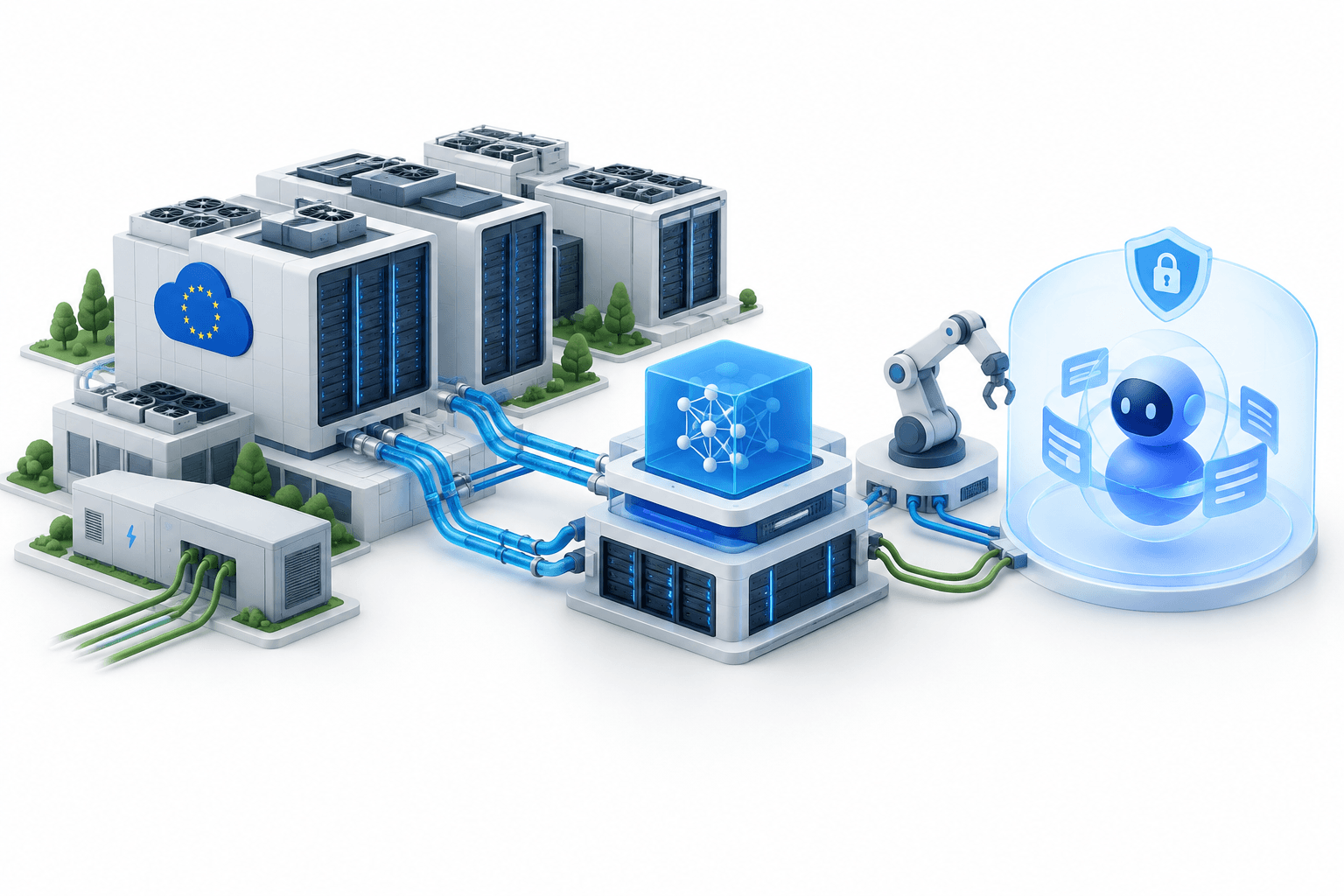
Connecting AI models to business tools creates a separate requirement from providing enough computing power: organizations need to define and enforce what agents may access and do. Announced at GTC Berlin, the OpenShell Reference Architecture is designed to address those boundaries across the deployment stack.
The architecture assigns distinct functions to its components. Vera Rubin NVL72 handles model inference; Vera CPUs with OpenShell support agent harnesses and tool use; and BlueField-4 DPUs running NVIDIA Sentry provide in-silicon enforcement. OpenShell secure runtime software forms the architecture’s foundation.
Supporters include cloud and model-service providers such as Baseten, CoreWeave, Crusoe, DigitalOcean, Fireworks, Nebius, Nscale and Vultr. The report describes ecosystem support intended to enable secure agent deployments, rather than documenting a completed rollout for every named partner.
Conclusion
The update connects regional computing investment with specific workloads and agent-access controls. Its strongest evidence lies in measured tests and services already in use; planned Vera Rubin deployments and broader OpenShell adoption represent the next stage rather than completed capacity.
Read More News
Disclaimer
This FinanceVelix article provides general information, not personalized financial, investment, legal, or tax advice. Market prices, interest rates and economic conditions can change; investments carry a risk of loss. Facts reflect the material available when published and may change. Check important information independently and consult a qualified professional when needed. Mentioning an asset, company, or service is not an endorsement.