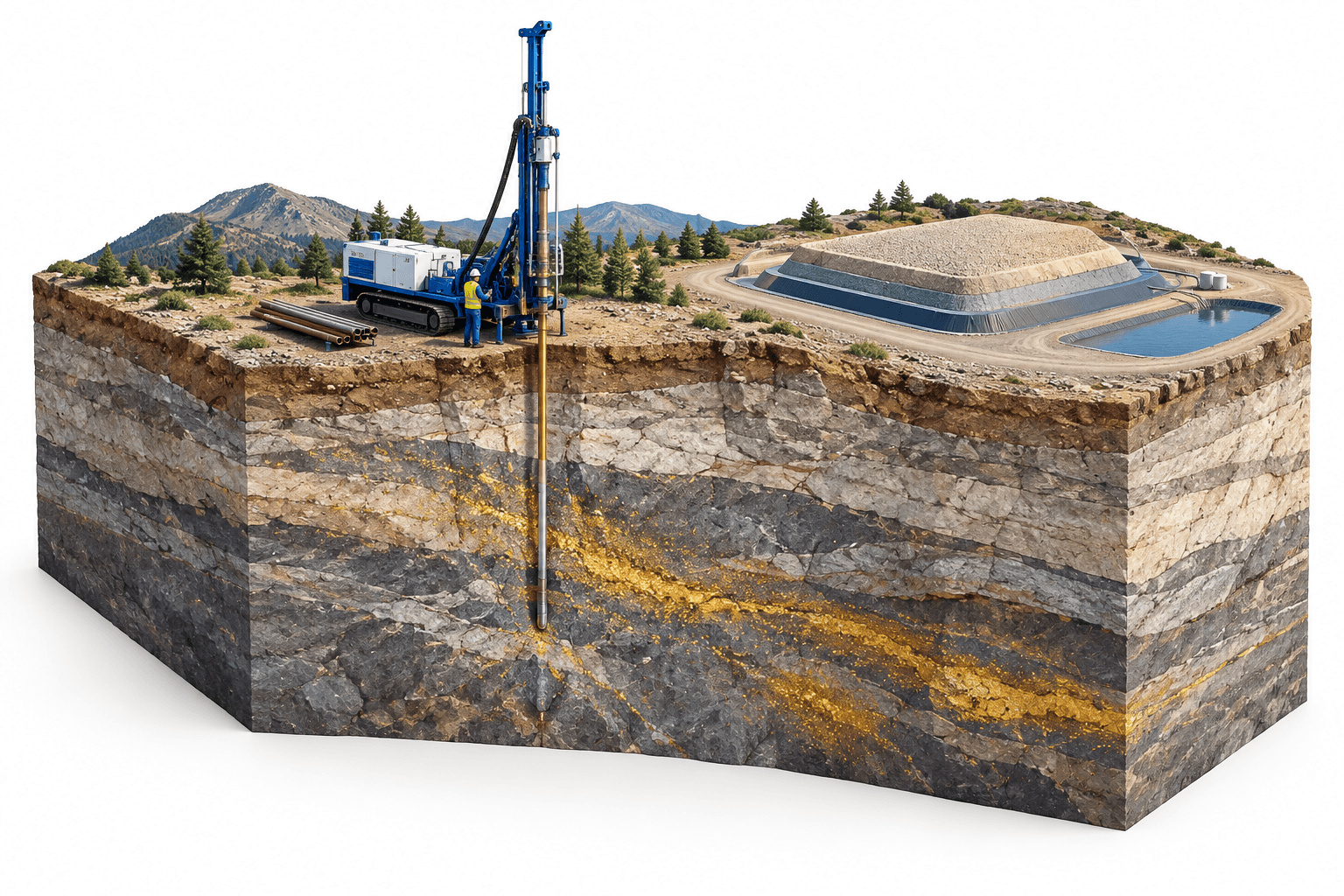
Black Pine drilling has outlined a northern extension of gold mineralization at Liberty Gold's Idaho project, providing new data for resource estimates and infrastructure design. The company released the initial results from its planned 50,000-metre 2026 reverse-circulation drilling campaign on October 22, 2026.
Key Takeaways
- Rangefront drilling defined a northern mineralized extension roughly 200 metres by 400 metres, with mineralization still open to the north.
- Liberty Gold targeted 25 million to 35 million tonnes of inferred material for a resource-classification upgrade; no completed upgrade was announced.
- Legacy rock storage drilling identified gold-bearing material, but its potential use as reserves or construction material remains under evaluation.
Table of Contents
- Black Pine drilling informs resource and infrastructure plans
- Selected gold intercepts show the scale of mineralization
- Stored rock requires further metallurgical evaluation
- Remaining campaign targets resource confidence
- Conclusion
Black Pine drilling informs resource and infrastructure plans
The Rangefront work completed 7,417 metres across 29 holes, with all assays received. Drilling extended mineralization beyond the feasibility resource boundary and established an eastern limit that will help guide detailed design of the proposed heap leach pad.
Liberty Gold's October 2026 drilling update describes work at spacing intended to support an Indicated resource classification. The company targeted approximately 25 million to 35 million tonnes of inferred material above the resource cutoff in the northern part of the existing resource shell.
The distinction matters: the assays provide inputs for a future resource estimate, rather than establishing that the targeted material has already been upgraded. Owen Nicholls, Liberty Gold's director of technical services, said the campaign was focused on areas that could affect design as Black Pine moves from feasibility work into detailed engineering.
| Item | Details |
|---|---|
| Rangefront — LBP1341A | 0.42 grams of gold per tonne over 62.5 metres. |
| Rangefront — LBP1347 | 0.36 grams of gold per tonne over 144.8 metres, including 1.27 grams per tonne over 18.3 metres. |
| Rangefront — LBP1293 | 0.30 grams of gold per tonne over 91.4 metres. |
| CD storage facility — BP26BF_CD039 | 0.86 grams of gold per tonne over 59.4 metres. |
| A storage facility — BP26BF_A029 | 0.29 grams of gold per tonne over 38.1 metres. |
Selected gold intercepts show the scale of mineralization
The results include broad mineralized intervals at Rangefront and gold-bearing material within the two principal Legacy Rock Storage facilities. Selected intercepts are shown in the table.
All lengths are reported as drilled intervals, not true thicknesses. Their geometry therefore needs to be considered alongside the reported gold grades when assessing the dimensions of the mineralization.
At Rangefront, cyanide-soluble gold relative to fire-assay gold, a ratio the company uses as an indicator of recovery performance, ranged from 61% to 98%. Liberty Gold said those readings were consistent with the zone's metallurgical characteristics.
Stored rock requires further metallurgical evaluation
The legacy rock storage program completed 2,848 metres in 73 holes across the CD and A facilities, which contain approximately 22.9 million tonnes and 7.9 million tonnes of material, respectively. Its objectives were to support an Indicated resource classification and assess metallurgical characteristics.
Results received so far showed gold grades above the current reserve cutoff, but that alone does not establish reserves. Detailed engineering will determine whether the material can enter the mine plan as reserves or serve as construction material for the new heap leach pad.
Metallurgical variability remains an issue to resolve. Cyanide-soluble-to-fire-assay ratios ranged from 8% to 98% across the facilities, prompting additional analytical work. All CD assays had been received; at the A facility, results from 14 holes were available and 16 remained pending.
Remaining campaign targets resource confidence
The remaining 2026 campaign includes drilling designed to support Measured resource classifications in the Discovery, J and Rangefront areas. Completion is weather-dependent.
Other planned work includes step-out drilling at F Zone and M Zone, further testing of Rangefront's western, southern and southeastern margins, and drilling for geotechnical and near-surface hydrological data needed for engineering and permitting.
Black Pine is wholly owned by Liberty Gold and is advancing through permitting toward a potential construction decision. The latest assays support that development work but do not represent a construction approval.
Conclusion
The next results to watch are the outstanding A facility assays and further releases from the ongoing drilling campaign. Resource classification and the proposed use of stored rock remain subject to additional estimation, metallurgical evaluation and engineering.
Read More News
Disclaimer
This FinanceVelix article provides general information, not personalized financial, investment, legal, or tax advice. Market prices, interest rates and economic conditions can change; investments carry a risk of loss. Facts reflect the material available when published and may change. Check important information independently and consult a qualified professional when needed. Mentioning an asset, company, or service is not an endorsement.