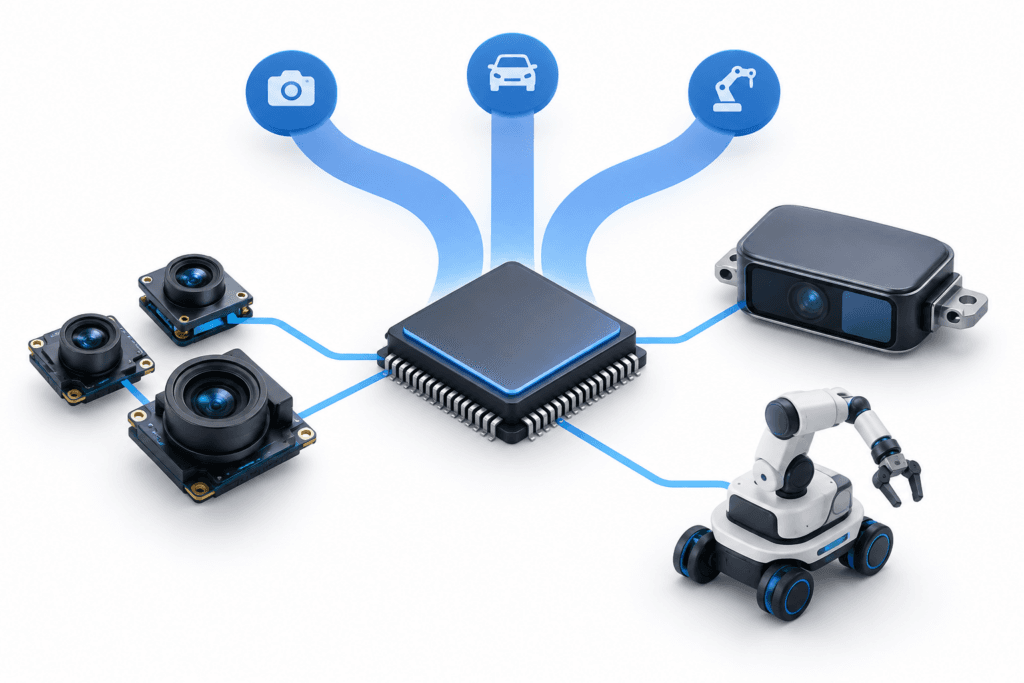
Samsung 8nm manufacturing technology is getting an upgrade aimed at automotive, robotics and edge AI chips. On October 20, 2026, the company’s foundry division announced its second-generation 8LPU+ platform, extending an existing process rather than moving these applications to its more advanced 2nm technology.
Key Takeaways
- The 8LPU+ platform targets automotive, robotics and edge AI applications.
- Samsung claims improvements in performance, power consumption and logic area over its predecessor.
- The update aims to make greater use of existing deep ultraviolet production lines.
Table of Contents
- Samsung 8nm upgrade emphasizes existing production lines
- Automotive offering already spans several process nodes
- Conclusion
Samsung 8nm upgrade emphasizes existing production lines
The 8LPU+ platform is intended to improve the capabilities of Samsung’s established 8nm technology while using existing deep ultraviolet, or DUV, manufacturing infrastructure. The approach aims to avoid the high equipment costs associated with extreme ultraviolet, or EUV, lithography.
Samsung is positioning the process for applications that do not require its most advanced 2nm technology. The practical distinction is between improving an established manufacturing platform and adopting a newer node: the announcement focuses on extracting more performance and efficiency from the former.
The stated improvements are process-level claims relative to the preceding platform, not reported operating results for customer products. The available announcement details do not specify a mass-production date or identify customers adopting 8LPU+.
| Item | Details |
|---|---|
| Performance | Claimed 12% increase over the preceding platform. |
| Power consumption | Claimed 15% reduction over the preceding platform. |
| Logic area | Claimed 8% reduction over the preceding platform. |
Automotive offering already spans several process nodes
Samsung’s automotive foundry capabilities already include 8nm manufacturing for in-vehicle infotainment and advanced driver-assistance applications. Its product documentation also describes other process nodes, showing that its automotive offering is not built around a single manufacturing technology.
That existing portfolio provides context for the 8LPU+ expansion, but the automotive documentation does not establish the new platform’s launch timing or claimed performance gains. Samsung separately describes 4nm and 2nm development for driver-assistance products requiring higher processing performance.
The distinction matters for evaluating the announcement: 8LPU+ broadens the role of an established process, rather than replacing Samsung’s work on more advanced automotive chips.
Conclusion
The 8LPU+ announcement extends Samsung’s established manufacturing technology into targeted automotive and industrial applications. Customer adoption and production timing remain the key implementation details to watch; neither is specified in the available announcement details.
Read More News
Disclaimer
This FinanceVelix article provides general information, not personalized financial, investment, legal, or tax advice. Market prices, interest rates and economic conditions can change; investments carry a risk of loss. Facts reflect the material available when published and may change. Check important information independently and consult a qualified professional when needed. Mentioning an asset, company, or service is not an endorsement.