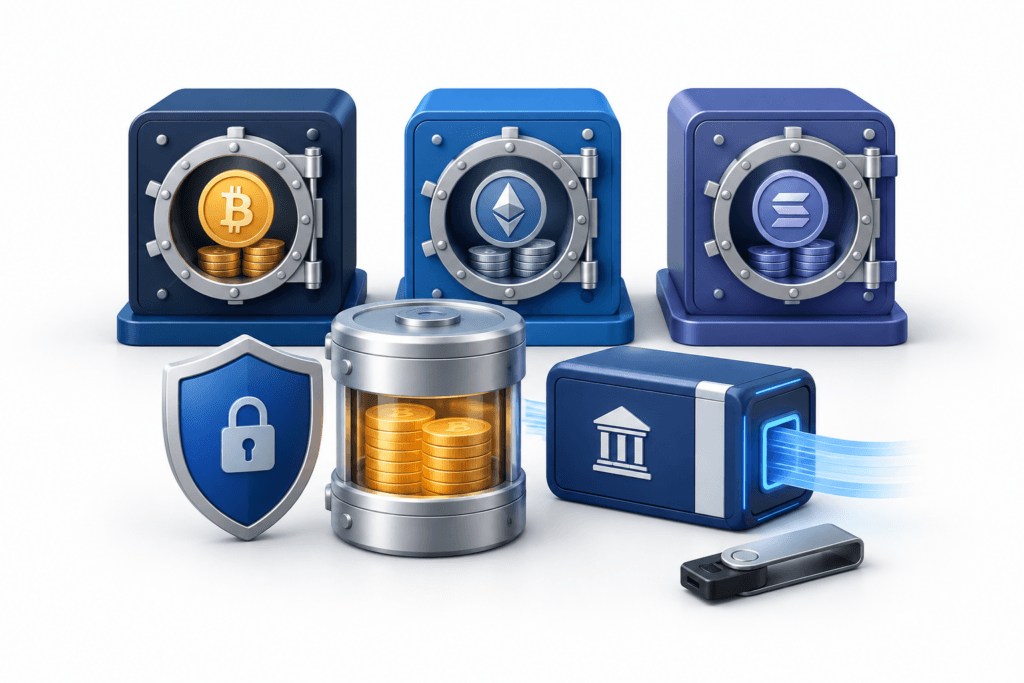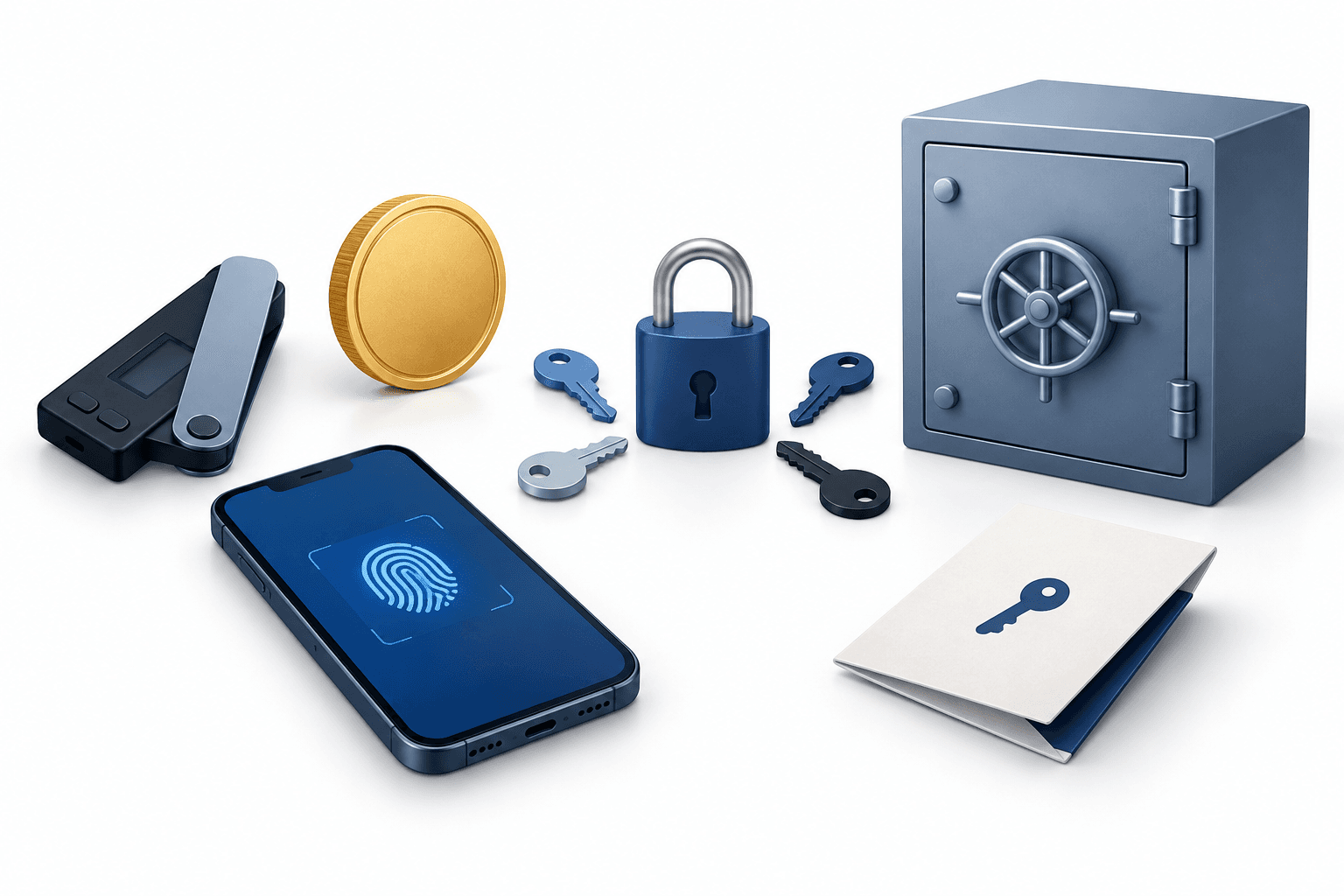
Bitcoin custody alternatives can reduce dependence on a hardware wallet, but they do not all preserve direct ownership or remove the possibility of losing access. The distinction for holders is whether an alternative changes who controls the keys, how transactions are approved, or what asset they actually own.
Key Takeaways
- Crypto ETFs replace direct coin ownership with shares, while centralized exchanges transfer private-key management to a company.
- Multisig reduces reliance on a single key, but signer availability, configuration and provider concentration remain important.
- Passkeys simplify access and paper wallets keep keys offline, yet both require careful attention to recovery and security.
Table of Contents
- Bitcoin custody starts with control, not convenience
- Multisig spreads authority but adds coordination
- ETFs and exchanges outsource different responsibilities
- Passkeys and paper move the recovery problem
- Conclusion
Bitcoin custody starts with control, not convenience
The alternatives address different parts of that problem. Multisig changes the authorization process. Passkey-based wallets change how users access accounts. Exchanges place key management with a company, while ETFs go further by replacing direct ownership with a financial product.
That makes the first decision more fundamental than choosing a device: does the holder need coins they can use onchain, or primarily financial exposure to the asset? A product that solves seed-phrase management may not preserve the same ownership rights or functionality.
| Item | Details |
|---|---|
| Crypto ETFs | Investors own shares rather than coins; custody, issuer exposure, fees and price deviations remain relevant. |
| Centralized exchanges | A company manages private keys; security, financial obligations and account-compliance requirements affect access. |
| Multisig wallets | Multiple approvals reduce reliance on one key; signer availability and secure configuration remain necessary. |
| Passkey-based wallets | Device credentials simplify access; backup and third-party recovery arrangements vary by design. |
| Paper wallets | Keys remain offline on paper, but generation, physical preservation and later spending can introduce risks. |
Multisig spreads authority but adds coordination
A multisignature wallet requires multiple keys to approve a transaction. In a common arrangement, any two of three signers must authorize a transfer. Losing or compromising a single key therefore does not, by itself, give an attacker the required approvals.
This is not necessarily a replacement for hardware wallets. Casa’s individual and family custody offering, for example, combines a hardware wallet, a mobile phone and a key held by Casa. The protection comes from distributing authority rather than eliminating every device.
The trade-off is operational complexity. Signers must remain available, and coordinating approvals across locations or time zones can delay transfers. Smart-contract multisig wallets can also carry code or configuration vulnerabilities; an attacker who compromises enough signers can still move funds.
Casa chief executive Nick Neuman said earlier in October that users should spread risk across providers even when using multisig. Multiple keys do not automatically mean that every source of dependence has been diversified.
ETFs and exchanges outsource different responsibilities
Crypto ETFs remove the need for investors to safeguard their own seed phrases or maintain wallet backups. But they are not technically a way to store personally owned coins: investors hold shares in a product whose crypto assets are held through a custodian, with a claim on net asset value in dollars rather than Bitcoin.
Ophelia Snyder said exchange-traded products can make sense for tax, estate-planning and security reasons. The costs include losing the ability to use the underlying crypto onchain, exposure to the issuer, custody arrangements, fees and possible differences between share prices and the asset’s market price.
Centralized exchanges instead take responsibility for private-key management within a crypto account. That can suit active trading or holders who do not want to manage recovery phrases, but it creates dependence on the company’s security and operations.
Proof-of-reserves reports do not establish an exchange’s complete financial health or its ability to meet every obligation. Access also depends on compliance: failing to provide required identity, residency or tax information can result in account restrictions or suspended withdrawals.
Passkeys and paper move the recovery problem
Passkeys use a cryptographic credential stored on a device, typically a phone, often protected by a fingerprint, face scan or PIN. They avoid a dedicated device for offline crypto-key storage and are more common on chains with smart contracts.
Coinbase Wallet’s Smart Wallet, Clave and Infinex are examples, with differing designs and recovery arrangements. Losing a device or passkey can still cause access problems. Users therefore need to understand backup procedures and whether recovery depends on a third party.
Paper wallets take a different approach: an address and its private key are printed on paper. Although the key stays offline, a compromised computer, malicious generator or weak randomness can expose it before printing. Paper can also be lost or damaged, and importing the key into an internet-connected wallet when spending can compromise its security.
Conclusion
Moving away from a hardware wallet changes the custody problem rather than ending it. The meaningful choice is between direct control, shared authorization and institutional dependence, with recovery arrangements and diversification determining how much damage a single failure can cause.
Read More News
Disclaimer
This FinanceVelix article provides general information, not personalized financial, investment, legal, or tax advice. Market prices, interest rates and economic conditions can change; investments carry a risk of loss. Facts reflect the material available when published and may change. Check important information independently and consult a qualified professional when needed. Mentioning an asset, company, or service is not an endorsement.