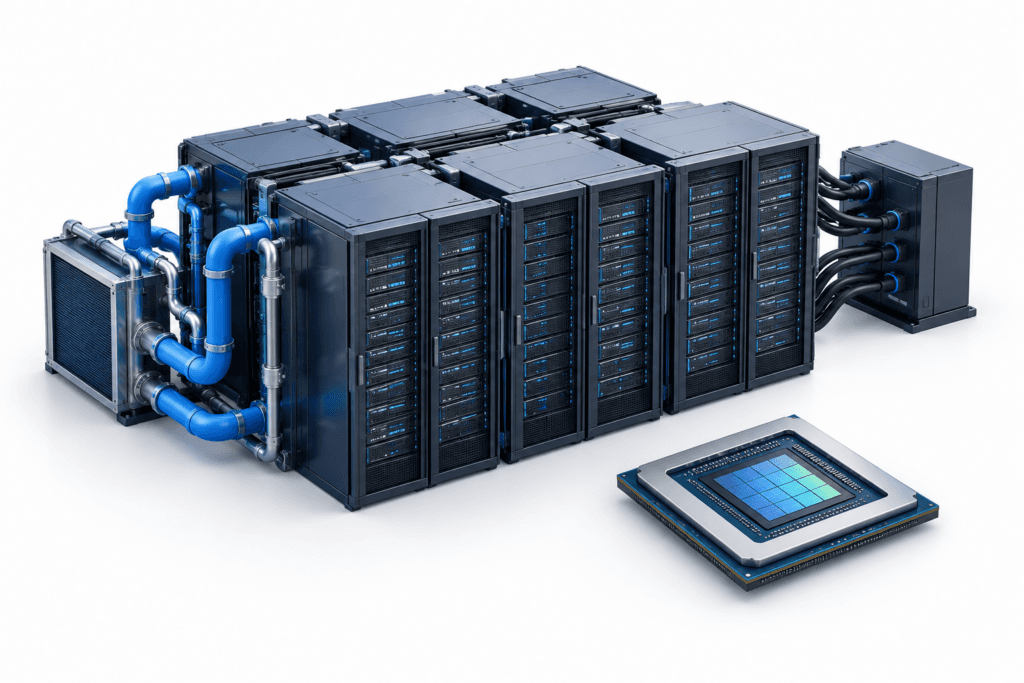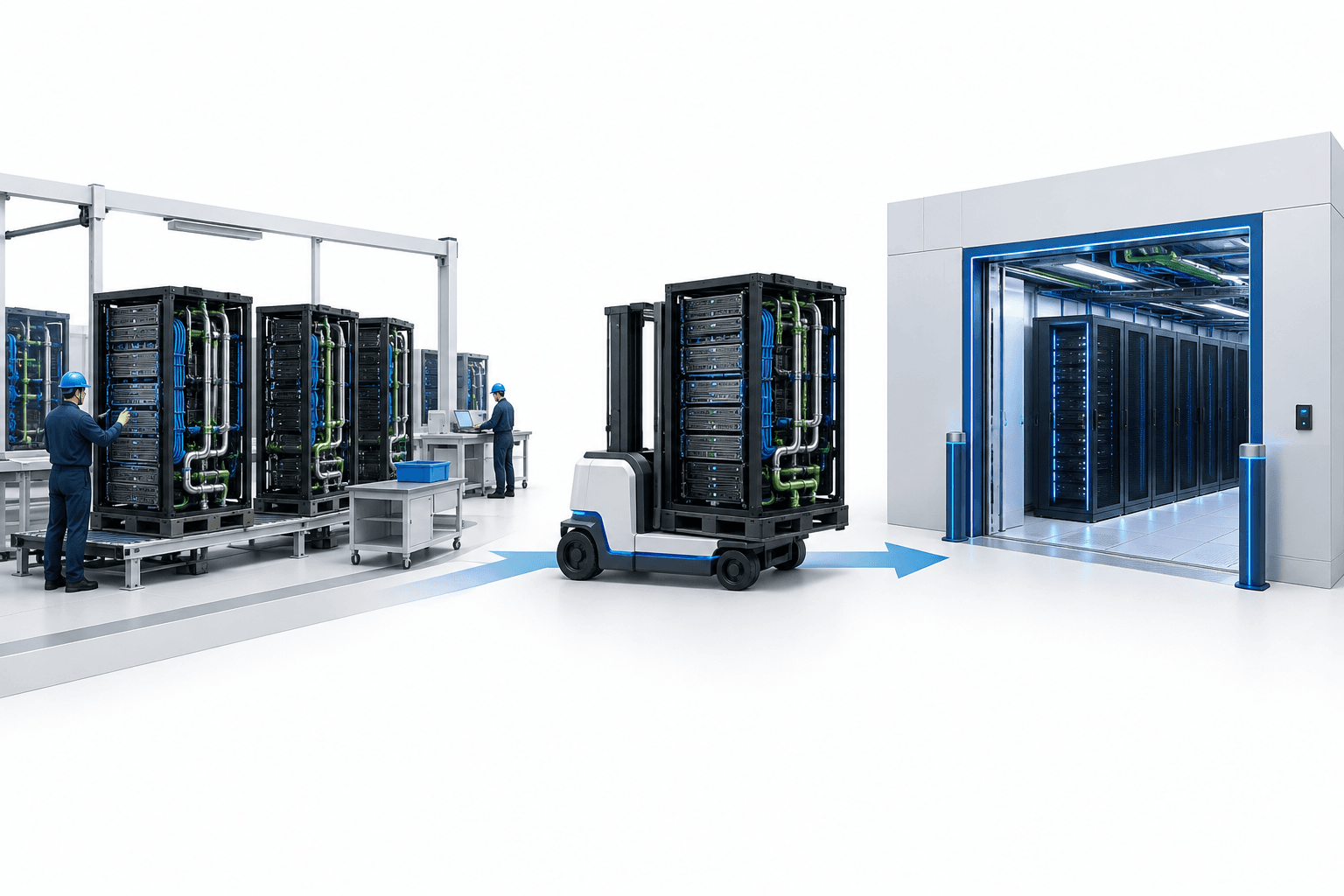
Nvidia DSX POD aims to shorten AI data center deployment from roughly six months to as little as 14 days by moving assembly and validation into factories. Introduced at GTC Berlin in October 2026, the modular reference design is intended for complete Vera Rubin AI factories. The timeline is a company claim, not a demonstrated result from the planned early-2027 deployments.
Key Takeaways
- Factory assembly would replace much of the integration work normally performed at the data center site.
- Nvidia says MaxLPS software could deliver the same token output using up to 30% less power.
- Cloud operators plan to adopt the technology, with initial deployments expected in early 2027.
Table of Contents
- Nvidia DSX POD moves integration off-site
- Power and cooling are part of the design
- Customers and delivery partners prepare for rollout
- Conclusion
Nvidia DSX POD moves integration off-site
The design brings compute, networking, cabling, rack power and liquid cooling together before equipment arrives at its destination. Instead of coordinating those systems primarily at a construction site, partners would assemble and validate them in a factory.
Nvidia says this approach could reduce on-site labor requirements, logistics problems and construction delays. The proposed change is therefore about how infrastructure is delivered, rather than simply making the processors inside it faster.
For customers, a shorter deployment period could bring forward the point at which installed computing capacity begins generating revenue. That benefit depends on whether actual deployments achieve the company's stated timeline.
| Item | Details |
|---|---|
| Computing platform | Vera Rubin AI factories |
| Deployment comparison | Roughly six months versus as little as 14 days, Nvidia says |
| Initial deployment window | Early 2027; planned, not completed |
Power and cooling are part of the design
Nvidia also says its MaxLPS software could use up to 30% less power to produce the same number of tokens. This is a claimed efficiency improvement, not a reported operating result from the upcoming installations.
The company says its cooling design could sharply reduce water use. As background, Nvidia's DSX facilities infrastructure reference design describes dry coolers that reject heat to ambient air without evaporative water use. That documentation explains the cooling approach; it does not establish water savings for a particular DSX POD installation.
Customers and delivery partners prepare for rollout
CoreWeave, Google Cloud, IREN, Nebius and Nscale are among the companies planning to use the technology. Dell, HPE, Eaton and Vertiv are among the partners helping deliver systems.
Those roles are distinct: planned users provide an adoption pipeline, while equipment and infrastructure partners support delivery. Neither a customer plan nor participation in the partner network establishes that an installation has been completed.
Conclusion
The next milestone is the planned early-2027 deployment window, when initial installations can begin testing whether factory integration delivers Nvidia's proposed reduction in deployment time.
Read More News
Disclaimer
This FinanceVelix article provides general information, not personalized financial, investment, legal, or tax advice. Market prices, interest rates and economic conditions can change; investments carry a risk of loss. Facts reflect the material available when published and may change. Check important information independently and consult a qualified professional when needed. Mentioning an asset, company, or service is not an endorsement.