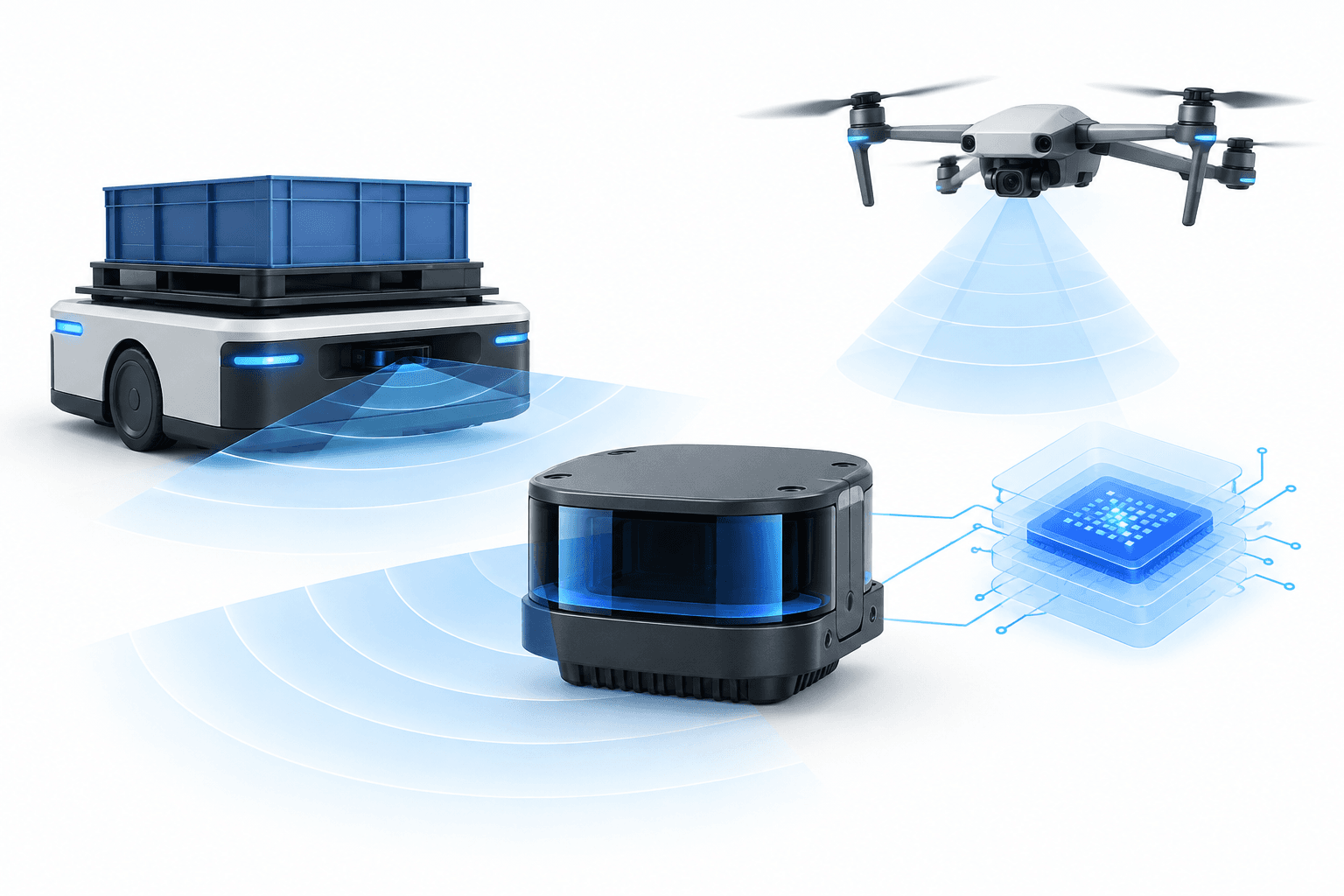
MicroVision announced on October 22, 2026, that it had begun commercial production and shipments of MOVIA Pro, its short-range lidar sensor with onboard perception software. The launch moves the product beyond prototype evaluation, with manufacturing underway in Orlando, Florida, and customer orders open.
Key Takeaways
- MicroVision says MOVIA Pro is in commercial production and sensors are shipping to meet customer demand.
- The device processes sensing data onboard, reducing reliance on separate computing hardware.
- The launch targets industrial automation, infrastructure and unmanned systems, but no order values or shipment volumes were disclosed.
Table of Contents
- MOVIA Pro moves from evaluation to production
- Onboard processing changes the integration task
- Industrial and unmanned systems are target markets
- Conclusion
MOVIA Pro moves from evaluation to production
MicroVision’s commercial production announcement establishes that the product is now being manufactured and shipped, rather than remaining a prototype. CEO Glen DeVos said customers were ready to move from evaluating prototypes to launching commercial programs.
“We’re thrilled to meet pent-up customer demand with this production launch of MOVIA Pro,” DeVos said. He identified the company’s Orlando facility as the manufacturing site.
The announcement did not identify customers, quantify demand or provide production capacity, pricing or expected revenue. It therefore marks a commercialization milestone without establishing the scale of the product’s financial contribution.
| Item | Details |
|---|---|
| Vehicle and equipment interface | CAN connectivity |
| Network interfaces | Gigabit and 100Mbit Ethernet |
| Industrial integration | Industrial-ready input/output and connectors |
| Software evolution | Capabilities and enhancements supported through software updates |
Onboard processing changes the integration task
MOVIA Pro is the production-ready version of MicroVision’s MOVIA S. Its integrated processing architecture allows perception software to run directly on the sensor, turning point-cloud data into object-level information that can be communicated to connected systems.
That approach reduces the need to send all sensing data to a separate computer for interpretation. MicroVision says combining sensing and perception is designed to reduce cabling, external hardware requirements and overall system complexity; the announcement did not quantify those potential savings.
The device also uses multi-echo sensing, which captures multiple returns from a single emitted pulse to help detect objects in challenging conditions. An open, Linux-based software framework lets customers develop, deploy and update applications on the device.
Industrial and unmanned systems are target markets
MicroVision is positioning the sensor for warehouse robots, automated guided vehicles and forklift driver-assistance systems, where obstacle detection and awareness of nearby people and equipment are important operating requirements.
Other intended uses include unmanned aerial navigation and mapping, traffic monitoring, infrastructure surveillance and security applications. The company also lists autonomous ground and marine systems, alongside selected automotive uses such as low-speed autonomy and blind-spot detection.
These are intended applications, not a list of confirmed customer deployments. MOVIA Pro joins MicroVision’s broader portfolio of short- and long-range lidar, airborne sensing and perception software.
Conclusion
With MOVIA Pro shipping and orders open, the next commercial step is customers’ progression into operating programs, as described by management. MicroVision has not provided a timetable or financial targets for that progression.
Read More News
Disclaimer
This FinanceVelix article provides general information, not personalized financial, investment, legal, or tax advice. Market prices, interest rates and economic conditions can change; investments carry a risk of loss. Facts reflect the material available when published and may change. Check important information independently and consult a qualified professional when needed. Mentioning an asset, company, or service is not an endorsement.