Eternal earnings commentary for the second quarter of fiscal 2027 set out a growth-first strategy: accelerate Blinkit’s store expansion, especially in smaller Indian cities, while reinvesting food-delivery operating gains rather than pushing percentage margins higher. In the October 21, 2026 update, CFO Akshant Goyal also described dark.ai as an early-stage experiment whose investment needs would depend on customer traction.
Key Takeaways
- Blinkit plans faster store additions, with most new expansion directed toward Tier 2 and Tier 3 cities.
- Food-delivery margins are expected to remain broadly flat over the next one to two years as Eternal reinvests in growth.
- Management views dark.ai as a limited-cost experiment for now, with larger infrastructure spending conditional on strong demand.
Table of Contents
- Eternal earnings put smaller-city expansion in focus
- Food delivery favors profit growth over higher margins
- Blinkit costs complicate the operating-leverage picture
- dark.ai remains an experiment, not a spending commitment
- Conclusion
Eternal earnings put smaller-city expansion in focus
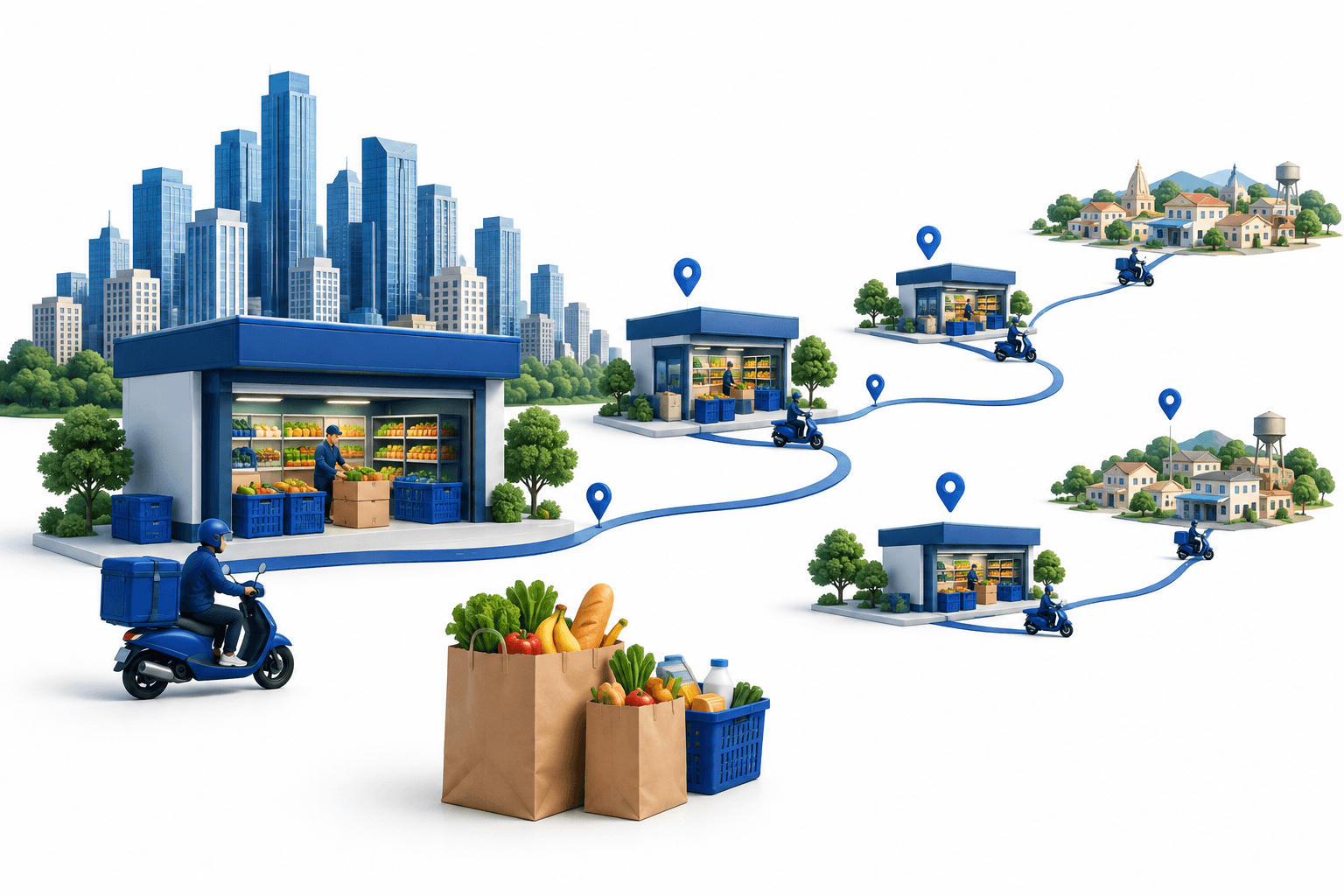
Goyal said strong store paybacks and lower competition in smaller cities support accelerating Blinkit’s expansion. The bulk of new stores will be in those markets, where management sees an opportunity to establish relationships with customers early.
The decision follows roughly 12 months of heightened quick-commerce competition. Goyal said that experience gave Eternal a clearer understanding of rivals’ strategies and the effect on its own business, making expected store paybacks more predictable.
Eternal’s customer accessibility and assortment goals emphasize reaching more consumers across locations and price points. Those stated priorities provide context for the smaller-city push, but the expansion decision rests on management’s assessment of store economics and competition.
Larger cities remain part of the growth opportunity. Goyal said customer acquisition, additional categories and a broader assortment continue to support growth in mature markets, with no plateau yet visible.
| Item | Details |
|---|---|
| Existing FY29 outlook | Management maintained its $1 billion EBITDA guidance and declined to elaborate further. |
| Quick-commerce indirect costs | Costs below contribution margin were growing 15%–20% quarter on quarter. |
| First-party inventory mix | About 90%–95% of SKUs were on a first-party basis; management expects no further incremental working-capital change from that transition. |
| Competitive landscape | Management described a quick-commerce market with five to seven players following new entrants. |
Food delivery favors profit growth over higher margins
Food-delivery competition increased during the quarter, partly because Zomato itself stepped up investment in customer acquisition and order frequency. Goyal said that spending trend is likely to continue.
Management’s priority is growth in absolute adjusted EBITDA rather than a higher percentage margin. Eternal intends to reinvest operating leverage into expanding the market while keeping food-delivery margins broadly stable over the next one to two years.
That distinction matters: a broadly unchanged margin does not necessarily mean unchanged profit. Management’s strategy is to grow the business while retaining a similar share of revenue as adjusted operating earnings, rather than maximizing the margin rate.
Blinkit costs complicate the operating-leverage picture
Quick-commerce contribution margin remained flat despite higher net order value per store. Larger stores and changes in business mix offset the operating leverage that rising store activity might otherwise have produced.
Goyal said many expenses below contribution margin also vary with the business, including technology costs. Some are denominated in dollars, and unfavorable exchange rates added pressure. He urged investors to focus on the overall adjusted EBITDA margin rather than contribution margin alone.
Management expects Blinkit’s year-on-year net order value growth to accelerate beginning in the December 2026 quarter. Goyal said faster store additions starting in fiscal Q3 were not expected to hurt margins in the short term, while longer-term margins should continue expanding. These are management expectations, not completed results.
dark.ai remains an experiment, not a spending commitment
Goyal said dark.ai sits within Eternal and has been under development for about a year. Its costs are booked in the other segment and are not yet meaningful; the product has also been piloted internally within Zomato for several months.
Management sees the possibility of a high-gross-margin business that could largely fund itself. Significant capital expenditure would depend on an exceptionally strong response requiring more GPUs and infrastructure.
Goyal also acknowledged that Eternal has no assured advantage in the emerging AI market. If dark.ai fails to gain traction, the company could discontinue it. The potential global opportunity therefore remains an uncertain ambition rather than an established earnings stream.
Conclusion
The next checkpoint is the December 2026 quarter, when management expects Blinkit’s year-on-year net order value growth to accelerate as store additions pick up. The central test for Eternal is whether that expansion can deliver growth without the near-term margin pressure management says it does not expect.
Read More News
Disclaimer
This FinanceVelix article provides general information, not personalized financial, investment, legal, or tax advice. Market prices, interest rates and economic conditions can change; investments carry a risk of loss. Facts reflect the material available when published and may change. Check important information independently and consult a qualified professional when needed. Mentioning an asset, company, or service is not an endorsement.