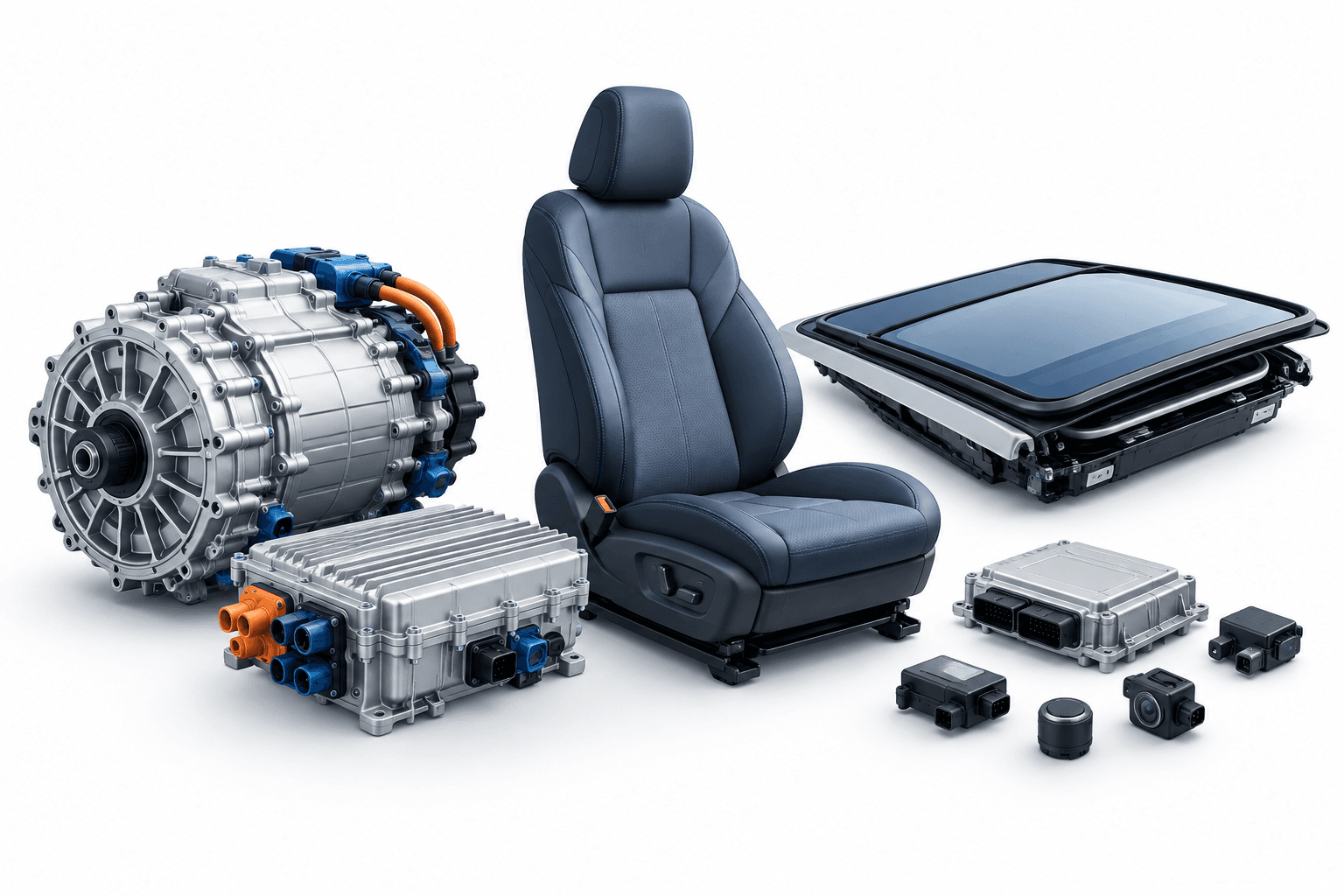
Uno Minda expansion plans outlined on October 21, 2026 centre on electric drives, complete passenger-car seating, sunroofs and advanced electronics, backed by ₹1,750 crore in planned FY27 capital expenditure. The strategy seeks to increase revenue earned from each vehicle. A revenue figure of up to ₹40,000 crore by FY30, compared with ₹19,700 crore in FY26, is a directional extrapolation rather than company guidance.
Key Takeaways
- Higher-value integrated systems are intended to lift revenue per vehicle, beyond growth in automobile production.
- New electric-drive and seating factories have planned start dates extending from FY27 into FY28.
- Project revenue potential is not a consolidated order book, while first-quarter margins were below FY27 guidance.
Table of Contents
- Uno Minda expansion focuses on more content per vehicle
- Factory schedules turn partnerships into production plans
- Customer programmes offer potential, not booked revenue
- Investment must translate into stronger profitability
- Conclusion
Uno Minda expansion focuses on more content per vehicle
Chairman Nirmal Minda’s strategy is to move beyond individual components toward complete, integrated systems. That would allow Uno Minda to earn more from each vehicle even without an equivalent increase in vehicle production.
Minda identified demand for alloy wheels, ambient lighting, sunroofs, advanced driver-assistance systems and infotainment as opportunities. The portfolio also spans conventional engines, electric and hybrid vehicles, and alternative fuels such as CNG and hydrogen.
Brokerage projections put FY27 revenue at ₹23,000–₹23,500 crore, up 17–19% from FY26. Those forecasts are separate from management guidance, and the longer-term ₹40,000 crore figure should not be read as a formal company commitment.
| Item | Details |
|---|---|
| FY27 growth capital expenditure | ₹1,100 crore planned |
| FY27 sustaining capital expenditure | ₹650 crore planned |
| September project approvals | ₹1,415 crore for projects extending into FY29 |
| Partner-related allocations within September approvals | ₹670 crore for Toyoda Gosei and ₹80 crore for Kyoraku |
Factory schedules turn partnerships into production plans
A proposed 70:30 venture with China’s Inovance would manufacture electric-drive systems, including motors and inverters, at Khed near Pune. Operations are scheduled to begin in the second half of FY27. Chinese regulatory approval remained pending at the August investor call.
A separate ₹550 crore plant in Chhatrapati Sambhajinagar, also covering hybrid transmissions, targets production in the second quarter of FY28. These are planned operating dates, not confirmation that production has started.
Uno Minda’s 51%-owned venture with Japan’s Tachi-S is investing ₹320 crore in complete passenger-car seating, with production targeted for the fourth quarter of FY28. Management estimates complete-seat content at ₹30,000–₹40,000 per vehicle, substantially above the value of individual seating mechanisms.
The partnership has an established seating focus: Tachi-S’s January 2025 description of its Indian seating collaboration identified Uno Minda as its Indian joint-venture partner and described efforts to expand automotive seat business and parts orders. That earlier disclosure provides background on the relationship, rather than verification of the latest investment or production targets.
Customer programmes offer potential, not booked revenue
Selected customer programmes have estimated annual peak revenue potential of ₹450 crore in two-wheeler lighting, ₹390 crore in commercial-vehicle seating exports, ₹200 crore in displays and more than ₹500 crore in sunroofs. Their ramp-up schedules differ, so the figures are not a consolidated order book or revenue expected in a single year.
Other wins include four-wheeler lighting for a global automaker, an Indonesian lighting customer, three export seating customers and another EV-charger customer. Minda said exports were gaining traction in lighting, commercial-vehicle seating and specialised electronics.
Denso supports infotainment, including an Android-based programme with estimated annual peak revenue potential of ₹600 crore. Sales from that venture are not consolidated into Uno Minda’s revenue; Uno Minda recognises its share of profits instead. This distinction matters when comparing programme opportunities with consolidated revenue projections.
Investment must translate into stronger profitability
The FY27 spending plan combines capacity expansion with maintenance of existing operations. Separate September approvals cover projects extending into FY29, meaning the investment programme stretches beyond the current fiscal year.
First-quarter EBITDA margin was 10.3%, below the FY27 guidance range of 10.5–11.5%. Minda said the company consistently allocates around 4% of revenue to research and development, alongside its technology partnerships.
CAFE III, proposed BS7 standards and phased TREM regulations could create demand for advanced components. Uno Minda has not quantified regulation-specific orders, so that potential should remain distinct from confirmed customer programmes.
Conclusion
The next scheduled milestone in Uno Minda expansion is the planned Khed electric-drive start in the second half of FY27. Regulatory approval, factory commissioning and progress toward the FY27 margin range will show how the investment programme is translating into operations.
Read More News
Disclaimer
This FinanceVelix article provides general information, not personalized financial, investment, legal, or tax advice. Market prices, interest rates and economic conditions can change; investments carry a risk of loss. Facts reflect the material available when published and may change. Check important information independently and consult a qualified professional when needed. Mentioning an asset, company, or service is not an endorsement.