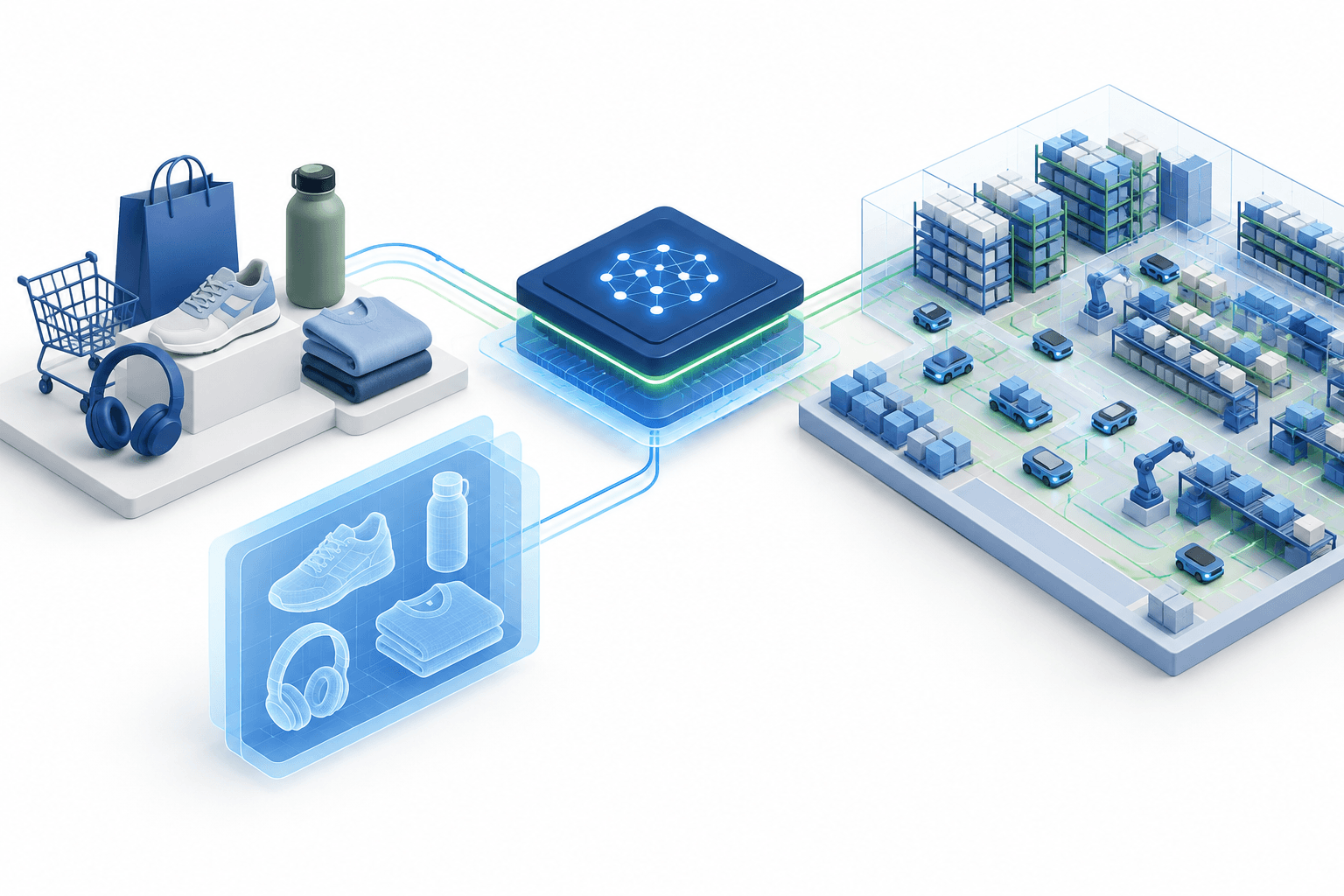
On October 22, NVIDIA detailed European retail AI projects involving model serving costs, product discovery and warehouse planning. Shopify’s internal benchmark showed a 90% reduction in serving costs for a customized model, while Otto Group expanded its simulation-based warehouse initiative to its largest fulfillment center in Germany.
Key Takeaways
- Shopify reported higher accuracy, 90% lower serving costs and sevenfold faster responses for a post-trained model on its internal benchmark.
- Retail applications range from a Zooplus search prototype to deployed image editing and physics-based virtual try-on.
- Otto Group expanded warehouse simulation capabilities, while three NVIDIA retail blueprints remain in early access.
Table of Contents
- European retail AI puts customized models to work
- Search and product imagery show different deployment stages
- Catalog processing and ingredient research broaden adoption
- Simulation reaches warehouses and virtual fitting
- Three retail blueprints remain in early access
European retail AI puts customized models to work
Shopify’s results center on a GraphQL subagent within Sidekick, its AI assistant for merchants. The company post-trained NVIDIA Nemotron 3.5 Lightning using tools including Megatron Bridge and NeMo RL. The subagent retrieves store data for features such as Sidekick Pulse, which researches a merchant’s business and recommends improvements.
On Shopify’s internal benchmark, the customized model exceeded an unnamed leading frontier model in accuracy, cut serving costs by 90% and returned responses seven times faster, NVIDIA said. Those results apply to the benchmark rather than establishing performance across all merchant tasks.
Separately, NVIDIA CCluster vLLM inference optimization software helped Shopify achieve 4.5 times faster performance and up to 12 times lower inference costs across five other uses: catalog enrichment, merchant assistance, shopping simulation, product classification and recommendations.
Search and product imagery show different deployment stages
Zooplus worked with Infosys and NVIDIA technologies to rebuild product discovery. A production-ready prototype deployed within the pet retailer’s Amazon Web Services environment achieved 86% search accuracy. It uses the Nemotron Retriever library for semantic search and NVIDIA’s retail catalog enrichment blueprint to generate searchable product attributes.
At Vestiaire Collective, Photoroom’s Image Editing API now standardizes every primary listing image, processing about 40,000 daily across 70 countries. NVIDIA reported that processed listings had a 5% higher liquidity rate and 3% to 7% more unique product-page views. The pipeline runs on NVIDIA GPUs using TensorRT and Triton Inference Server.
Omi launched ProductDrop to tie generated imagery to approved digital twins and avoid product errors across catalogs. L’Oréal is using that approach in its CreAItech program. Omi’s TRELLIS 3D asset generation runs on RTX PRO 6000 Blackwell Server Edition GPUs, with reported tenfold faster inference and a fourfold reduction in pipeline latency.
Catalog processing and ingredient research broaden adoption
Mirakl’s Catalog Transformer has onboarded more than 70 million products, combining fine-tuned open models with proprietary services to organize vendor data. Mirakl runs models on NVIDIA GPUs on its own infrastructure and through European cloud providers such as Scaleway.
L’Oréal is also integrating NVIDIA ALCHEMI into ingredient research, with a reported shift from months of experimentation to hours of computational screening. It is testing a related approach through Orbital Industries’ CurieOS using the open-source OrbMol-v2 molecular simulation model.
Integrated with the ALCHEMI Toolkit, OrbMol-v2 is reported to run five times faster than comparable models with 21% lower error than the next-best model of its kind. The workflow identifies promising ingredient combinations for solubilizing UV filters before laboratory testing.
Simulation reaches warehouses and virtual fitting
Otto Group advanced its human-supervised autonomous warehouse initiative to its largest fulfillment center in Haldensleben, Germany. Built with Reply using NVIDIA Omniverse libraries and running on Google Cloud, the system lets logistics teams design, test and optimize operations in simulation before physical implementation.
ALLSIDES launched an automated 3D Digital Twin Factory that converts physical objects into simulation-ready assets in minutes. The company reports sub-millimeter geometric accuracy, measured physical properties and relightable materials. Its platform already serves brands including adidas, Amazon, Nike, Zalando and Zara.
In virtual fitting, CATCHES reported that its RealFit deployment with AMIRI lifted conversion by 55%, add-to-cart activity by 80% and gross sales by 56%, after seasonal adjustment against like-for-like styles. CATCHES also launched PredictiveFit for retailers and CASI, a WhatsApp fashion agent for shopping, styling and sizing.
Three retail blueprints remain in early access
At GTC Berlin, Nebius is showcasing three NVIDIA retail blueprints running on its infrastructure. All are available in early access, rather than described as generally available products.
Agent Harness for Employee Productivity combines scheduling, task management, inventory alerts and operational insights. Inventory Simulation and Optimization models demand and replenishment strategies before real-world commitments. Agentic Finetuning Flywheel links training-data generation, open-source model fine-tuning and real-world performance feedback.
Read More News
Disclaimer
This FinanceVelix article provides general information, not personalized financial, investment, legal, or tax advice. Market prices, interest rates and economic conditions can change; investments carry a risk of loss. Facts reflect the material available when published and may change. Check important information independently and consult a qualified professional when needed. Mentioning an asset, company, or service is not an endorsement.