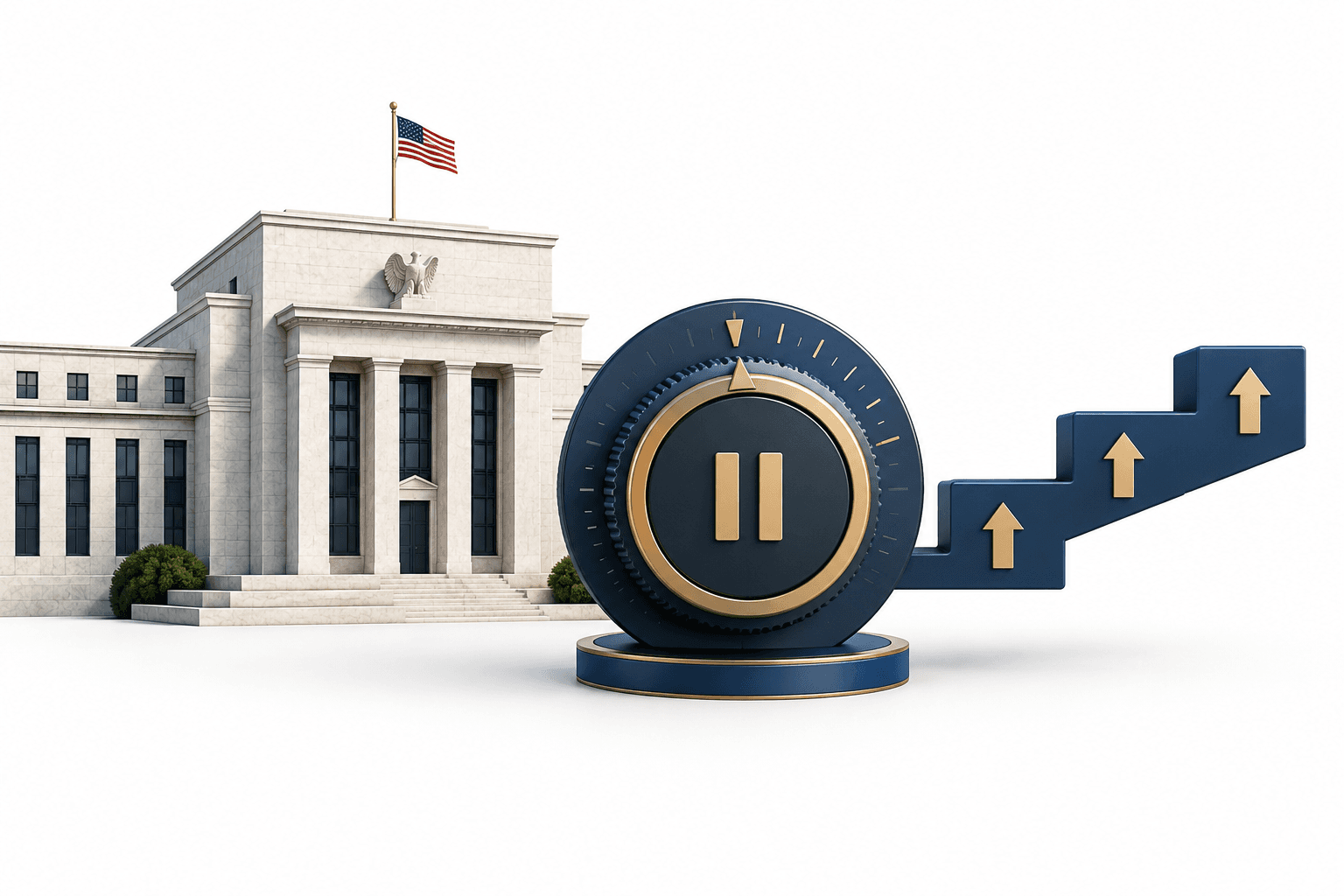
The Fed rate outlook from Deutsche Bank points to a pause in October 2026, not an end to tightening. In an assessment dated October 23, analysts led by chief U.S. economist Matthew Luzzetti expect Federal Reserve Chair Kevin Warsh to keep further increases on the table, with inflation still persistent and economic activity holding up.
Key Takeaways
- Deutsche Bank expects an October hold followed by quarter-point increases in December and March.
- The bank expects Warsh to argue that tighter financial conditions do not necessarily replace further rate increases.
- September Fed projections provide policy context, but they are individual assessments rather than commitments.
Table of Contents
- Fed rate outlook separates a pause from an end to hikes
- Inflation and financial conditions shape the expected message
- September projections provide context, not a promise
- Conclusion
Fed rate outlook separates a pause from an end to hikes
Deutsche Bank forecasts another 50 basis points of tightening: 25 basis points in December 2026 and a further 25 in March 2027. That is the bank’s forecast, not an announced Federal Reserve decision.
The analysts expect Warsh to use his post-meeting press conference to emphasize that recent data have done little to resolve concerns about persistent inflation. An unchanged rate in October would therefore be compatible with a message that additional tightening may still be necessary.
The distinction matters when interpreting the decision: holding rates steady for one meeting would not, by itself, establish that the Fed had reached the end of its tightening cycle.
| Item | Details |
|---|---|
| 2026 GDP growth | September Fed median projection: 2.3%, measured fourth quarter over fourth quarter. |
| 2026 unemployment | September Fed median projection: 4.1%, averaged over the fourth quarter. |
| 2026 headline PCE inflation | September Fed median projection: 3.7%, measured fourth quarter over fourth quarter. |
| 2026 core PCE inflation | September Fed median projection: 3.4%, measured fourth quarter over fourth quarter; distinct from the September monthly estimate. |
Inflation and financial conditions shape the expected message
The assessment puts expected September core personal consumption expenditures inflation at around 3.1%–3.2% year over year. That remains an estimate rather than a released result. Deutsche Bank also points to stronger-than-expected consumer-price data, expected solid third-quarter growth and relatively stable labor-market conditions.
A central question is whether Warsh continues to describe overall financial conditions as accommodative. Deutsche Bank expects him to acknowledge recent tightening in those conditions while resisting the argument that it removes the need for further policy-rate increases.
Artificial intelligence could also feature in the discussion. The bank expects Warsh may distinguish between potential longer-term productivity gains that could reduce inflation and near-term investment and demand that could add to price pressures. Those are anticipated remarks, not statements already delivered at the October meeting.
September projections provide context, not a promise
The Fed’s September 2026 economic projections show how officials assessed the outlook at their September 15–16 meeting. Each participant based the projections on an individual assessment of appropriate monetary policy, rather than a binding committee agreement about future decisions.
For the end of 2026, 12 participants projected a federal funds rate midpoint of 4.125%, four projected 4.375% and two projected 3.875%. The distribution illustrates the range of views entering the autumn meetings; it does not settle the October decision or validate Deutsche Bank’s December and March forecasts.
Conclusion
The next policy checkpoint is the October 2026 meeting and Warsh’s post-meeting press conference. The key distinction will be between the immediate rate decision and any signal about further tightening; Deutsche Bank expects a pause without a declaration that the inflation fight is over.
Read More News
Disclaimer
This FinanceVelix article provides general information, not personalized financial, investment, legal, or tax advice. Market prices, interest rates and economic conditions can change; investments carry a risk of loss. Facts reflect the material available when published and may change. Check important information independently and consult a qualified professional when needed. Mentioning an asset, company, or service is not an endorsement.