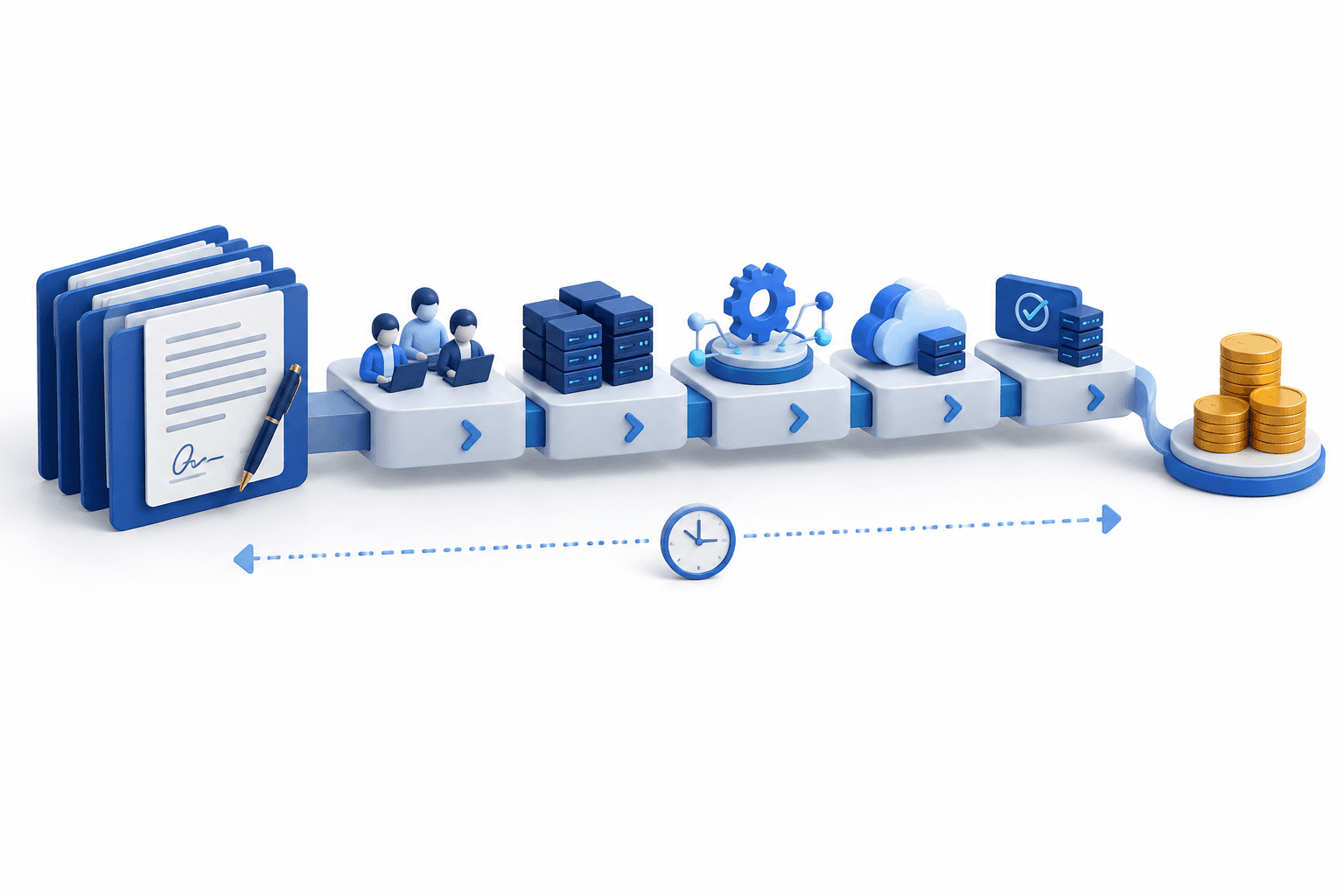
Indian IT bookings remained substantial in the second quarter of fiscal 2027, but new contracts are taking time to translate into revenue. Results available as of October 25, 2026, showed stronger deal values at HCLTech and Infosys and a broadly steady order book at TCS, while Wipro and Tech Mahindra reported sequential declines. Longer implementation cycles and clients’ emphasis on cost savings are limiting the immediate revenue benefit.
Key Takeaways
- Deal momentum varied across the five major firms rather than improving uniformly.
- Longer, outcome-based contracts can spread revenue recognition over several years.
- Wipro expects delayed contract signings in Q3, but its revenue guidance remains cautious.
Table of Contents
- Indian IT bookings show an uneven quarter
- Why contract wins do not immediately become revenue
- Management confidence meets a cautious near-term outlook
- Conclusion
Indian IT bookings show an uneven quarter
HCLTech, TCS and Infosys each reported higher contract values than in the preceding quarter. Infosys’s large-deal total included a contract worth more than $2 billion, and 62% of its $5.2 billion in large-deal wins represented net new business.
Wipro moved in the opposite direction, with both total and large-deal bookings falling sharply in constant-currency terms. Tech Mahindra’s quarterly contract value also slipped, although its trailing 12-month deal wins rose 34.8% year over year to $4.27 billion.
The measures describe different scopes: Infosys reports large-deal wins, HCLTech reports new-deal contract value, and Wipro reports total bookings as well as large deals. They should not be read as identical measures of new demand.
| Item | Details |
|---|---|
| HCLTech | Q2 FY27 new-deal TCV: $3.25 billion, versus $2.4 billion in Q1. |
| TCS | Q2 order-book TCV: $9.6 billion, versus $9.5 billion in the previous quarter. |
| Infosys | Q2 large-deal TCV: $5.2 billion, versus $3.6 billion in the previous quarter. |
| Wipro | Q2 total bookings: $2.595 billion, down 22.9% sequentially in constant currency; large-deal bookings: $674 million, down 58.6%. |
| Tech Mahindra | Q2 TCV: $1.023 billion, versus $1.078 billion in Q1. |
Why contract wins do not immediately become revenue
Bookings measure contracted work, not revenue earned during the quarter. Wipro’s bookings definition explains that its total includes new orders, renewals and increases to existing contracts, with revenue accruing over the contracts’ duration. A large signing can therefore strengthen future business without producing a comparable near-term revenue increase.
Gartner senior principal analyst Biswajit Maity said many large programs remain in their early implementation stages. Demand continues to focus on cost optimisation, modernisation, managed services and AI-led transformation, but the commercial structure of those engagements is changing.
Enterprises are increasingly choosing outcome-based and AI-enabled contracts rather than traditional labour-based agreements, Maity said. Revenue may consequently depend on business outcomes, platform adoption or AI usage, extending the period over which a deal pays off.
Praveen Bhadada, CEO and managing director of Neovay Global, also highlighted the conversion challenge. He said large deals now often run for five to ten years, focus on vendor consolidation and cost reduction, and pass AI productivity savings back to clients.
Management confidence meets a cautious near-term outlook
TCS CEO and managing director K Krithivasan said its deal value, pipeline and client conversations supported confidence in sustaining growth momentum over the medium term. That assessment concerns future performance, rather than revenue already delivered.
Wipro CEO and managing director Srini Pallia said two contracts could not be signed before Q2 ended and were pushed into the current quarter. He expected both to be signed and said the broader Q3 pipeline could provide revenue upside in Q4. Those signings and benefits remain management expectations, not completed outcomes.
Wipro’s announced outlook for the quarter ending December 31, 2026, puts IT services revenue at $2.571 billion to $2.625 billion, equivalent to a sequential decline of 1.5% through growth of 0.5% in constant currency. Its September-quarter IT services revenue was flat sequentially on that basis, illustrating the gap between a deal pipeline and immediate growth.
Conclusion
The next reporting period to watch is the quarter ending December 31, 2026. Wipro’s results will show how revenue compares with its announced range, while any updates on delayed signings will help distinguish pipeline confidence from completed business.
Read More News
Disclaimer
This FinanceVelix article provides general information, not personalized financial, investment, legal, or tax advice. Market prices, interest rates and economic conditions can change; investments carry a risk of loss. Facts reflect the material available when published and may change. Check important information independently and consult a qualified professional when needed. Mentioning an asset, company, or service is not an endorsement.