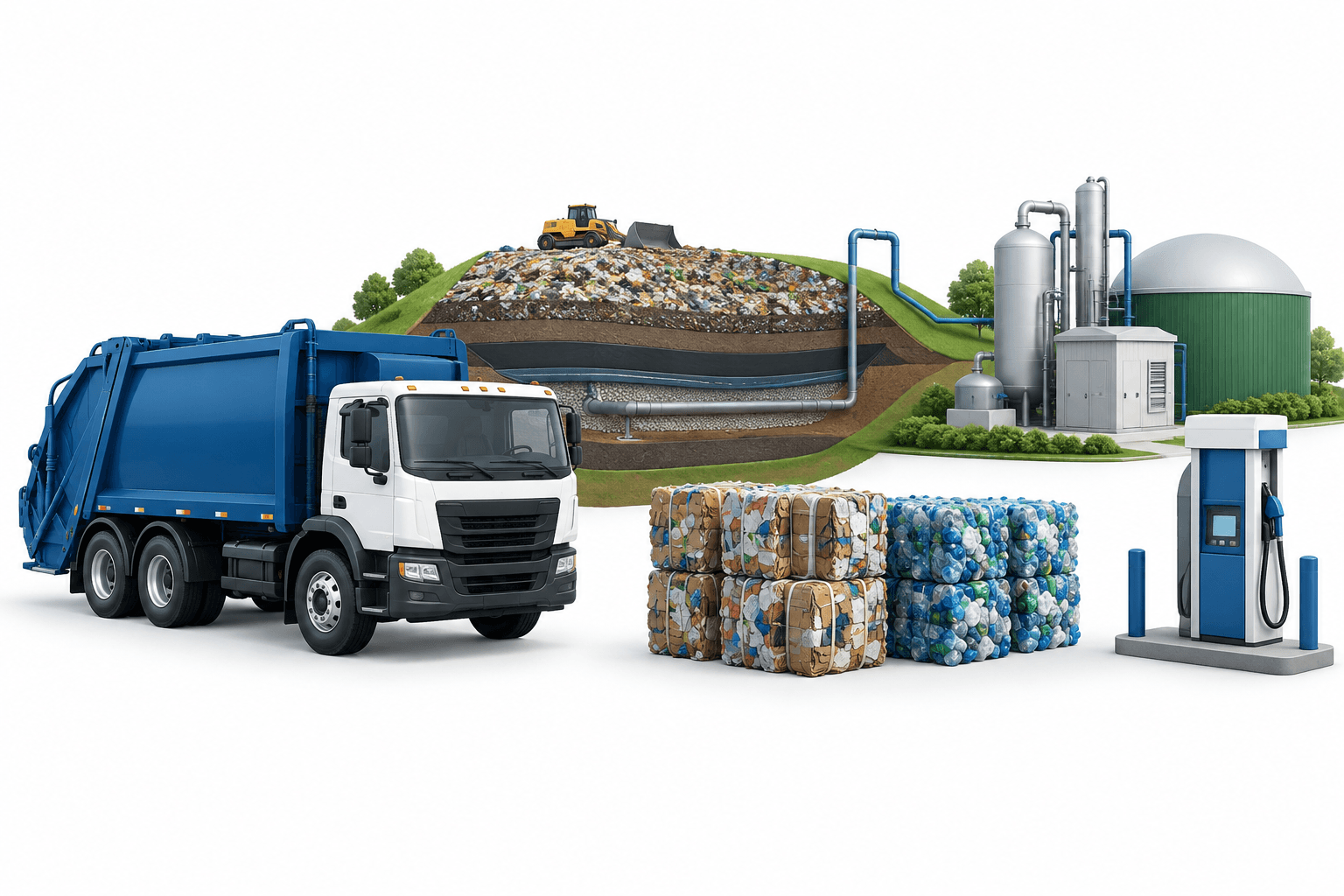
Waste Connections earnings increased in the third quarter of 2026 as higher pricing and improving landfill activity helped offset rising diesel costs. In results released on October 21, the waste-services company reported revenue of $2.638 billion, up 7.3% from a year earlier, and raised its full-year revenue and adjusted profit outlook for the second time in 2026.
Key Takeaways
- Adjusted EBITDA rose 7.9% to $895.8 million despite a roughly 30-basis-point fuel drag on margins.
- Landfill tonnage increased, but overall solid waste unit volumes remained below year-earlier levels.
- Management raised annual guidance while the board authorized a 10% quarterly dividend increase.
Table of Contents
- Waste Connections earnings grow faster than revenue
- Pricing offsets weaker collection volumes
- Higher annual targets come with clear assumptions
- Dividend and buybacks accompany selective acquisitions
- Conclusion
Waste Connections earnings grow faster than revenue
Waste Connections’ third-quarter results announcement showed net income of $359.2 million, or $1.43 per diluted share, compared with $286.3 million, or $1.11 per share, a year earlier. Adjusted diluted earnings increased to $1.58 from $1.44.
Adjusted earnings before interest, taxes, depreciation and amortization, or EBITDA, reached $895.8 million, compared with $830.3 million in the prior-year quarter. Its margin widened by 20 basis points to 34.0%. Management said underlying margin expansion was 50 basis points before the impact of higher fuel costs.
The adjusted measures are non-GAAP figures that primarily exclude impairments and acquisition-related items. The reported profit comparison also benefited from lower charges: the year-earlier quarter included $63.5 million primarily associated with write-downs, an environmental liability and transaction-related expenses.
| Item | Details |
|---|---|
| 2026 net income guidance | Approximately $1.18 billion |
| 2026 capital expenditure guidance | Approximately $1.25 billion |
| 2026 operating cash-flow guidance | $2.64 billion–$2.69 billion |
| 2026 adjusted free-cash-flow guidance | $1.40 billion–$1.45 billion; non-GAAP measure |
Pricing offsets weaker collection volumes
Core solid waste pricing increased 5.5%, while same-store yield rose 4.3%. The measures capture different effects: core pricing tracks increases net of rollbacks, while yield also reflects customer churn, new business and service mix.
Solid waste unit volumes declined 1.2% year over year, an improvement of 70 basis points from the second quarter. Collection activity remained uneven, with roll-off pulls down about 2.5%, although rates per pull increased 5.5%.
Disposal activity was stronger. Landfill tonnage rose 3%, including increases of 7% in special waste and 5% in construction and demolition waste. All three major waste categories—municipal solid waste, construction and demolition, and special waste—recorded year-over-year tonnage growth for the first time in two years.
Commodity-linked businesses also contributed. Recycling revenue increased about 12%, supported by higher old corrugated cardboard values, while landfill gas sales rose 35% on new renewable natural gas facilities and higher renewable fuel credit values. Those gains helped broaden growth beyond collection pricing.
Higher annual targets come with clear assumptions
Waste Connections now expects approximately $10.09 billion in 2026 revenue and $3.345 billion in adjusted EBITDA. The outlook assumes no change in the current economic environment or underlying economic trends and excludes additional acquisitions that may close during the year.
Adjusted free cash flow was about $1.09 billion year to date. Management’s annual cash-flow and spending targets provide a separate benchmark from adjusted operating profit.
The 2027 framework remains preliminary
On the October 22 earnings call, management outlined preliminary expectations for mid- to high-single-digit revenue growth in 2027, normalized adjusted EBITDA margin expansion and double-digit growth in adjusted free cash flow per share.
Management described 20–40 basis points, excluding fuel effects, as the appropriate range for underlying margin expansion. It continued to view fuel as a potential headwind rather than assuming diesel costs would normalize. The framework did not include incremental benefits from the company’s major artificial-intelligence initiatives.
Dividend and buybacks accompany selective acquisitions
The board authorized a 10% increase in the regular quarterly cash dividend, marking the company’s 16th consecutive double-digit annual increase. Waste Connections also announced year-to-date share repurchases exceeding $1 billion, representing 2.5% of outstanding shares.
Completed acquisitions represented approximately $130 million in annualized revenue, including two West Coast collection franchises closed during the third quarter. That figure describes the acquired businesses’ annual revenue base, not the purchase price or revenue already recognized.
Chief Executive Ronald Mittelstaedt said the slower acquisition pace reflected buying discipline rather than a shift away from acquisitions toward repurchases. Management reported leverage of about 2.75 times debt to adjusted EBITDA and more than $1 billion of liquidity.
Conclusion
The remaining fourth quarter will determine delivery against the higher 2026 targets. Pricing, landfill activity and fuel costs remain the key operating measures to watch, while management’s 2027 framework is preliminary rather than a finalized annual outlook.
Read More News
Disclaimer
This FinanceVelix article provides general information, not personalized financial, investment, legal, or tax advice. Market prices, interest rates and economic conditions can change; investments carry a risk of loss. Facts reflect the material available when published and may change. Check important information independently and consult a qualified professional when needed. Mentioning an asset, company, or service is not an endorsement.