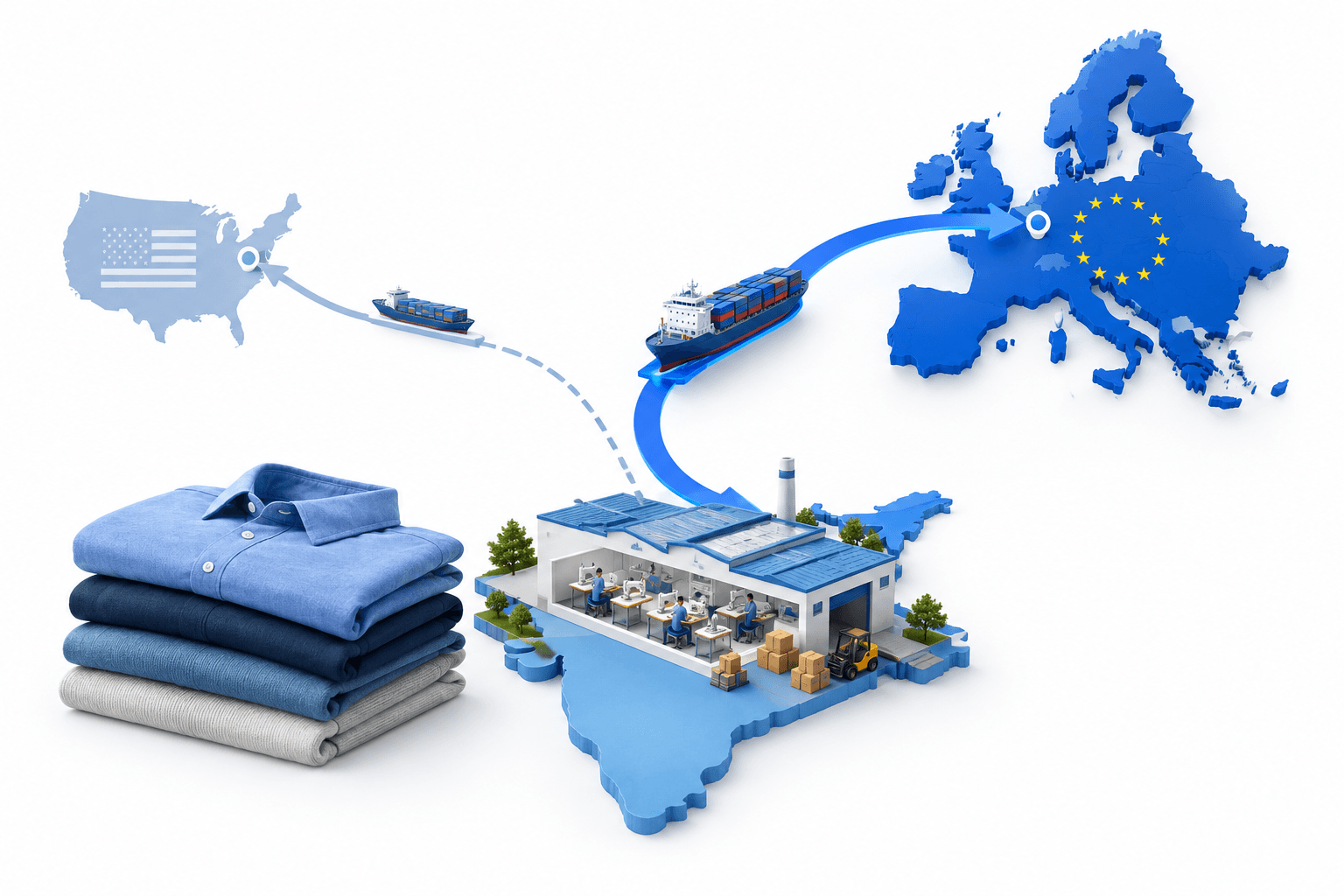
Gokaldas Exports expects Europe to account for 25%–30% of its exports over the next three to five years, up from around 15%, as the Indian apparel supplier seeks to reduce its reliance on the United States. The outlook, outlined on October 26, 2026, depends partly on improved trade access under the proposed India–European Union trade agreement.
Key Takeaways
- Management expects Europe’s export share to rise by 10–15 percentage points over three to five years.
- The company is expanding capacity in India rather than moving production elsewhere.
- Stronger US spring and summer orders for 2027 suggest diversification is not a withdrawal from its largest market.
Table of Contents
- Gokaldas Exports seeks a broader customer mix
- Trade benefits remain conditional
- Indian investment supports expansion
- Conclusion
Gokaldas Exports seeks a broader customer mix
Vice-Chairman and Managing Director Sivaramakrishnan Ganapathi said the company is discussing potential business with major European retailers in preparation for duty-free trade. He did not identify the retailers.
The United States currently accounts for 69% of exports. Gokaldas expects that share to moderate as it reduces exposure to tariff shocks and policy uncertainty, but it has not set out a target for the decline.
The European goal concerns the geographic mix of exports, not a stated forecast for total export revenue. A lower US share would not necessarily mean lower US sales if business in other markets grows faster.
| Item | Details |
|---|---|
| Fiscal 2027 investment | 1.25 billion rupees ($13.2 million) for capacity expansion and facility upgrades |
| Major customers | Gap, Carhartt and JCPenney |
| US apparel imports, January–August 2026 | Down 7% to $49.08 billion across global suppliers |
| Gokaldas holiday-season shipments from India | Up 3%–4% year on year for the 2026 holiday season, management said |
Trade benefits remain conditional
The European Commission’s EU-India trade agreement objectives include removing trade barriers, simplifying procedures and opening export opportunities. These goals explain the commercial rationale for preparing European customer relationships, but they do not establish that duty-free access is already available.
The agreement still requires signature, approvals and ratification before taking effect. Expectations of signing by the end of 2026 are therefore not the same as a confirmed start date for tariff relief.
Equirus Securities analyst Ronak Shah said the agreement could improve competitiveness over the medium term, subject to implementation, product coverage and origin requirements. Those conditions will determine which garments qualify for any preferential treatment.
Indian investment supports expansion
Gokaldas is adding capacity and upgrading facilities in India rather than shifting production abroad. Its fiscal 2027 investment plan supports overall capacity, rather than a separately disclosed European production allocation.
The diversification effort also comes alongside stronger US spring and summer orders for 2027 than those for the 2026 holiday season, Ganapathi said. That order comparison contrasts with a broader decline in US apparel imports.
Ganapathi identified holiday sales as an early indication of demand for next year, making retail sell-through a nearer-term checkpoint than the company’s multiyear European target.
Conclusion
Gokaldas Exports is pursuing a larger European business while continuing to serve US demand. The next checkpoints are holiday retail sales and the remaining steps toward bringing the India–EU trade agreement into force; neither the European export target nor tariff benefits have yet been realized.
Read More News
Disclaimer
This FinanceVelix article provides general information, not personalized financial, investment, legal, or tax advice. Market prices, interest rates and economic conditions can change; investments carry a risk of loss. Facts reflect the material available when published and may change. Check important information independently and consult a qualified professional when needed. Mentioning an asset, company, or service is not an endorsement.




Comments
Be respectful. No spam, impersonation or private credentials. Ordinary posts and comments appear immediately; suspicious links are held for review.
Please wait…