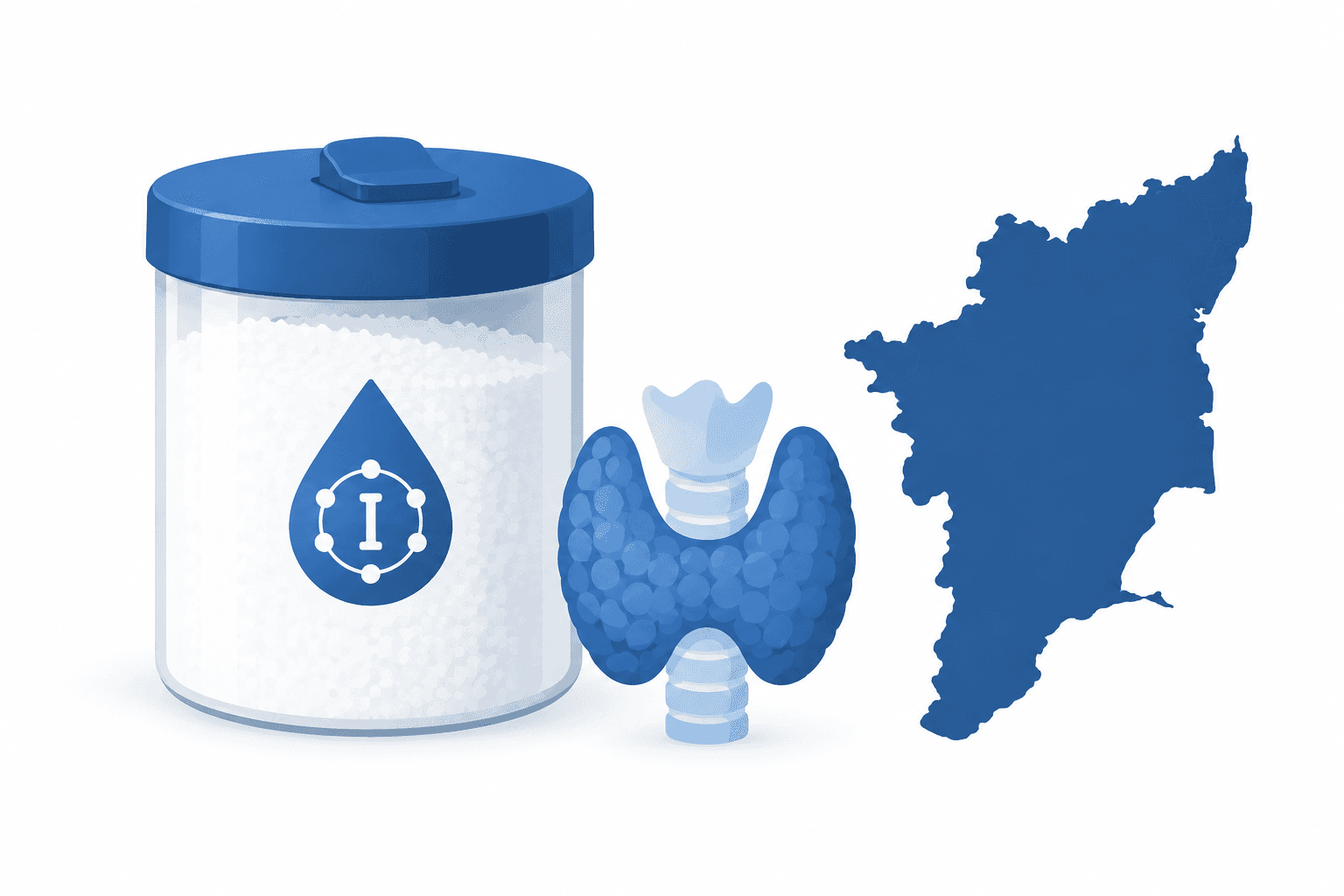
Tamil Nadu had the lowest share of households using adequately iodised salt among Indian states in a 2018–19 survey, despite being the country’s second-largest salt producer. State health officials cited the findings as they urged residents to reduce salt consumption without giving up iodised salt.
Key Takeaways
- The survey found that 62% of Tamil Nadu households used adequately iodised salt, compared with 76% nationally.
- Separate district screenings found goitre among schoolchildren, although the results cover different years.
- The state says it will continue intensified enforcement of iodine standards for salt manufacturers.
Iodised salt and household consumption
Health Minister K G Arunraj raised the issue on October 26, 2026, at an event marking Iodine Deficiency Disorders Prevention Day. He said families should consume less than 5 grams of salt a day and ensure that it is iodised.
A recent study by a Chennai-based medical institution found that rural residents consumed around 13 grams of salt daily and that a third of households used salt with insufficient iodine. Excessive salt consumption and inadequate iodine intake are separate health concerns.
Arunraj said iodine can be lost when salt is stored in open containers exposed to sunlight and moisture or added early to food cooked for long periods.
| Item | Details |
|---|---|
| Ramanathapuram, 2024–25 | 9% of screened schoolchildren had goitre. |
| Villupuram, 2018–19 | Around 9% of screened schoolchildren had goitre. |
| Madurai, 2022–23 | 6% of screened schoolchildren had goitre. |
| Pudukottai, 2024–25 | 5% of screened schoolchildren had goitre. |
District screenings and salt tests
Tamil Nadu’s public health department screens schoolchildren for goitre in every district. Officials classified Ramanathapuram, Villupuram, Madurai and Pudukottai as high-risk areas based on district screening results. The figures below are from different reporting years and are not a single statewide estimate.
In salt samples analysed between April 2025 and March 2026, the share that was adequately iodised ranged from 70% to 88% across six named districts. At least 2% of samples tested in Thoothukudi contained no iodine.
Standards and health risks
Food safety rules require salt intended for human consumption to contain at least 30 milligrams of iodine per kilogram at production and 15 milligrams per kilogram at the household level. Village health nurses test household cooking salt against the standard.
Iodine helps the thyroid produce hormones involved in growth, metabolism and brain development. Public Health Director Dr A Somasundaram said it is particularly important during pregnancy, when a developing fetus depends on its mother’s iodine supply. Severe deficiency can cause goitre and lasting intellectual impairment in children.
Read More News
Disclaimer
This FinanceVelix article provides general information, not personalized financial, investment, legal, or tax advice. Market prices, interest rates and economic conditions can change; investments carry a risk of loss. Facts reflect the material available when published and may change. Check important information independently and consult a qualified professional when needed. Mentioning an asset, company, or service is not an endorsement.



Comments
Be respectful. No spam, impersonation or private credentials. Ordinary posts and comments appear immediately; suspicious links are held for review.
Please wait…