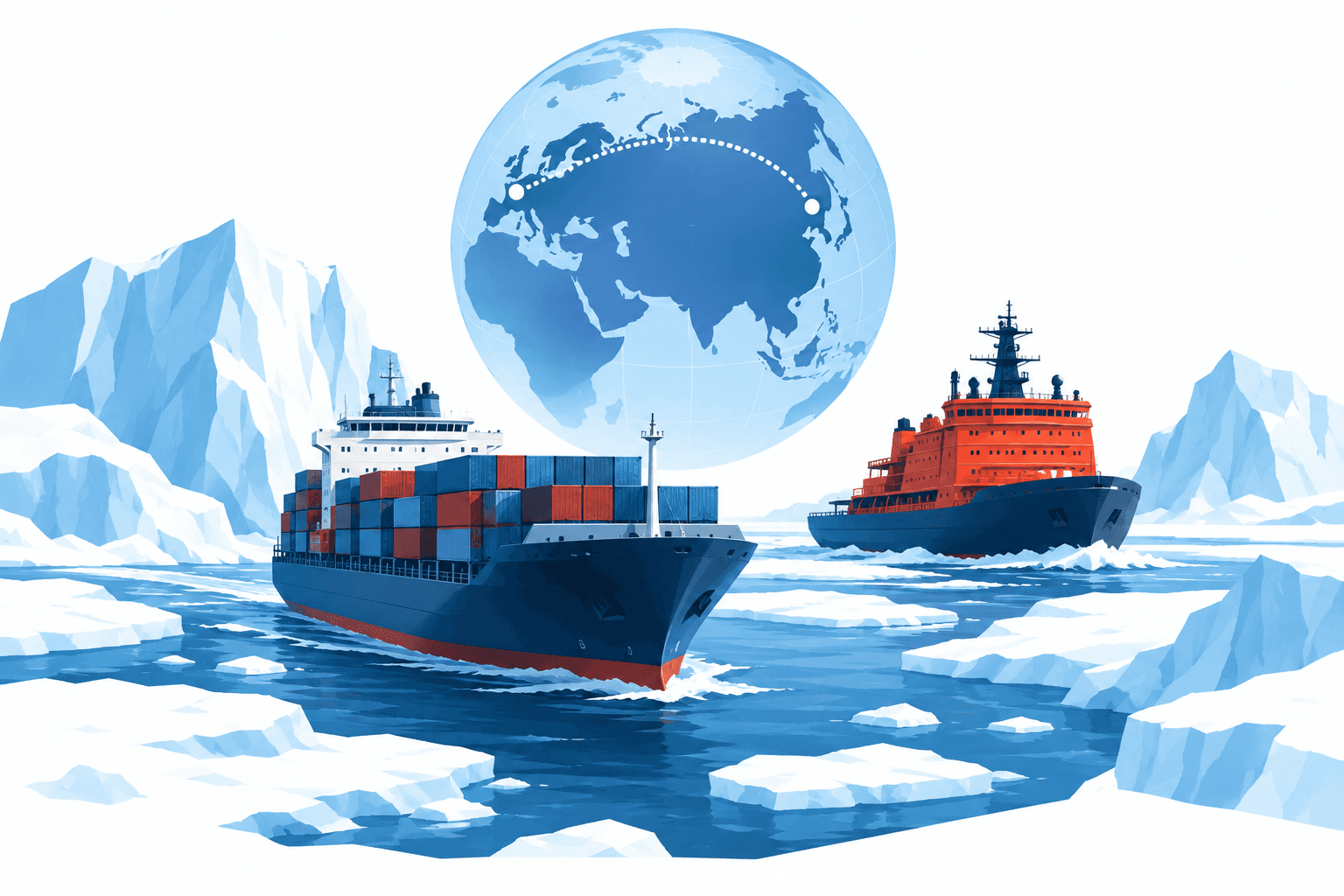
China and Russia agreed in October 2026 to expand Arctic shipping cooperation, including freight traffic, port services and polar vessel construction, as the European Union pursues a strategy to strengthen its presence in the region.
Key Takeaways
- Russia controls permits and transit fees on the Northern Sea Route, while China contributes cargo, vessels and industrial capacity.
- The EU strategy calls for more icebreaker capacity, maritime surveillance and infrastructure, but Europe faces limited leverage over the corridor.
- Full-route transit cargo reached an estimated 3.7 million tonnes by the end of September 2026, exceeding the total for the 2025 navigation season.
Why Arctic shipping matters
The agreement between Moscow and Beijing followed the EU's announcement of a new Arctic strategy. Russia controls the Northern Sea Route, including permits, transit fees and a fleet of nuclear icebreakers, while China supplies commercial and industrial capacity, said Alicia Garcia-Herrero, chief economist for Asia-Pacific and the Middle East and Africa at Natixis CIB.
The route offers a potential alternative between Asia and Europe. Fertmax FZCO estimates that a journey could take 18 to 22 days via the Northern Sea Route, compared with 28 to 35 days through Suez.
Strategist David Roche said the route is significant for Russian energy shipments to China, potentially increasing Russia's dependence on Chinese buyers as it compensates for lost European gas markets.
Europe weighs a response
The EU strategy calls for expanding European icebreaker capacity, strengthening maritime surveillance and developing infrastructure connecting Arctic trade networks to European markets. It also proposes a maritime security hub and greater protection for undersea cables.
Garcia-Herrero said Europe has leverage as a destination market, but its limited icebreaker capacity and Arctic infrastructure constrain its ability to challenge the partnership. Daejin Lee, former global head of research at Fertmax FZCO, said sanctions, insurance and compliance complications make the route less attractive for Western operators than for Chinese companies.
Traffic grows, but obstacles remain
The Northern Sea Route carried 37.02 million tonnes of cargo in 2025. Of that, only 3.2 million tonnes involved vessels transiting the entire route, rather than shipments originating or ending in the Russian Arctic, according to the Centre for High North Logistics.
By the end of September 2026, the centre had recorded 104 confirmed full-route transit voyages carrying an estimated 3.7 million tonnes, more than the 3.2 million tonnes recorded during the whole 2025 navigation season.
Much of the existing traffic consists of Russian oil, liquefied natural gas and other commodities. Ice restricts navigation for much of the year, while specialized vessels, insurance premiums and Russian transit fees can offset savings from shorter journeys.
Read More News
Disclaimer
This FinanceVelix article provides general information, not personalized financial, investment, legal, or tax advice. Market prices, interest rates and economic conditions can change; investments carry a risk of loss. Facts reflect the material available when published and may change. Check important information independently and consult a qualified professional when needed. Mentioning an asset, company, or service is not an endorsement.



Comments
Be respectful. No spam, impersonation or private credentials. Ordinary posts and comments appear immediately; suspicious links are held for review.
Please wait…