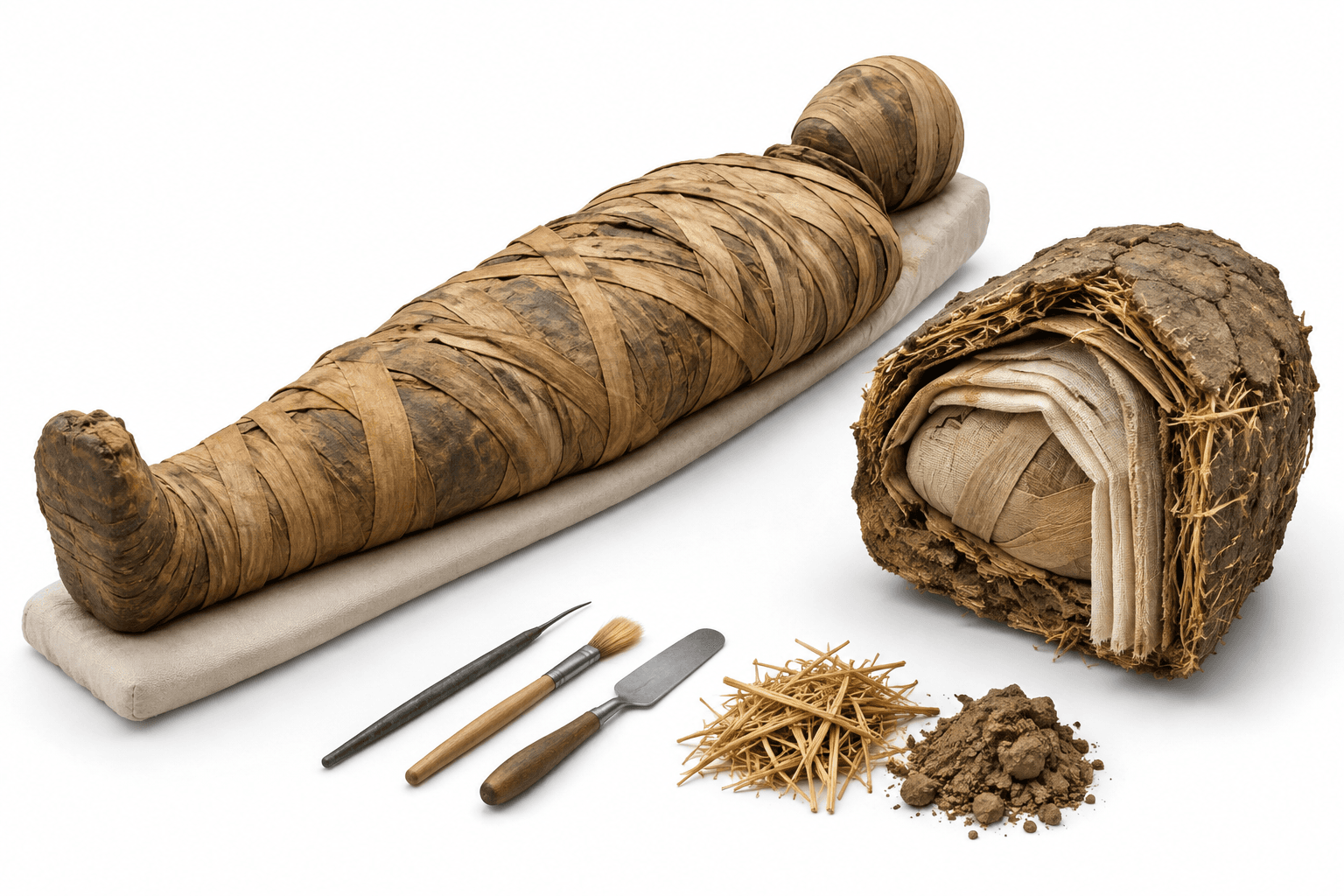
An Egyptian mummy held at the University of Sydney was encased in a shell of mud, sand and straw after its body was damaged, researchers found in a study published in 2021. The casing may have repaired the remains while imitating a more expensive treatment used in royal burials.
Key Takeaways
- Researchers found the shell between layers of linen using CT scans and material analysis.
- The woman was estimated to have been 26 to 35 years old when she died.
- The coffin found with the mummy dates from a later period and may not have been made for her.
How the Egyptian mummy was repaired
The study, published in PLOS ONE on February 3, 2021, drew on scans and laboratory analysis to examine the casing beneath the wrappings. A 1999 CT scan had revealed unusual features, while a more detailed examination in 2017 helped researchers investigate them.
The researchers believe the shell was added after the initial mummification, possibly within one or two generations of the burial. Damage around the left knee and lower leg may have been caused by tomb robbers, although the circumstances remain unclear.
Fragments of the casing had a thin mud base, a calcite-based white coating and a red-painted surface. Researchers could not determine whether the entire shell had been painted red.
Why researchers considered the material significant
Some royal mummies were protected by shells made from resin, which could be costly when large quantities had to be imported. The researchers proposed that locally available mud, sand and straw could have served both to repair the body and to echo a treatment associated with elite burials.
The team could not establish who performed the repair, whether that person had a connection to the woman or what resources were available to them.
The mummy and coffin date to different periods
Radiocarbon dating of textile samples placed the remains between about 1370 and 1113 BC, with a median date near 1207 BC. Bone analysis suggested the woman was between 26 and 35 years old when she died.
The coffin bears the name Meruah, or Merutah, and dates to around 1000 BC. Researchers suggested that antiquities dealers may have paired an unrelated body and coffin for sale, but the precise circumstances are unknown. Charles Nicholson donated both to the University of Sydney in 1860.
Read More News
Disclaimer
This FinanceVelix article provides general information, not personalized financial, investment, legal, or tax advice. Market prices, interest rates and economic conditions can change; investments carry a risk of loss. Facts reflect the material available when published and may change. Check important information independently and consult a qualified professional when needed. Mentioning an asset, company, or service is not an endorsement.




Comments
Be respectful. No spam, impersonation or private credentials. Ordinary posts and comments appear immediately; suspicious links are held for review.
Please wait…