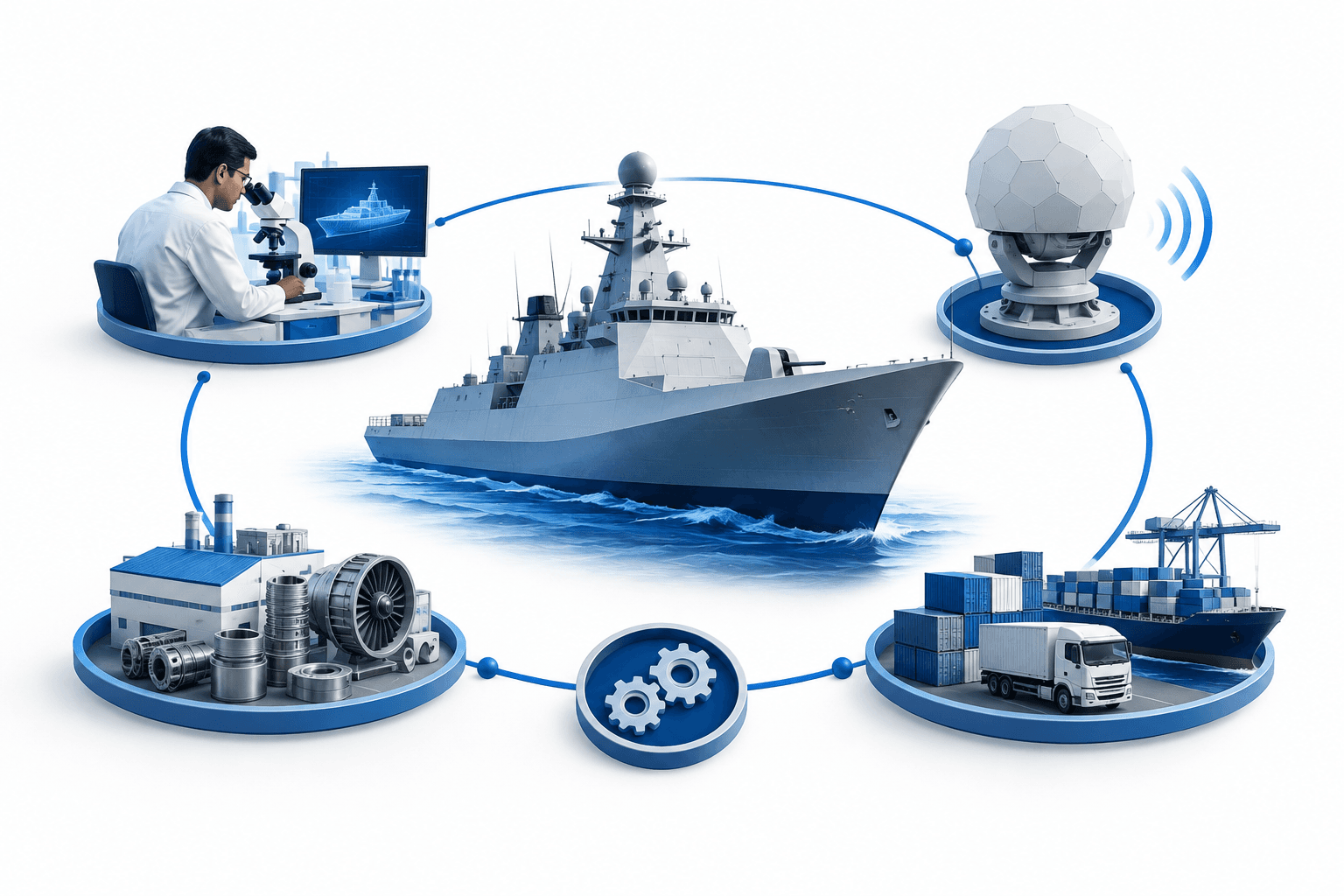
India defence innovation should enter a new phase focused on advanced technology, research and resilient supply chains, Defence Minister Rajnath Singh said on October 26, 2026. He called for a rollout of “Aatmanirbharta 2.0” to reduce reliance on imported defence equipment.
Key Takeaways
- Singh called for a roadmap identifying technologies, industries, resources and timelines needed for self-reliance.
- The Navy has signed 25 contracts worth more than ₹1,900 crore under its innovation initiatives, its chief said.
- Singh also proposed a roadmap for technologies that could serve both civilian and military needs.
India defence innovation priorities
Speaking at the fifth Swavlamban naval innovation and indigenisation seminar, Singh said the next phase should build on earlier self-reliance efforts while putting more emphasis on the quality, efficiency and affordability of domestically manufactured products.
He described supply chain management as a national security priority and called for clear timelines for achieving self-reliance in individual items. He also urged stronger collaboration between industry and academia and more opportunities for young people to pursue research careers.
Singh said remaining import dependence, particularly in Buyer Nominated Equipment, needed to be addressed. He also called for a “Dual Technology Roadmap” to identify and prioritise technology with both civilian and military applications.
Navy contracts and innovation challenges
Singh said the Navy’s iDEX initiative had received more than 4,000 proposals against 229 challenges, with entrepreneurs developing solutions in naval systems, sensors and communications.
Chief of the Naval Staff Admiral Krishna Swaminathan said Navy-specific iDEX challenges had grown from 20 to 229 since Swavlamban began in 2022. He said they represented approximately 35% of all iDEX challenges across the defence sector.
Swaminathan said 41 cases worth more than ₹3,500 crore had received in-principle approval, while 25 contracts valued at more than ₹1,900 crore had been signed. He called for promising innovations in areas including artificial intelligence, autonomous systems, robotics and quantum sensing to be turned into operational capabilities.
Read More News
Disclaimer
This FinanceVelix article provides general information, not personalized financial, investment, legal, or tax advice. Market prices, interest rates and economic conditions can change; investments carry a risk of loss. Facts reflect the material available when published and may change. Check important information independently and consult a qualified professional when needed. Mentioning an asset, company, or service is not an endorsement.



Comments
Be respectful. No spam, impersonation or private credentials. Ordinary posts and comments appear immediately; suspicious links are held for review.
Please wait…