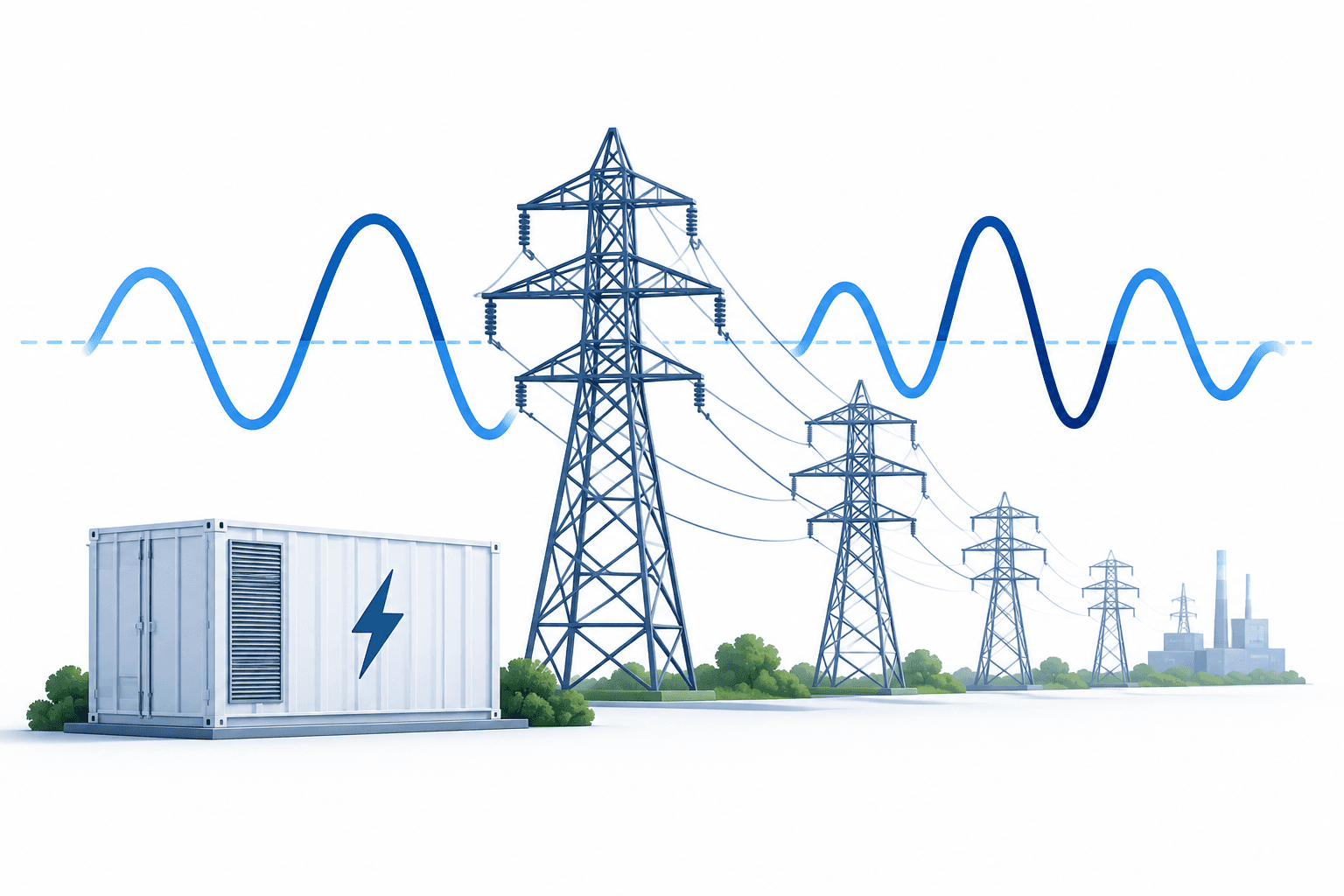
India grid frequency remained within its prescribed operating band for 68.81% of September 2026, down from 77.14% in August, Grid-India data show. The decline signals more frequent imbalances between electricity supply and consumption, although it is not by itself evidence of an imminent grid collapse.
Key Takeaways
- Frequency was below the operating band for 15.68% of September and above it for 15.51%.
- An October 21 low remained above the first automatic load-shedding threshold.
- A government scheme provides support for battery storage, while industry voices have raised questions about emergency action and curtailment.
India grid frequency breaches operating band
India’s grid operates at a nominal frequency of 50 hertz. The Indian Electricity Grid Code sets an operating band of 49.9–50.05 Hz. Frequency was within that range for 78.33% of September 2025, compared with 68.81% a year later.
A falling frequency generally means demand exceeds generation, while a rising frequency indicates the opposite. Repeated or sustained deviations leave less room to absorb a further shock, such as a generating unit tripping or an unexpected increase in demand.
Daily profiles for October showed no clear improvement. On October 21, frequency was outside the prescribed band for a total of five hours and 43 minutes, and an instantaneous reading fell to 49.485 Hz at 4:56 p.m.
Storage and emergency response
The October 21 low stayed above 49.4 Hz, the threshold at which the first stage of under-frequency load shedding is designed to disconnect designated feeders automatically.
Battery storage is one possible source of flexibility. The Green Energy Corridor-III scheme provides ₹6,000 crore to support 50 gigawatt-hours of battery energy storage systems, and states are increasingly pairing storage with renewable projects.
SR Narasimhan, a former chairman and managing director of Grid-India, has argued that operators should be able to take necessary emergency action, including load shedding, without being unfairly blamed. He also called for accurate forecasting and adequate flexible resources.
Wind industry veteran Ramesh Muthya stressed that renewable generators should be compensated when their output is curtailed. He argued that, unlike coal generators on two-part tariffs, renewable generators generally do not receive a separate fixed-cost payment when they cannot generate.
Read More News
Disclaimer
This FinanceVelix article provides general information, not personalized financial, investment, legal, or tax advice. Market prices, interest rates and economic conditions can change; investments carry a risk of loss. Facts reflect the material available when published and may change. Check important information independently and consult a qualified professional when needed. Mentioning an asset, company, or service is not an endorsement.



Comments
Be respectful. No spam, impersonation or private credentials. Ordinary posts and comments appear immediately; suspicious links are held for review.
Please wait…