Peter Gaffney, co-founder of O2O Capital Partners, estimates that shifting 5% of Sky and Ethena’s reserve capital into leveraged real-world asset strategies could generate $1.8 billion of demand. That is a hypothetical allocation, not an announced investment.
Key Takeaways
- Gaffney’s scenario uses $600 million of equity from Sky and Ethena reserves to support $1.8 billion of RWA exposure.
- Variable borrowing costs can exceed tokenized credit yields while investors wait for redemptions to settle.
- Fixed-rate markets are already operating, but the proposed reserve allocation has not been announced.
Table of Contents
- What fixed-rate lending could unlock
- Why variable rates can erase the income margin
- Which lending markets are already available?
- Why the loan’s maturity matters too
What fixed-rate lending could unlock
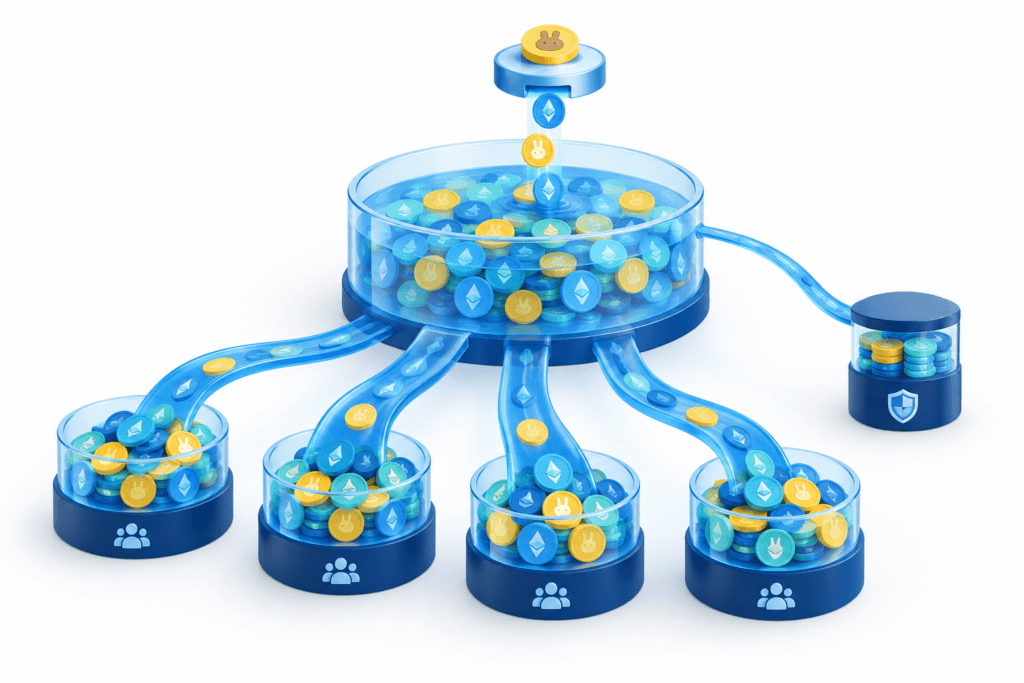
The investment strategy is straightforward: buy an income-producing asset, borrow against it at a locked rate below its yield, and use the proceeds to acquire more of the asset. Gaffney argues that predictable financing would make these leveraged positions easier for institutional credit teams to underwrite.
His sizing example starts with $12 billion in Sky and Ethena reserve capital. A 5% allocation supplies $600 million of equity; leverage of three times that amount produces $1.8 billion in RWA demand. The calculation illustrates potential scale rather than a commitment by either organization.
Ethena and Sky have committed more than $2.4 billion to JAAA, BUIDL, STAC and USTB. The proposed change concerns how such assets could be financed and leveraged, not their first use in stablecoin reserves.
| Item | Details |
|---|---|
| Modeled reserve allocation | 5% of $12 billion in Sky and Ethena reserve capital, producing $600 million of equity. |
| Modeled RWA demand | $1.8 billion at threefold leverage; a hypothetical scenario, not an announced allocation. |
| Completed lending launch | Coinbase launched fixed-rate crypto-backed loans using Morpho Midnight in September twenty twenty-six. |
| RWA loan offering | Kamino offered 5.3% fixed-rate financing against Figure’s auto loan portfolio in rolling terms of thirty days. |
Why variable rates can erase the income margin
The obstacle is the gap between an asset’s income and its financing cost. Gaffney cites JAAA yields of 4.5% to 5% and a 5.2% payout for Maple’s syrupUSDC, against a one-year average USDC borrowing rate of 4.56% on Aave V3 Ethereum. Those figures leave limited room for borrowing costs to rise.
Aave’s USDC borrow rate climbs from 4% to 14% as utilization moves from 92% to 100%. The April twenty twenty-six KelpDAO rsETH exploit kept the pool at full utilization, leaving borrowers paying the maximum rate for five days.
That matters particularly for tokenized credit: an investor may not be able to redeem collateral quickly enough to escape an unprofitable leveraged position.
Which lending markets are already available?
Morpho opened fixed-rate, fixed-term markets through Morpho Midnight, which Coinbase used to launch fixed-rate crypto-backed customer loans in September twenty twenty-six. That launch is distinct from the hypothetical RWA reserve strategy.
Tenor Finance, Kamino, Term Labs and Loopscale also offer fixed-rate lending. One RWA example is a Kamino market offering 5.3% fixed-rate loans against Figure’s auto loan portfolio in rolling terms of thirty days.
Why the loan’s maturity matters too
Locking the interest rate addresses only part of the financing mismatch. Gaffney says tokenized credit redemptions can settle as quickly as the next day or take well beyond ninety days. The loan’s term therefore needs to accommodate the collateral’s redemption schedule.
Read More News
Disclaimer
This FinanceVelix article provides general information, not personalized financial, investment, legal, or tax advice. Market prices, interest rates and economic conditions can change; investments carry a risk of loss. Facts reflect the material available when published and may change. Check important information independently and consult a qualified professional when needed. Mentioning an asset, company, or service is not an endorsement.