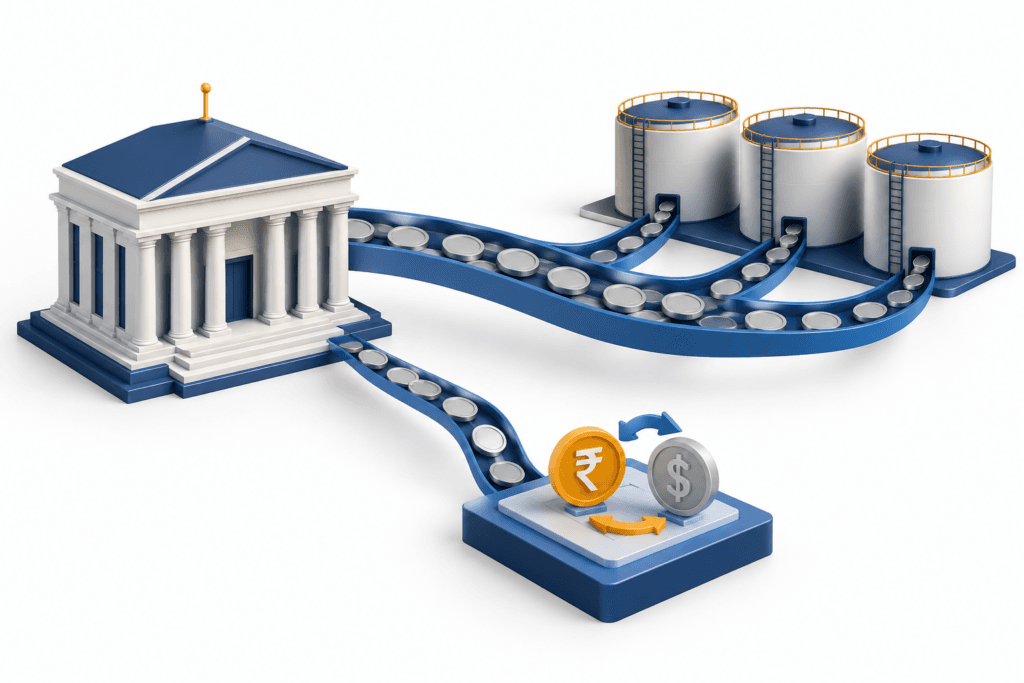
RBI forex purchases reached a record net $43.26 billion in the spot market in August 2026 as the Reserve Bank of India absorbed dollar inflows tied to foreign-currency funding schemes. Large simultaneous foreign-exchange sell/buy swaps meant the purchases did not produce an equivalent increase in reserves.
Key Takeaways
- August’s record spot purchases accompanied substantial foreign-currency deposit and borrowing inflows.
- The RBI’s net forward dollar sales position reached a record $200.06 billion at month-end.
- Spot purchases alone do not capture the effect of the central bank’s foreign-exchange operations on reserves.
Table of Contents
- RBI forex purchases tell only part of the story
- June funding measures brought in dollars
- Intervention focuses on orderly currency trading
- Conclusion
RBI forex purchases tell only part of the story
The central bank bought dollars in the spot market while also undertaking large sell/buy swaps. The combination makes the headline purchase figure an incomplete measure of how much foreign currency was added to reserves.
At the end of August, the RBI’s net forward dollar sales position stood at $200.06 billion, up from $136.77 billion at the end of July. That was an increase of $63.29 billion in one month.
The spot and forward figures describe different parts of the RBI’s market activity. Neither should be treated on its own as the change in the headline reserve stock.
| Item | Details |
|---|---|
| Funding measures introduced | June 2026 |
| Funding-scheme deadline | August 31, 2026; more than $127 billion attracted |
| Monthly increase in net forward dollar sales | $63.29 billion from end-July to end-August |
| Foreign-exchange reserve peak | $785 billion in early September 2026 |
June funding measures brought in dollars
The inflows followed measures introduced in June 2026 to attract foreign currency through non-resident Indian deposits and overseas borrowings by banks and public-sector companies.
Banks brought dollars into India under these arrangements, including the foreign currency non-resident bank deposit scheme, known as FCNR(B), and swapped them with the RBI. This allowed the central bank to absorb the inflows while managing their effect on the rupee.
The measures attracted more than $127 billion by the August 31 deadline. Foreign-exchange reserves subsequently peaked at $785 billion in early September.
Intervention focuses on orderly currency trading
The RBI has also been intervening to moderate rupee volatility amid geopolitical uncertainty, elevated oil prices and pressure on capital flows.
The RBI’s explanation of foreign-exchange intervention in its November 2024 bulletin describes the purpose as smoothing undue volatility so that markets function in an orderly manner. That policy background is separate from the August 2026 transaction figures.
The distinction matters: absorbing a large funding inflow and responding to currency-market volatility can involve several instruments, rather than a straightforward accumulation of reserves through spot purchases.
Conclusion
The August record reflects both substantial dollar inflows and the RBI’s use of swaps to manage them. Subsequent reserve and forward-position data will be the next indicators to watch together, rather than treating spot purchases as a direct measure of reserve growth.
Read More News
Disclaimer
This FinanceVelix article provides general information, not personalized financial, investment, legal, or tax advice. Market prices, interest rates and economic conditions can change; investments carry a risk of loss. Facts reflect the material available when published and may change. Check important information independently and consult a qualified professional when needed. Mentioning an asset, company, or service is not an endorsement.