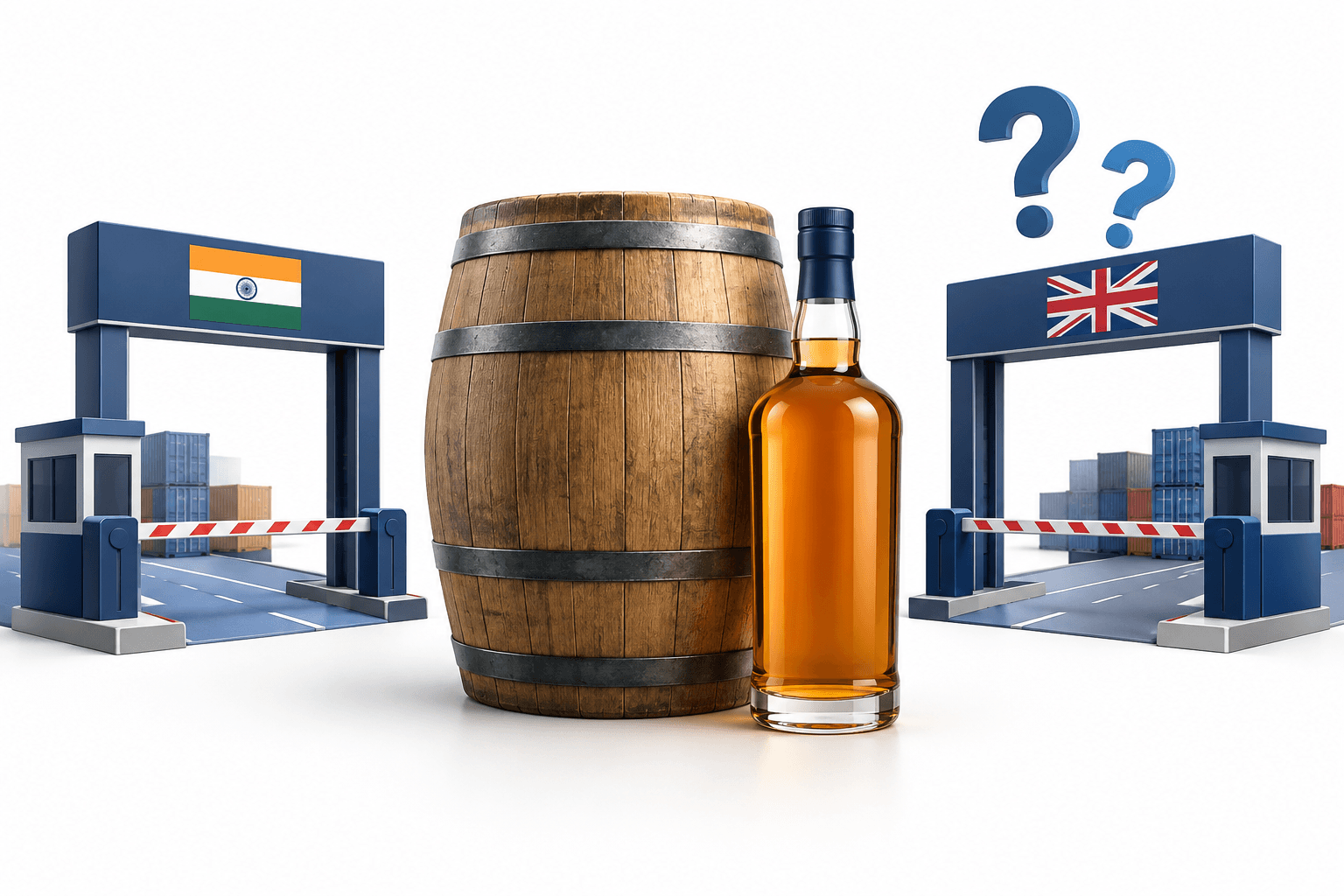
A Scotch tariff dispute over bulk imports has put a key benefit of the India-UK trade agreement under scrutiny. On October 23, 2026, the International Spirits and Wines Association of India warned that excluding Scotch concentrates from reduced duties could undermine negotiated market access, as Indian authorities investigate imports by Diageo and Pernod Ricard.
Key Takeaways
- The dispute concerns whether bulk Scotch concentrates qualify for the trade agreement’s reduced whisky tariff.
- Indian investigators searched Diageo and Pernod Ricard offices in October over suspected import misclassification.
- The British government says it is working with India to resolve the issue.
Table of Contents
- What the Scotch tariff dispute turns on
- Industry seeks clarification as customs inquiry proceeds
- Why bulk imports matter to drinks companies
- Conclusion
What the Scotch tariff dispute turns on
The India-UK trade agreement took effect on July 15, 2026. UK guidance on Scotch whisky tariff reductions describes preferential treatment for whisky classified under HS code 2208.30, with an immediate duty cut followed by further reductions over ten years. That guidance does not settle whether the bulk concentrates now under investigation qualify.
Indian investigators have privately told companies that bulk Scotch concentrates must be declared under a classification attracting the previous, higher duty. Diageo and Pernod Ricard believe concentrates imported from Britain should qualify for the lower rate.
The disagreement is therefore about which imports receive the concession, rather than whether the agreement contains a whisky tariff reduction. That distinction matters for companies importing concentrates to blend into locally produced spirits.
| Item | Details |
|---|---|
| Scotch tariff before the agreement | 150%. |
| Preferential tariff at entry into force | 75% from July 15, 2026, for qualifying Scotch whisky imports. |
| Scheduled preferential tariff | 40% after staged reductions over ten years. |
| Treatment disputed for bulk concentrates | Investigators say a classification carrying 150% duty applies; companies argue for the reduced rate. |
Industry seeks clarification as customs inquiry proceeds
India’s Directorate of Revenue Intelligence searched the offices of Pernod Ricard and Diageo and questioned executives in October as part of an investigation into whether imported products were misclassified to obtain reduced duties. Both companies said earlier that week that they were cooperating with authorities.
In its October 23 letter to India’s commerce minister, the International Spirits and Wines Association of India said the classification issue “risks undermining, in practice, an important market-access benefit negotiated and agreed between India and the United Kingdom.”
The association argued that the agreement expressly provides preferential treatment for whisky under the relevant tariff lines and sought urgent clarification to avoid uncertainty and disruption. It declined to comment on the letter, while India’s commerce ministry did not immediately respond. The investigation does not establish that either company misclassified imports.
Why bulk imports matter to drinks companies
Pernod Ricard and Diageo import bulk concentrates and mix them with other ingredients to make Indian brands including Royal Stag, Blenders Pride and McDowell’s. The tariff classification therefore affects an input used in local production, not simply finished bottles of imported Scotch.
India is Pernod Ricard’s largest market by volume. Britain accounts for almost 75% of India’s imported spirits, primarily driven by Scotch whisky, according to Crisil Ratings, giving the classification issue wider significance for the drinks trade.
A British government spokesperson said: “We are working with the Government of India to resolve this issue to ensure UK businesses can export under the tariffs agreed in the trade deal.”
Conclusion
The unresolved question is whether bulk Scotch concentrates qualify for the negotiated concession. Clarification from Indian authorities and the outcome of the customs investigation are the next developments to watch; the British government has confirmed that discussions with India are under way.
Read More News
Disclaimer
This FinanceVelix article provides general information, not personalized financial, investment, legal, or tax advice. Market prices, interest rates and economic conditions can change; investments carry a risk of loss. Facts reflect the material available when published and may change. Check important information independently and consult a qualified professional when needed. Mentioning an asset, company, or service is not an endorsement.