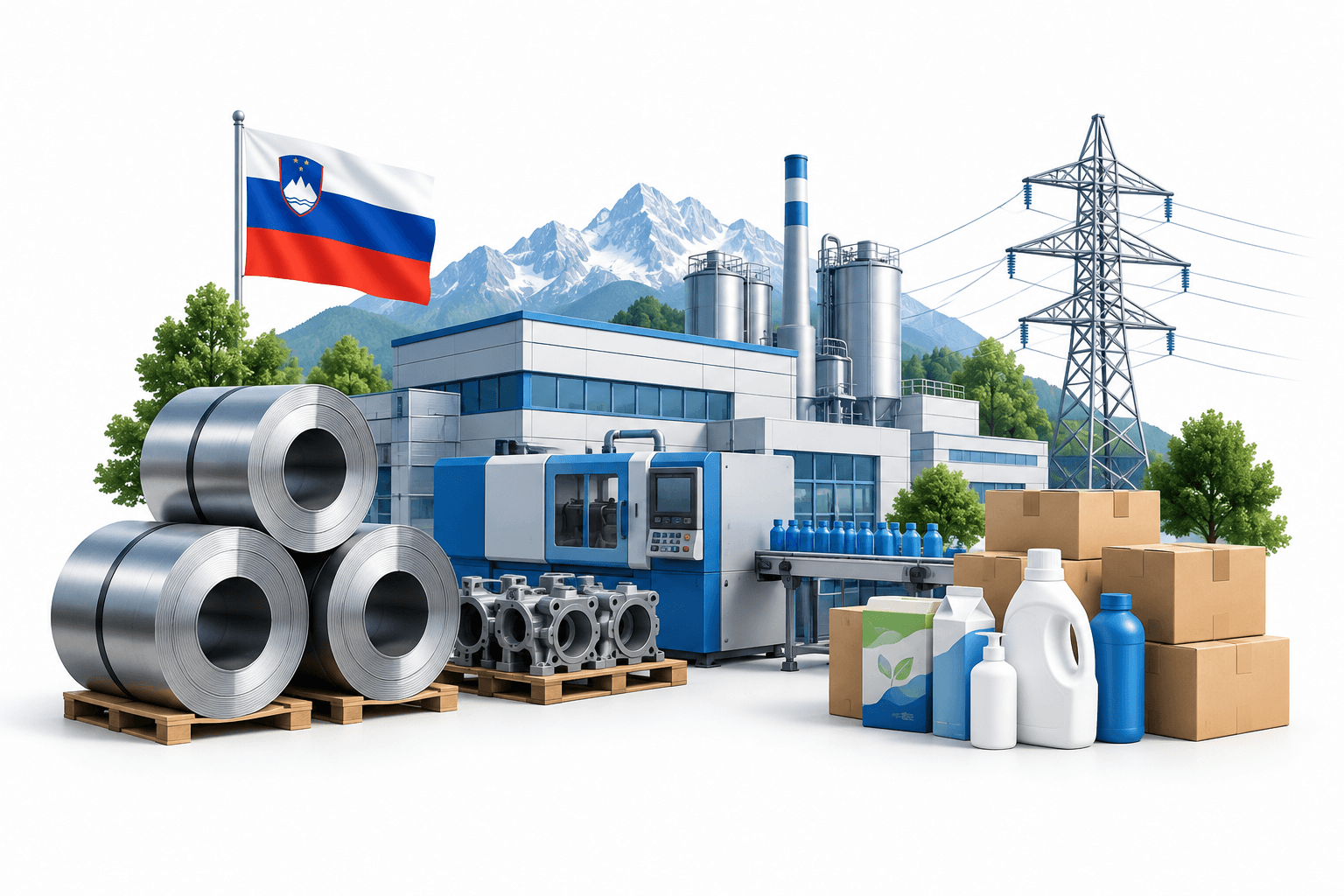
Slovenia producer prices increased 3.9% year on year in September 2026, up from 3.5% in August and the fastest annual rise since July 2023. Final figures published by the Statistical Office of the Republic of Slovenia on October 21 showed a smaller monthly increase of 0.1%, compared with 0.3% in August.
Key Takeaways
- Annual producer inflation accelerated even as month-on-month price growth slowed.
- Prices for domestic sales rose faster than those for sales abroad.
- Energy recorded the largest annual increase among the main industrial groupings.
Table of Contents
- Slovenia producer prices show uneven momentum
- Domestic and export-market prices diverge
- Basic metals lead annual industry increases
- Conclusion
Slovenia producer prices show uneven momentum
September’s annual increase was the strongest since July 2023, when producer prices rose 4.1%. Prices have been rising year on year since February 2025.
The statistical office’s September 2026 producer price release showed increases across all four main industrial groupings. Energy and intermediate goods recorded stronger annual growth than capital goods and consumer goods.
The annual and monthly measures tell different parts of the story: prices were rising faster relative to a year earlier, but the increase from the immediately preceding month had eased.
| Item | Details |
|---|---|
| Energy | September 2026: up 6.2% year on year; up 1.9% month on month. |
| Intermediate goods | September 2026: up 5.7% year on year; down 0.2% month on month. |
| Capital goods | September 2026: up 3.3% year on year; up 0.7% month on month. |
| Consumer goods | September 2026: up 1.0% year on year; down 0.2% month on month. |
Domestic and export-market prices diverge
Producer prices for goods sold on the domestic market increased 4.6% from September 2025, compared with 3.2% for goods sold on non-domestic markets. Within foreign markets, prices rose 3.7% for sales to euro-area countries and 2.0% for sales outside the currency bloc.
The monthly figures showed a clearer split. Domestic-market prices rose 0.5% from August, while non-domestic prices fell 0.3%. Prices for sales to euro-area markets declined 0.3%, and those for non-euro-area markets slipped 0.2%.
Basic metals lead annual industry increases
Among individual industries, basic metals manufacturing recorded the largest annual price increase, at 14.3%. Other manufacturing followed at 14.1%, while leather and leather products rose 10.2%.
Not every industry recorded higher prices. Water collection, treatment and supply prices fell 4.0% year on year, pharmaceutical manufacturing prices declined 1.7%, and food manufacturing prices dropped 0.5%.
Electricity recorded the largest monthly increase, at 2.6%. Basic metals prices, despite their strong annual rise, fell 1.1% from August, illustrating how short-term movements can differ from the year-on-year comparison.
Conclusion
Slovenia producer prices ended September with stronger annual inflation but slower monthly growth. The next monthly figures will show whether the divergence between rising domestic prices and falling non-domestic prices persists.
Read More News
Disclaimer
This FinanceVelix article provides general information, not personalized financial, investment, legal, or tax advice. Market prices, interest rates and economic conditions can change; investments carry a risk of loss. Facts reflect the material available when published and may change. Check important information independently and consult a qualified professional when needed. Mentioning an asset, company, or service is not an endorsement.