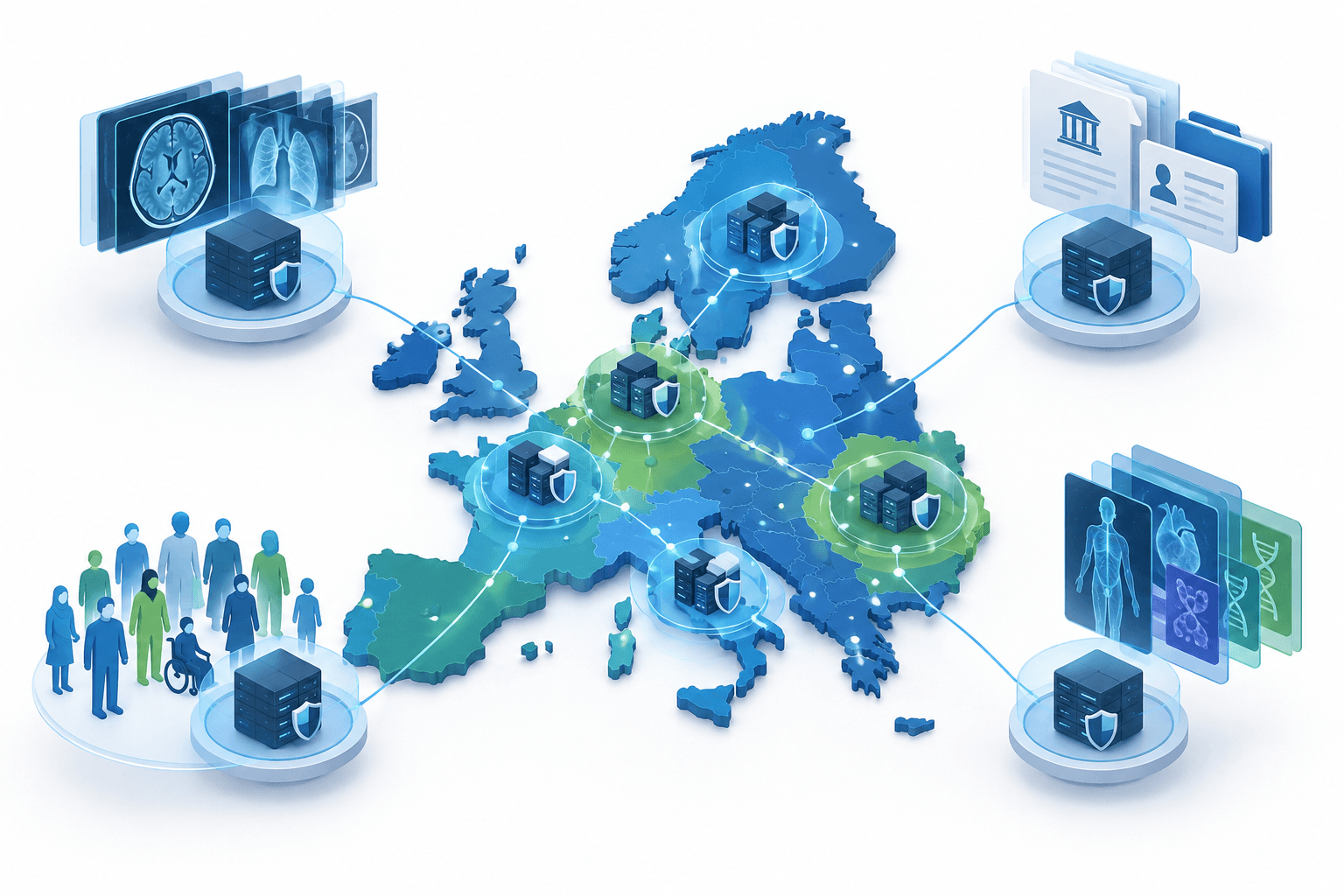
European AI projects are extending into medical imaging, employment offices and government collaboration tools, according to an October 22, 2026, report from NVIDIA. The initiatives combine open models with locally managed infrastructure, although their status varies from released datasets and available purchasing frameworks to systems still under development.
Key Takeaways
- Public-sector initiatives across Europe emphasize control over infrastructure, sensitive information and model governance.
- Projects in Poland and Germany include systems under development for employment services, medical imaging and classified workloads.
- Localized synthetic-persona datasets give developers tools to assess models across different populations without using real people’s private data.
Table of Contents
- European AI projects put governance alongside deployment
- Poland develops healthcare and employment systems
- Germany pursues internal assistants and classified workloads
- Synthetic populations support local model testing
- France opens a purchasing route as Greece builds infrastructure
- Codefest supports further public-sector applications
- Conclusion
European AI projects put governance alongside deployment
The European Commission’s AI@EC platform illustrates how governance requirements are shaping the software behind public-sector AI. Berlin-based deepset is expanding Haystack Enterprise Platform, which underpins AI@EC, to connect the development and operation of agents with optimization and oversight.
The update adds ways to assess response quality, compare running costs and investigate problems. NVIDIA Triton Inference Server supports common information-retrieval and ranking services. NVIDIA said requirements demonstrated at AI@EC include access controls, audit records and safeguards for uses such as summarizing documents and analyzing policy across languages.
Poland develops healthcare and employment systems
Deloitte is supporting two Polish initiatives with distinct public-service roles. The eHealth Centre is developing an Intelligent Services Platform using NVIDIA DGX BasePOD and MONAI for medical imaging. It is intended to help doctors identify abnormalities in X-rays, CT scans and MRI images and give urgent cases priority; the report does not establish that shorter waiting times have already been achieved.
Separately, the Ministry of Family, Labour and Social Policy is developing an agentic factory intended for more than 400 labor offices. NVIDIA accelerated computing will support models including PLLuM, GPT OSS and Inkling for searching documents, producing summaries and providing digital assistants to staff serving job seekers.
Germany pursues internal assistants and classified workloads
Materna is introducing Sinfonie, an on-premises platform that lets employees ask spoken questions to retrieve organizational knowledge. Developed from a German state-administration project, it combines generative AI, voice features and three-dimensional avatars, with NVIDIA Audio2Face available to animate them.
A separate collaboration involving secunet, NVIDIA, Red Hat and deepset is developing a sovereign cloud service for organizations working with classified information. The planned service builds on secunet’s SINA Cloud foundation, whose security components include authorizations for classified use. That does not establish authorization for the entire proposed offering.
The partners plan to combine NVIDIA computing and Nemotron models, Red Hat OpenShift AI, Haystack orchestration and secunet-operated infrastructure in German data centers.
Synthetic populations support local model testing
Locai Labs has released Nemotron-Personas-UK with 1 million synthetic personas representing demographic and geographic differences across the United Kingdom. Potential applications include healthcare evaluation and checking for uneven model performance across age, education and location.
In Germany, the Soofi research initiative is developing models for industry and government. Its work includes Nemotron-Personas-Germany: 1 million records containing six synthetic personas apiece, grounded in the 2022 census and covering 16 states and 400 districts. NVIDIA said the dataset was created with NeMo Data Designer without private information from real people.
Both country editions can work with NeMo User Sim for simulation-based evaluation and training. NVIDIA is also collaborating with Poland’s SpeakLeash and Slovenia’s University of Ljubljana on national additions, with localized datasets planned.
France opens a purchasing route as Greece builds infrastructure
France’s CANUT selected LINAGORA and Docaposte for a Twake.ai-based collaborative workspace. More than 2,500 eligible institutions can use the procurement framework without conducting separate tenders. The offering combines email, shared documents and collaboration features, with French-hosted infrastructure and NVIDIA-supported speech transcription. Région Occitanie is the preferred deployment-scaling partner; eligibility does not mean all those institutions have adopted it.
In Greece, KIEFER is developing an agentic factory using DGX SuperPOD infrastructure with DGX GB200, Sophea open-weight models and Greek-language retrieval, speech and assistant tools. The project aims to make institutional knowledge more accessible while allowing organizations to determine where agents operate and how information is handled.
Codefest supports further public-sector applications
NVIDIA also identified Pleias, Zehnlab.ai, Disseqt, Algoritmica GmbH and ABA Technology as the top five teams in its Open Models Codefest. The program targets applications including medical reasoning, tutoring and model governance. Deutsche Telekom and T-Systems supplied computing infrastructure for participating teams to train and deploy language models.
Conclusion
The report shows public-sector AI taking several forms rather than advancing through one common rollout. Released datasets and procurement access sit alongside planned infrastructure and developing services, with local control and evaluation recurring across the projects.
Read More News
Disclaimer
This FinanceVelix article provides general information, not personalized financial, investment, legal, or tax advice. Market prices, interest rates and economic conditions can change; investments carry a risk of loss. Facts reflect the material available when published and may change. Check important information independently and consult a qualified professional when needed. Mentioning an asset, company, or service is not an endorsement.