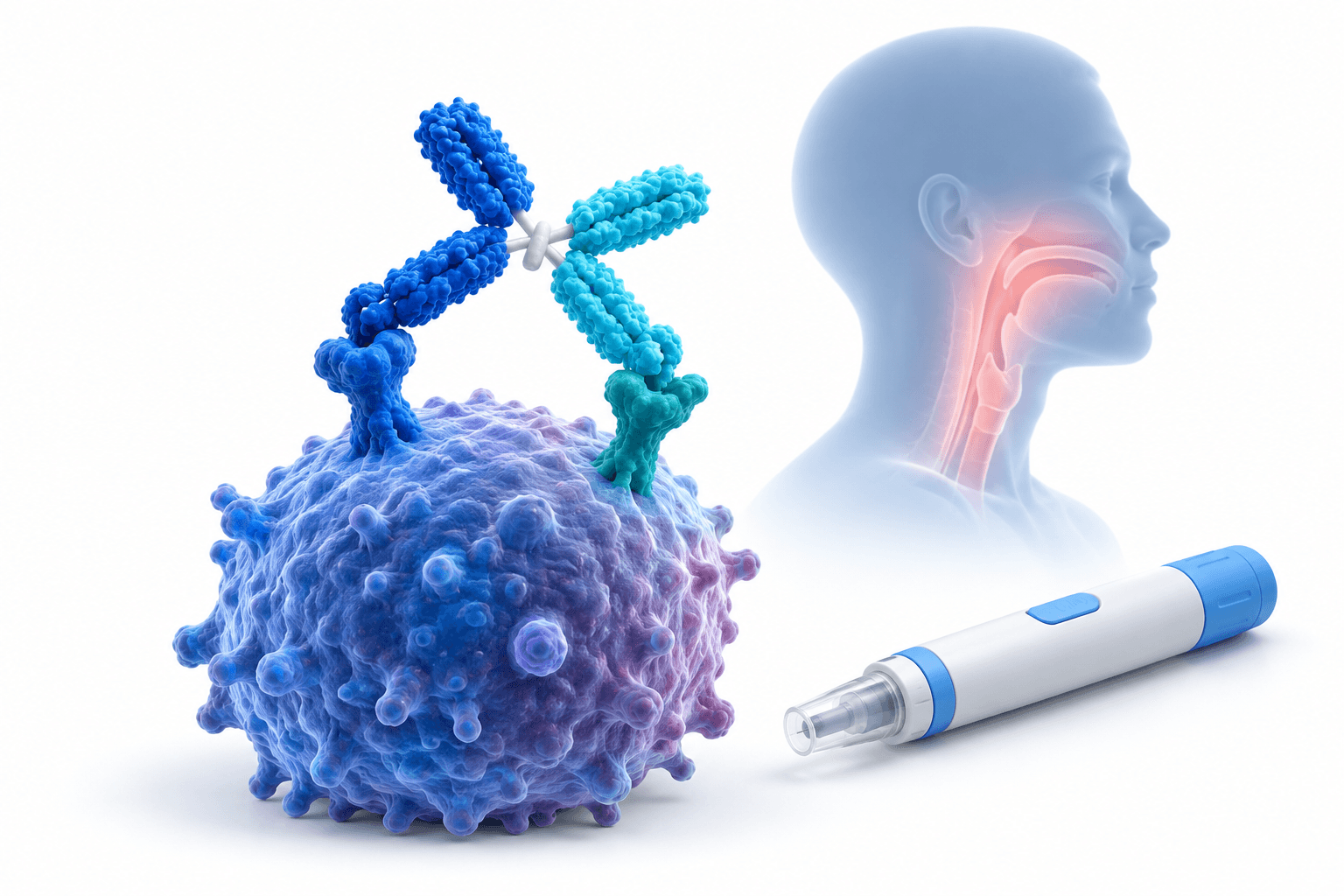
Johnson & Johnson announced Rybrevant trial results on October 25, 2026, showing a 77% confirmed overall response rate in a 22-patient subgroup with advanced head and neck cancer. The investigational combination paired subcutaneous amivantamab, marketed as Rybrevant, with pembrolizumab and carboplatin. The early-stage findings support continued testing, but do not establish that the regimen outperforms existing treatment.
Key Takeaways
- The 77% response rate applied to patients with head and neck squamous cell carcinoma other than HPV-associated oropharyngeal cancer.
- Complete responses occurred in 14% of that subgroup, while 65% of responses remained ongoing at the clinical cutoff.
- The regimen remains investigational in this setting, with the Phase 3 OrigAMI-5 study ongoing.
Table of Contents
- Rybrevant trial results differ across patient groups
- Study design sets the limits of the findings
- Safety remains part of the development assessment
- Conclusion
Rybrevant trial results differ across patient groups
The findings came from Cohort 5 of the Phase 1b/2 OrigAMI-4 study and were presented at the European Society for Medical Oncology Congress 2026. Thirty patients received treatment, and 29 were included in the efficacy analysis after one was deemed ineligible.
Among the 22 patients with head and neck squamous cell carcinoma other than human papillomavirus-associated oropharyngeal squamous cell carcinoma, the confirmed response rate was 77%, with a 95% confidence interval of 55% to 92%. Responses were assessed by investigators using standard RECIST version 1.1 criteria.
Responses occurred at a median of 9.4 weeks. At a median follow-up of 10.6 months, 65% of responses remained ongoing. Median overall survival had not been reached, and 77% of patients in this subgroup were alive at one year.
The remaining seven efficacy-evaluable patients had HPV-associated oropharyngeal cancer. Their response rate was 29%, with a wide 95% confidence interval of 4% to 71%. The small, separately assessed groups mean the headline response rate should not be applied to the full cohort or all head and neck cancers.
| Item | Details |
|---|---|
| Anemia | Reported in 73% of treated patients |
| Hypoalbuminemia | Reported in 63% of treated patients |
| Thrombocytopenia | Reported in 63% of treated patients |
| Stomatitis | Reported in 57% of treated patients |
Study design sets the limits of the findings
Johnson & Johnson’s OrigAMI-4 study design overview describes an ongoing, nonrandomized, open-label Phase 1b/2 program testing subcutaneous amivantamab alone and in several combinations. That background document explains the trial structure, rather than verifying the newly announced October Cohort 5 results.
Cohort 5 evaluated first-line treatment for recurrent or metastatic disease in patients whose tumors had a PD-L1 combined positive score of at least one. The regimen combined amivantamab with the PD-1 inhibitor pembrolizumab and up to six cycles of carboplatin.
Following the initial treatment period, patients received treatment every three weeks. Subcutaneous amivantamab administration took five minutes or less; that timing does not describe the administration time for the entire combination.
Because this was a small, nonrandomized cohort, the response findings do not establish a comparative survival benefit. For Johnson & Johnson’s development program, the next stage is the ongoing pivotal Phase 3 OrigAMI-5 study evaluating the investigational approach in first-line treatment.
Safety remains part of the development assessment
Johnson & Johnson said the combination’s safety profile was consistent with those of the individual agents. The most common adverse events reported in the treated cohort are summarized below.
Administration-related reactions associated with subcutaneous amivantamab occurred in 13% of patients, with no Grade 3 or higher reactions reported. This finding applies specifically to administration-related reactions, not to all adverse events experienced during treatment.
Conclusion
The Rybrevant trial adds an early clinical signal for Johnson & Johnson’s head and neck cancer program, with important limits from the small sample and nonrandomized design. The ongoing Phase 3 OrigAMI-5 study is the next confirmed development milestone; the announcement did not provide a results date.
Read More News
Disclaimer
This FinanceVelix article provides general information, not personalized financial, investment, legal, or tax advice. Market prices, interest rates and economic conditions can change; investments carry a risk of loss. Facts reflect the material available when published and may change. Check important information independently and consult a qualified professional when needed. Mentioning an asset, company, or service is not an endorsement.