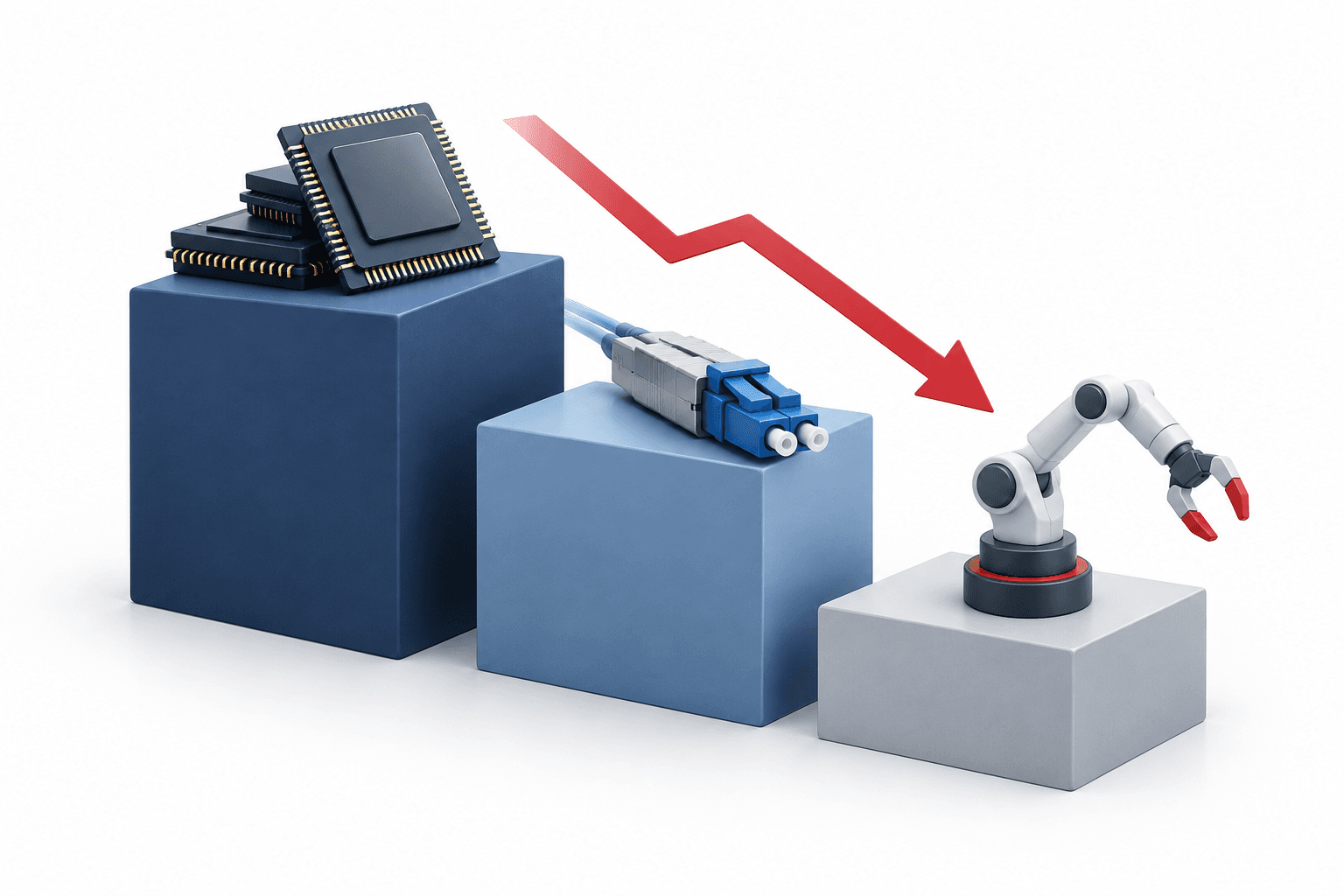
China AI stocks have suffered a sharp reversal from their summer highs. In the market snapshot published on October 26, 2026, the STAR 50 index had fallen nearly 40% over three and a half months, with about $480 billion in market value erased. Several semiconductor, robotics and optical-component companies had recorded even steeper losses from their peaks.
Key Takeaways
- The STAR 50 decline spans three and a half months, rather than a single trading session.
- Some prominent technology listings have lost roughly half their value after earlier sharp gains.
- Valuation, profitability and export-policy concerns surround the sell-off, but no single cause has been established.
China AI stocks retreat beyond a handful of names
The correction extends beyond individual AI-related companies. The broader CSI 300 index was down about 20% from its June highs in the October snapshot, indicating that the weakness was not confined to a few technology shares.
The Shanghai Stock Exchange’s explanation of the STAR 50 index describes a benchmark designed to reflect core companies on its science and technology board. Its launch methodology selected 50 constituents using market capitalization and liquidity. The index is therefore a technology-oriented market benchmark, not a measure exclusively of AI businesses.
The company-level declines have followed unusually strong earlier gains. Semiconductor companies MetaX Integrated Circuits and Moore Threads Technology rose approximately 700% and 400%, respectively, on their market debuts in 2025, before subsequently falling sharply from their July highs.
| Item | Details |
|---|---|
| MetaX Integrated Circuits and Moore Threads Technology | Each lost around half its value from July highs. |
| Unitree | Fell approximately 50% after trading began in August. |
| CXMT | Lost more than a quarter of its value in the month preceding the October account. |
| Zhongji Innolight and Eoptolink Technology | Dropped around 60% from their respective June and July peaks. |
Profit expectations face closer scrutiny
The STAR 50 was estimated to trade at about 100 times trailing earnings after the sell-off, compared with a peak multiple of roughly 250. That contraction shows how much investors’ pricing of earnings has changed; it does not, by itself, establish whether shares are now inexpensive.
Concerns surrounding the retreat include the cost of developing advanced technology, companies’ ability to turn demand into profits, domestic competition and possible foreign restrictions on Chinese technology products. These are risks accompanying the decline, rather than a confirmed explanation for every stock’s move.
For Beijing, the practical tension is between encouraging investment in strategic industries and limiting excessive speculation. Weaker demand for new share offerings could constrain an avenue of funding for production expansion and product development, although the supplied figures do not establish a quantified financing shortfall.
Read More News
Disclaimer
This FinanceVelix article provides general information, not personalized financial, investment, legal, or tax advice. Market prices, interest rates and economic conditions can change; investments carry a risk of loss. Facts reflect the material available when published and may change. Check important information independently and consult a qualified professional when needed. Mentioning an asset, company, or service is not an endorsement.



Comments
Be respectful. No spam, impersonation or private credentials. Ordinary posts and comments appear immediately; suspicious links are held for review.
Please wait…