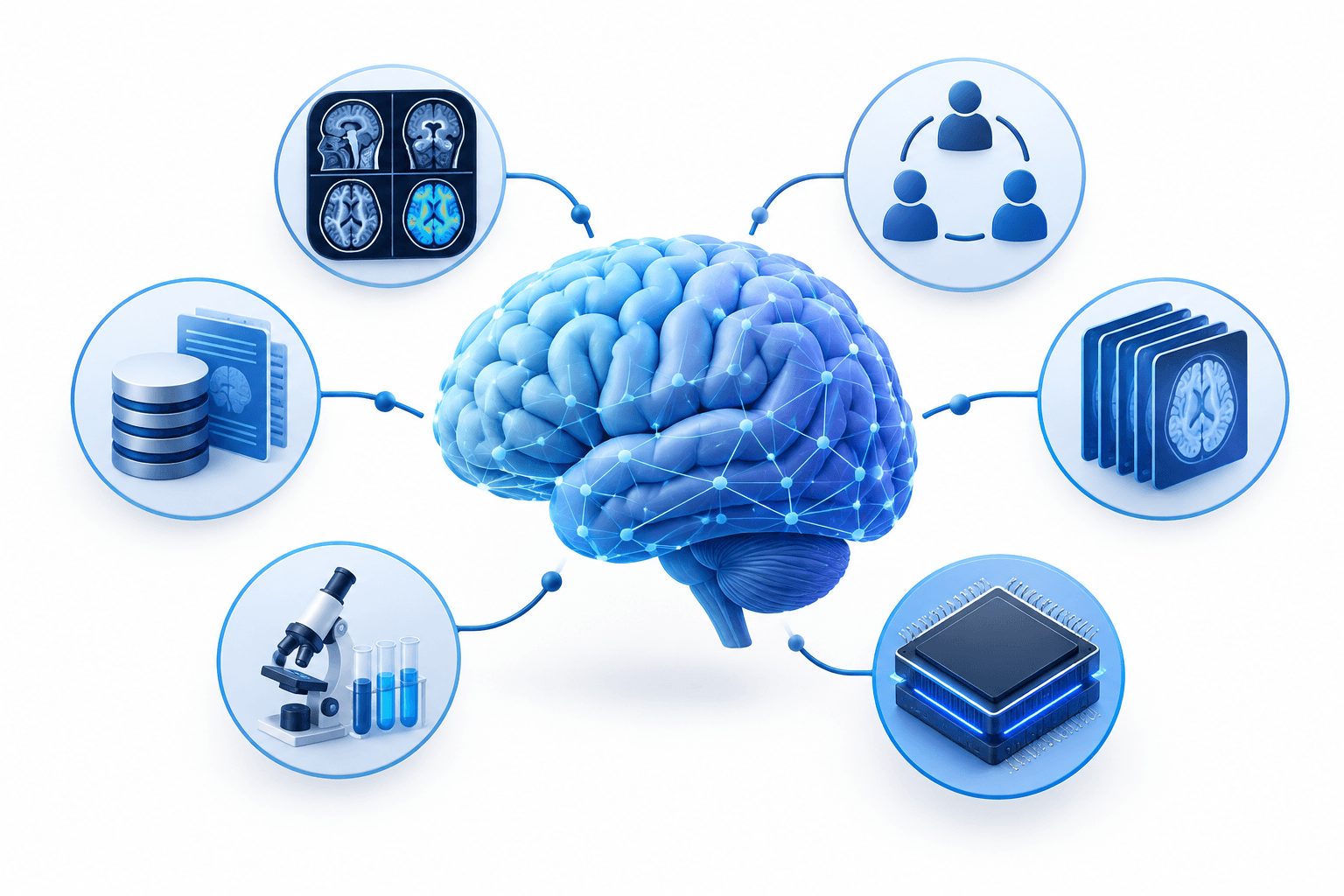
Alzheimer’s research consortium C-BRAIN is working with Nvidia to incorporate artificial intelligence tools into its research pipelines, including software for analyzing biological data and medical images. The collaboration aims to help scientists use data that has often been difficult to access across institutions.
Key Takeaways
- C-BRAIN has built two open-source research tools with separate collaborators.
- The consortium uses a mix of centralized and federated systems to work with sensitive data.
- Published case studies found that one tool completed analyses in minutes at under $10 per run.
How Alzheimer’s research data will be used
C-BRAIN, led by neurologist Randall Bateman, launched in November 2025 and has 18 member institutions spanning academic, philanthropic, pharmaceutical and research organizations. Its work includes unpublished findings, negative results and proprietary data governed by member institutions.
Some data is deposited in secure systems. C-BRAIN also uses a federated approach in which AI models learn from data at individual institutions without the data leaving those institutions. The approach is intended to protect patient privacy and institutional governance.
Open-source tools and computing capacity
C-BRAIN is working with Nvidia to incorporate the BioNeMo developer platform and the MONAI framework into its research pipelines. It currently operates 64 Nvidia data center GPUs on its premises alongside cloud-based nodes on Microsoft Azure. Additional Nvidia GPU capacity, including Blackwell systems, is planned.
The consortium has already built two open-source tools with other partners. OpenScientist, developed with Lawrence Berkeley National Laboratory, takes a research question and dataset and semi-autonomously generates hypotheses, runs analyses and produces auditable insights. InsightEngine, built with 387 Labs, tests hypotheses against scientific literature and other evidence.
In published case studies, OpenScientist completed analyses in minutes that domain scientists estimated would take weeks to months, at a cost of under $10 per run. Those case studies do not establish that every research task will see the same results.
A longer-term model for brain aging
C-BRAIN aims to build a biological foundation model using data that includes brain imaging, molecular measurements, fluid biomarkers and clinical measures collected over time. By its third year, the consortium aims to identify new causal mechanisms of brain aging and Alzheimer’s disease that can be tested scientifically.
Those are research goals, not completed discoveries or treatments.
Read More News
Disclaimer
This FinanceVelix article provides general information, not personalized financial, investment, legal, or tax advice. Market prices, interest rates and economic conditions can change; investments carry a risk of loss. Facts reflect the material available when published and may change. Check important information independently and consult a qualified professional when needed. Mentioning an asset, company, or service is not an endorsement.



Comments
Be respectful. No spam, impersonation or private credentials. Ordinary posts and comments appear immediately; suspicious links are held for review.
Please wait…