Binance Learn & Earn combines educational courses with campaign rewards for eligible users. Completing a lesson is not the same as receiving a reward: you must qualify for the specific activity, complete its requirements while rewards remain available, and claim any issued voucher before it expires.
This guide compares official public instructions checked on October 24, 2026. It separates learning progress, campaign eligibility and reward delivery so you can identify where a missing reward needs attention. Examples are illustrative, not evidence of a personal reward claim or a promise of earnings.
Check the campaign before starting
Start at the official Learn & Earn catalogue. Inspect the activity status and its terms, then sign in through the official site to see account-specific eligibility. An old search result, an available lesson or a Start Learning button does not prove that a funded campaign is currently open.
During our public-page check, the first catalogue page displayed ended activities that still offered educational material. That observation describes the page we could see; it does not establish that every activity is unavailable to every signed-in user. Use the campaign and your account's actual status to decide.
| Check | What to establish | What is insufficient |
|---|---|---|
| Account | Required identity verification and the activity's target-user rules | An email-verified account alone |
| Location | Participation is offered for your account and region | A tutorial written for another country |
| Activity | Current dates, task requirements and remaining reward availability | An old announcement with an attractive reward amount |
| Reward | Reward type, distribution process and claim deadline | A quiz completion message alone |
The programme FAQ describes targeted participation, identity verification and limited rewards. Eligibility can differ between activities, and completing the same course repeatedly does not create repeated entitlements. Treat each campaign as a separate offer, rather than assuming that qualifying once gives permanent access.
How to use Binance Learn & Earn
- Open the official catalogue and choose an activity that your account can join.
- Read its conditions before spending time on the course. Note the reward type and the deadline.
- Work through the specified articles or videos and complete the associated quiz.
- Check the activity's reward history rather than relying only on the lesson's completion status.
- If a voucher is issued, open Rewards Hub and inspect its conditions before redeeming it.
- Confirm the resulting credit or product position in the appropriate account record.
Binance's participation guide explains the learning, quiz and reward-history flow. Its restrictions include limited allocations and campaign-specific conditions. Do not create additional accounts or use another person's verification to try to repeat a reward. A purported shortcut can invalidate participation instead of improving it.
Keep a small record while working: course title, campaign link, completion time, reward status and any voucher expiry shown. These are useful diagnostic facts. A screenshot of an answer sheet found elsewhere tells support little about whether your account completed the eligible activity.
Course completion, distribution and redemption are different states
Imagine two users see the same completed lesson. One has a voucher waiting in Rewards Hub; the other completed an ended activity. Their visible learning progress may look similar, but their next steps are different. The first needs to inspect and claim the voucher; the second needs to verify campaign eligibility before treating the absence of a voucher as a delivery error.
Similarly, “issued” does not necessarily mean “available to withdraw.” A reward may need redemption, have a defined product use, or involve a locked position. Read the actual instrument before deciding what you received. This distinction prevents a common accounting mistake: treating an advertised reward value as unrestricted cash in your account.
How long do rewards take?
The official pages are not identical. The participation guide updated in June 2026 describes distribution within 48 hours. The separate programme FAQ published in July 2024 describes rewards generally arriving in less than 2 hours, allows delays and points users to support if they have not arrived after 48 hours. A current campaign may specify its own timetable.
Because these sources differ, a two-hour countdown is a poor basis for declaring a failed claim. Record your completion time and apply the current activity's stated deadline. If that deadline passes, use the relevant history and voucher records to explain the issue to official support. Do not repeatedly redo the course or create new accounts merely because a shorter estimate appeared in an older article.
The participation guide also describes a 14-day voucher validity period starting from distribution. Check the actual voucher's expiry because a distribution clock and a redemption clock begin at different events. Waiting for a notification is not a substitute for inspecting the account record.
Read the reward type before redeeming
Binance's voucher overview distinguishes token vouchers, fee-related vouchers, trial funds and other instruments. Their permitted uses differ. Vouchers belong to the issued account, and expiry or transfer restrictions cannot be ignored just because a promotional page displays a monetary equivalent.
| Displayed reward | Practical interpretation |
|---|---|
| Token voucher | Inspect the asset, amount, conditions and expiry; confirm the credit after redemption. |
| Fee rebate voucher | Read which eligible fees it can rebate; do not record its face value as immediately withdrawable cash. |
| Trial fund | Distinguish the trial principal from any reward that the product allows you to receive. |
| Locked product reward | Check maturity and redemption rules instead of assuming immediate availability. |
For a token voucher, the official redemption instructions direct users to Rewards Hub, My Vouchers and the ongoing voucher's details. Read the information panel, use the reward as instructed, and check the Spot credit. The separate Rewards Shop flow involving points is not an extra quiz step that every Learn & Earn participant must perform.
The learning guide describes an activity involving Simple Earn Locked rewards with its own eligibility rules and no early redemption for that activity. Do not extend a generic product's redemption description to a campaign that explicitly restricts it. If the actual reward is locked, its terms determine when the asset becomes available.
A reward's token amount and cash value can differ
The participation guide explains that a campaign's stated equivalent can use a price fixed when the campaign launches. Therefore the token quantity, the original advertised equivalent and today's market value are separate figures.
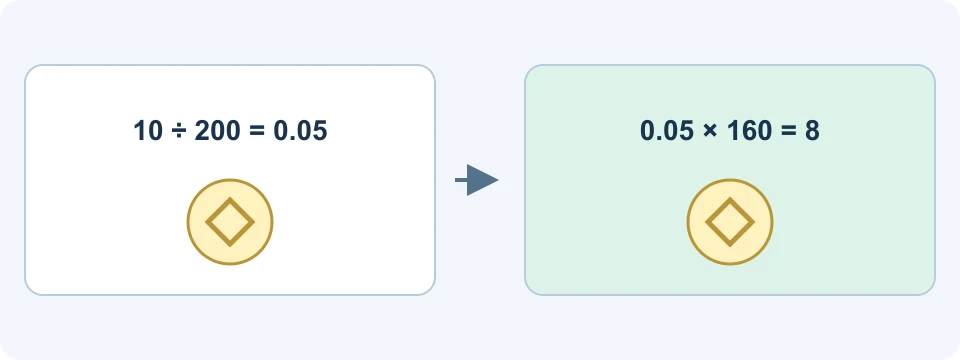
For an independent example, 10 ÷ 200 = 0.05 tokens. If the later price is 160, then 0.05 × 160 = 8. Nothing in this arithmetic says the token will trade at either price; the numbers simply show why a fixed token amount does not guarantee a fixed cash return.
Do not buy, trade or transfer assets solely to make an illustrative reward look larger. A learning reward and a decision to take market risk are separate decisions. Any later conversion or withdrawal also has its own available routes, minimums and costs.
Troubleshoot a missing reward without guessing
| Observation | Next useful check |
|---|---|
| The course opens but participation is unavailable | Activity dates and signed-in eligibility |
| The quiz is completed but no reward is listed | Allocation, qualifying tasks and the distribution timetable |
| A reward is listed but the balance has not changed | Whether redemption or a different product account is involved |
| A voucher cannot be used | Expiry, eligible product and any unmet voucher condition |
| The displayed value is lower than expected | Token quantity versus the campaign's reference price and current valuation |
For support, describe the exact activity and last confirmed stage. Include the reference and timestamp through Binance's official support interface, with sensitive details limited to what that verified workflow requests. Do not post identity documents, authentication codes or account recovery information in public comments beneath a quiz-answer article.
Common questions
Should I use a current quiz-answer list?
Use the course material to answer the actual questions shown. An answer list can be stale, refer to a different activity or omit qualification rules. Even a correct answer cannot restore an ended allocation or make an ineligible account eligible.
Is Learn & Earn the same as Simple Earn?
No. Learn & Earn is an educational campaign format. Simple Earn is a separate product family, although a particular campaign may distribute a reward through one of its products. Read the activity's reward conditions and the product's applicable terms together.
Does a referral code guarantee a learning reward?
No. Registration benefits, trading-fee discounts and learning campaigns have separate conditions. Read each applicable offer instead of adding their advertised values together as guaranteed earnings.
Affiliate disclosure
FinanceVelix may earn a commission from registrations through its Binance referral link. Using this link is optional and does not establish Learn & Earn eligibility. Product availability and benefits depend on your account, location and current terms.
Official educational references
- benchmark-learn-earn-official-guide ↗Source accessed: 2026-10-24
- source-learn-earn-faq ↗Source accessed: 2026-10-24
- source-learn-earn-vouchers ↗Source accessed: 2026-10-24
- source-learn-earn-token-voucher ↗Source accessed: 2026-10-24